
Photo: Estonian Theatre Agency.
Asking the Big Questions
Dina Bite
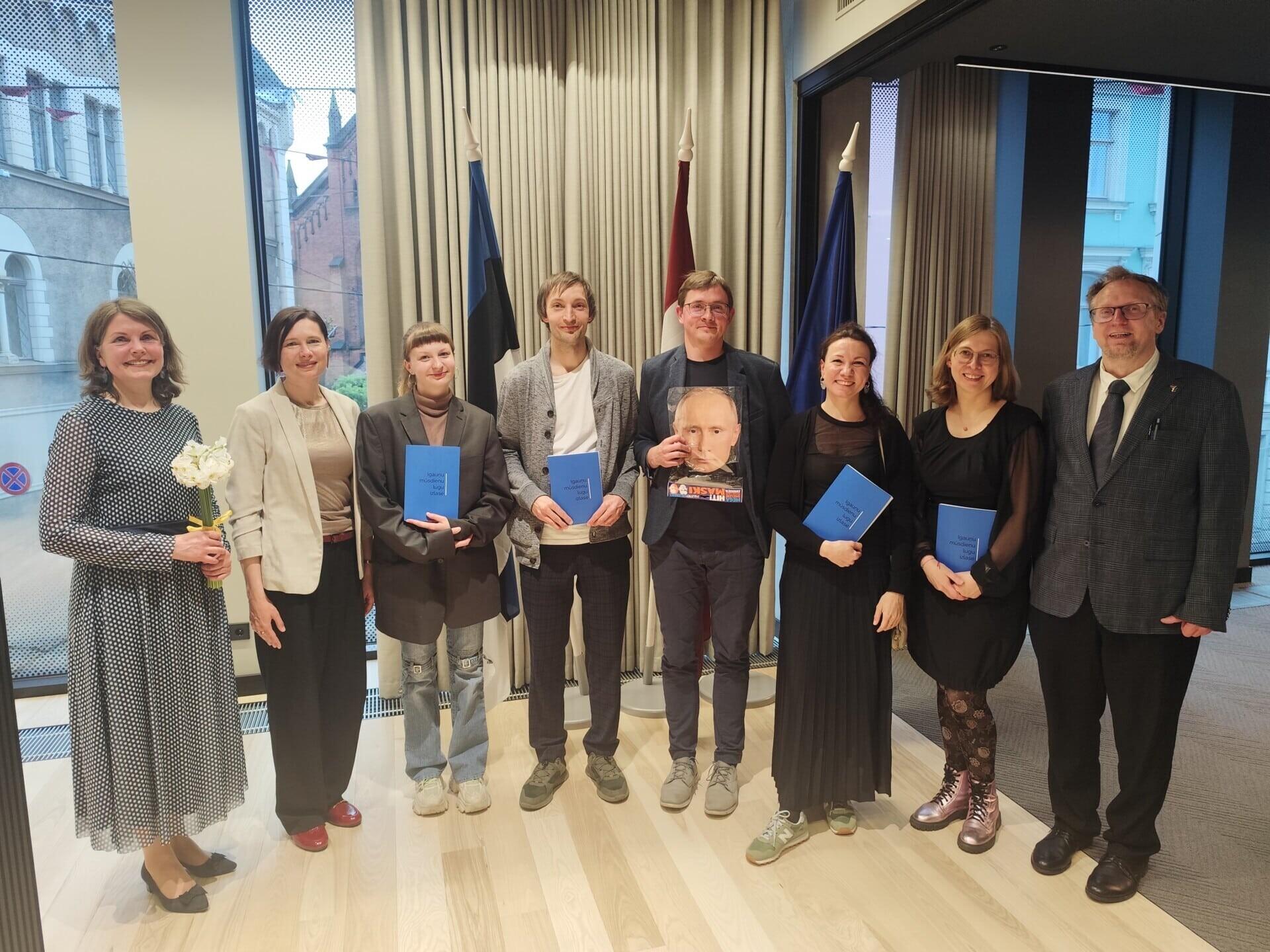
‘Did you know that Estonians also like to say that their neighbours in Latvia have it better in every way?’ is the phrase we heard at the launch event for the Igauņu mūsdienu lugu izlasi (Contemporary Estonian Play Anthology) which took place at the Embassy of Estonia in Riga on the evening of 15 May 2025. ‘How so?’ we wondered. ‘That sort of thinking has always been Latvia’s monopoly.’ Perhaps these preconceived beliefs about each other could be interpreted as something coming from a place of shyness and modesty, of anger and helplessness that people experience as they face absurdity in their respective countries. After all, the grass always seems greener across the border, and this notion could be used to absolve oneself of the responsibility of improving things at home. As we all know, prejudice is born of ignorance. This is why the first anthology of contemporary Estonian plays in Latvian translation is such an opportunity for finding out more not only about the world of Estonian theatre but also about the issues currently exercising our neighbours’ minds.
Written between 2017 and 2022, these works by Estonian playwrights bring surprising freedom and facility to reflections on historical events, with precise and biting revelations of existing social problems and an almost prophetic glimpse into the future. A sober and investigative look at the period since the restoration of independence in 1991 and a genuine and bold approach to questions that matter to the nation are the key concepts that underlie the plays included in the anthology.
Samad sõnad, teine viis (Same Words, Another Tune, 2021), a documentary play by Piret Jaaks, examines the anatomy of the restoration of Estonia’s state thirty years prior. The protagonists are two women who throughout the play discuss the ideological and practical points of restoring the state, all while constructing a room on stage. With a profusion deserving of Pandora’s box, they bring out arguments for and against the legitimate foundations of the restoration of the state, the idea of the constitution, the principles of democracy, the manifestations of power as they join the room’s wooden panels and frames together, power tools in hand. Tellingly, a typical Soviet-era factory-upholstered door and wallpaper from both the pre-war and Soviet periods find their use in building this home (state). Plastic unit window frames and linoleum eventually show up, too. Piret Jaaks does not hold back on the big questions, questions that I suspect could make some viewers uncomfortable. Have we indeed not traded our ideals for momentary selfish benefit? Have we not, like a people long lost in the wilderness, begun to lose sight of what truly matters? What could unite us and make us overcome petty squabbles now? Does it really have to be a war or a serious crisis to remind us of our true values?
The 2018 play Isamaa pääsukesed (Fatherland Swallows) by Andrus Kivirähk, well-known to readers and theatre-goers in Latvia, has been referred to as a comedy, even if those working in the culture sector and anyone familiar with life in rural regions might not find it quite amusing. At the centre of the play is an amateur theatre group composed of women between the ages of fifty and seventy, revealing a social and cultural landscape typical of rural Estonia as well as Latvia. After all, with few exceptions, it is middle-aged and older women who take charge of organizing cultural events and strengthening local communities in such areas. Despite the decline in the number of schools and libraries, pharmacies and post offices, and the departure of able-bodied men and young people who are not addicted to work, women in the countryside cling to culture. Their struggle often turns out to be pointless and grotesque, as demonstrated by Kivirähk’s toilet-in-the-culture-centre ‘epic’. Set against such an accurately and trenchantly presented social background, the theatre group’s idea of staging a musical about the War of Independence on Estonia’s Independence Day seems plainly absurd. One might just as well have retreated into some quaint tale of fairy maidens – the kind of subject traditionally and somewhat condescendingly deemed appropriate for a women’s group. Despite a relatively happy ending and some hopeful (perhaps naive) twists, the play leaves a lasting and sad aftertaste – that of absent men, of women who have disproportionately heavy responsibilities, of silenced children and of many other things.
One of the anthology’s most surprising plays is Mehis Pihla’s tragicomedy Vlad i Mir (2019). As you might infer from the title, the play’s events revolve around Vladimir Putin. His plan to create an all-encompassing Putin Kingdom falls through, and he parachutes like a mere mortal into a farmhouse in the village of Jõgeva. For Helena and Silver, a young couple trying to build a life in the country, this means a chance to change history that literally falls out of thin air. At the anthology’s launch, actors Januss Johansons, Eduards Johansons and Elīna Bojarkina performed a brief passage from the play. That brought up in me an overwhelming and warm feeling of home, seeing someone daring to look without fear into the eyes of someone crude, cunning and superior in strength and call him out, and doing so without political correctness and generations of internalized fear. Unfortunately, Mehis Pihla’s words about the expansion of ‘Putinismus maximus’ proved prophetic. It is to be hoped that its demise will prove equally prophetic. Meanwhile, we should not shy away from publishing and staging this play to strengthen our nation’s backbone.
With surprising ease, Heneliis Notton’s Emesis (2021) pulls the reader into the world of young people who have just graduated from high school. The lines the play’s characters exchange are choppy and curt, and Notton uses them masterfully to reveal what remains unspoken and painful. As in the anthology’s other plays, Emesis dissects a social issue – in this case, what can happen to children whose parents move abroad in search of a better life. Violence, addictions and other means of coping with the situation define the environment in which the play’s protagonist Sabine has to survive while making important decisions for herself and about her future. A grim and harshly realistic story, it can still serve as an encouragement to today’s younger people and as a direct reminder to their parents of the responsibilities they bear. With the use of language approaching youth slang and the dynamic structure of the work, the play deserves to be introduced to Latvia’s schoolchildren.
With his 2022 drama Üle oma varju (Over Your Shadow), Paavo Piik challenges the reader’s weariness with postmodernism, twisting eras, characters, locations and identities into a wild tangle. A reader has the luxury of pausing, rereading a sentence, even starting again from the beginning; it is harder to foresee the effect such material might produce in performance. Even if you do not know that the prototype of one of the play’s characters is Argo Riistan, an Estonian journalist known for publishing fictional interviews with global celebrities in Estonia’s mass media, it does not prevent you from seeing how conditional everything is in the reality that surrounds you. One of the play’s protagonists is a university student whose parents slow the pace with their trite questions and comments in the vein of ‘How was school?’ offering a counterbalance to the ebullient structure and progress of the play (perhaps a metamodernist feature). The reader/viewer of the play will find interest in various intellectual references to Baudrillard, Houellebecq, Lindemann and others, which do not, however, distract from the core issue at hand: what is real and who do you trust.
Siret Campbell, in her drama Beatrice (2017), presents a futuristic story exploring the benefits of digitalization, as well as its dark side. It raises the ethical dilemma of preserving the consciousness of a family member in a chip and potentially transferring it into a surrogate body. Although today we know relatively more about artificial intelligence, tracking algorithms and other advances in digital technology, we are not even close to imagining the reality described in the play. The author cleverly maintains suspense using various arguments, both supporting and opposing digitalization. In one scene, for example, the husband tells his wife that her attempts to refashion him to her preferences (‘so that I get up earlier and stay fit and don’t leave socks lying around’) is the same as hacking his consciousness. Campbell encourages us to think and discuss the fragile and situational boundaries between the acceptable and the unacceptable in digital environments.
Finally, a play that, on the surface, is not about the present at all: Tiit Aleksejev’s drama Liivimaa reekviem (Livonian Requiem, 2020). In early thirteenth-century Kubesele, a love blossoms between a Livonian woman and a knight of the Sword Brothers, despite their opposing religious allegiances; in the end, it proves stronger than dogma and creed. The play engagingly exposes the internal contradictions and doubts of those who brought Christianity to the region, inviting a reconsideration not only of the Crusades but also of the possible assimilation or integration of a dominant culture..
The plays of our Estonian neighbours pose big questions. Regardless of the scale of the action and the nature of the problems discussed, their authors ask things that are essential, both individually and collectively. Even if they are sometimes naive or exaggerated in the questions they ask, they call us back from the confusing maze of information and opinion, warn us against falling into relativity and indifference and always offer at least some hope if not a way out.
It is a commonly held truth that the reader of a printed play has to be simultaneously the director, the stage manager, the actor, the choreographer, the set and costume designers as well as everyone else involved in the staging of a play. Although no one but the reader can perform this work of imagining the action, praise goes to Sandra Godiņa and Guntars Godiņš for the way they organized the book, and to the excellent translation by Daila Ozola. It is hard to overstate the importance of an accurate and witty translation – one that preserves the nuances of colloquial speech – in the effect this text produces and in the way you perceive it. As you read, it is impossible to tell whether the playwrights are describing Latvian sensibilities and events or their own, Estonian ones, because we turn out to be less dissimilar than we are accustomed to believing. And thus, as Heidi Aadma, head of the Estonian Theatre Agency’s literary department, writes in the afterword to the collection: ‘We hope that these plays, translated using contemporary and expressive language, will duly manifest themselves on Latvia’s theatrical stages and keep us together in a shared space for thought and growth.’
Originally published on 31 July 2025 on Kroders.lv.
Translated by Skrivanek Baltic
ABOUT THE AUTHOR
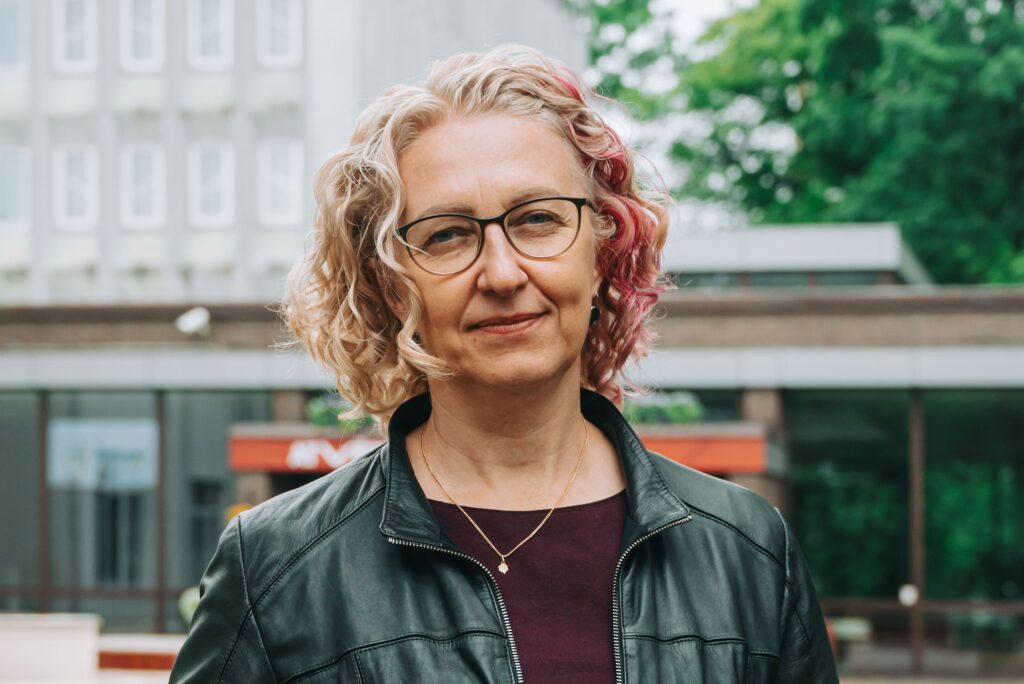
Dina Bite holds a PhD in Applied Sociology and has over twenty years of experience in sociological research, with a focus on rural life. She also holds a Master’s degree in Writing Studies and is particularly interested in representations of sisterhood in literature.