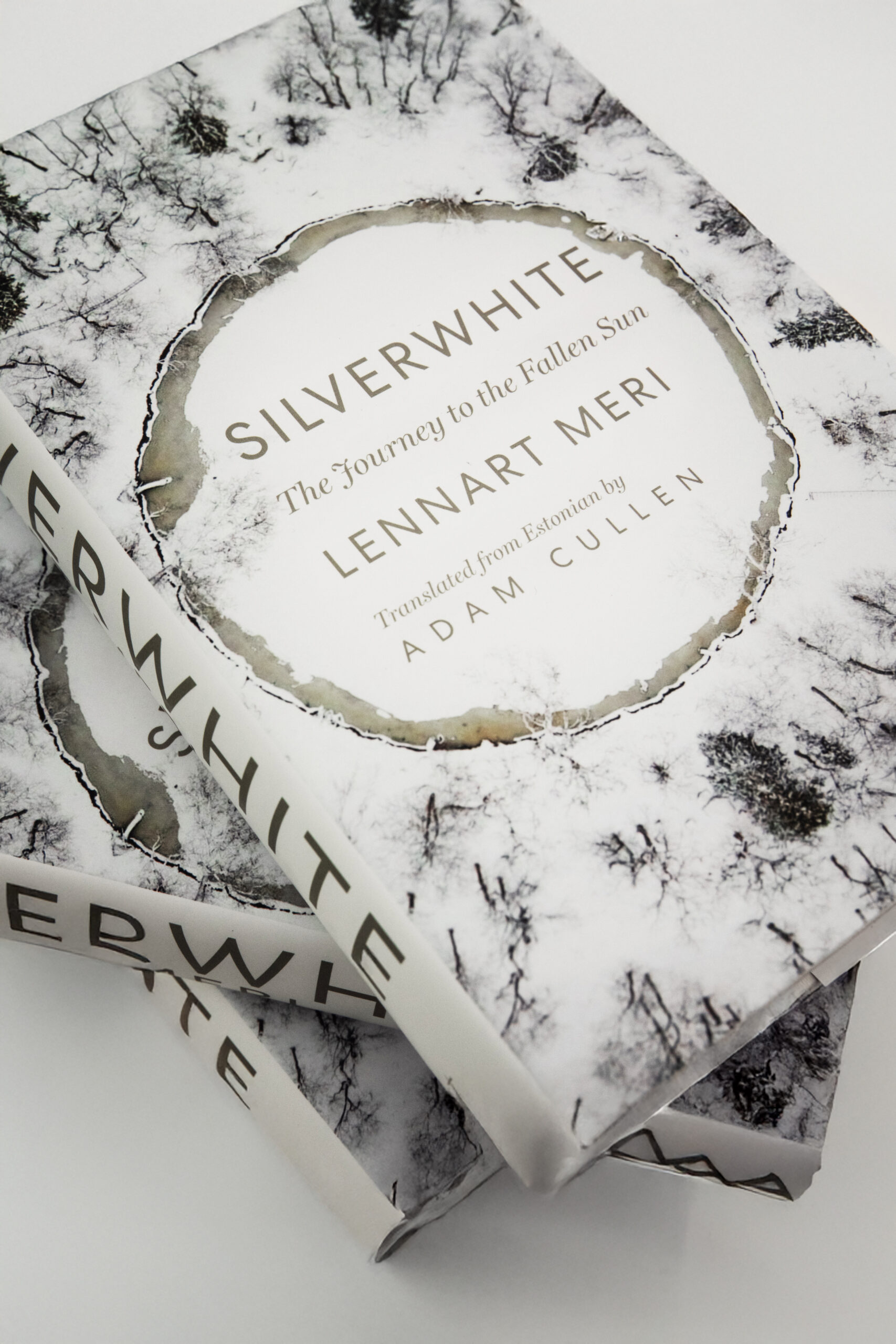
Silverwhite by Lennart Meri, translated by Adam Cullen
Francis Young
The publication of Adam Cullen’s English translation of Lennart Meri’s Silverwhite is a major event for the cultural projection of Estonia in the English-speaking world, for few non-fiction books are as influential in their country of origin as this remarkable work. Silverwhite is an unclassifiable book, and to reduce it to its central thesis (that the cultural memory of the Kaali meteorite hitting Saaremaa in ancient times somehow generated the myth of Thule) is to miss the point of the book. While this is indeed the book’s central thesis, Silverwhite is really a book about Estonia’s (and the Estonians’) historical place in the world. It is a passionate, learned and many-layered love letter to a country, but it is also an evocation of that country – almost in the literal sense of an incantation that sought to summon Estonia into existence at a time (the 1970s) when the Soviets would have preferred it did not exist. James Joyce famously joked that if Dublin were ever destroyed it could be rebuilt from the pages of Ulysses, and Silverwhite is a book with similarly grand aspirations. It is not so much a book about Estonia as a book in whose pages Estonia exists.
Viewed solely from the perspective of history, Silverwhite advances a tenuous and historically unconvincing thesis (in the view of this reviewer, at least). The idea that every scrap of ancient geography and Estonian folklore somehow alludes darkly to the Kaali impact and its consequences is a classic case of a writer allowing his conclusion to write the evidence, rather than vice versa. But, in the case of Silverwhite, I do not think the historical implausibility of the central thesis actually matters. Kaali, the perfectly round crater at the heart of Saaremaa that forms a sacred pool and a mysterious source of iron, becomes a metaphor for the centrality of Estonia to Europe’s history that Meri longs for. For in the end Silverwhite is not a work of history but of mythography. Meri comes across as a philologist and mythographer who has been let loose on history, and he is not afraid to use his imagination – such as in the long-imagined conversation between the Arab geographer al-Idrisi and a Baltic Finn in Chapter 8. Silverwhite is a work of literary non-fiction of the historical imagination, and a great one. As Meri declares: ‘Literature offers not history but visions and, in the best case, historical possibilities’.
Silverwhite is a book that emerged from the cognitive dissonance of being Estonian and belonging to a country and a people of undoubted antiquity who nevertheless lack an ancient history. The Estonians first appear in the chronicles of thirteenth-century crusaders, and, for all the beauty of its prose, Silverwhite does not change that fact. It seems unlikely that the ancient geographers tell us as much about Estonia and the Baltic as Meri would like to believe. But Silverwhite is a book about Estonia’s (and the Finnic peoples’) place within Europe as well as about Estonia alone, and Meri is at his most convincing when he draws philological connections between Finno-Ugric languages or explores the boat-building practices of Finno-Ugric and Uralic peoples (based on first-hand, hands-on research); and he is at his most convincing when he carefully explores ‘the logic of landscape’ that has created peoples and cultures. Meri had a deep geographical understanding of Eastern Europe and Central Asia that imbued him with genuine insight about the fundamental forces that lie at the root of language and culture, even if a collective memory of the Kaali impact was not one of them.
Of all books I have read, Meri’s Silverwhite reminds me most powerfully of Robert Graves’s The White Goddess. Like Silverwhite, The White Goddess is a lengthy, complex, multi-layered and ambitious yet unclassifiable work of imaginative non-fiction. Like Meri with Silverwhite, Graves revised The White Goddess several times, and both books advance central theses that are historically unsustainable. Both are interdisciplinary works, roving widely (and at times wildly) over disparate sources and methodologies, sustained by the author’s passionate attachment to an idée fixe bordering on the obsessive. And both Silverwhite and The White Goddess are a joy to read; they are deep, transformative experiences of exploring the limits of the human imagination, regardless of the objective validity of the conclusions they purport to reach. Robert Graves would surely have agreed with Meri that ‘Literature, unlike science, prefers imaginative poetry over unsmiling probability’. Like a novel whose plot is moved by a central ‘McGuffin’ whose inherent plausibility is irrelevant to that plot, Silverwhite does not stand or fall by the validity of its central thesis, which is better seen as a conceit permitting an exploration of the totality of the Estonian cultural cosmos. Meri had to start somewhere, and Kaali (as a natural landmark whose European significance is unarguable) is as good a place as any to begin the journey into the heart of ‘Estonianness’.
It would be wrong, however, to see Silverwhite as nothing more than a charming literary excursion whose historical contribution is of no value. The ‘Silverwhite Way’ of the title is the river network that connected the Baltic to Kyiv, the Black Sea, Constantinople and the Arab world. Meri was not wrong about its importance, and one historical strength of Silverwhite is his analysis of Arab sources for the early medieval Baltic (little considered at the time). The Baltic was indeed connected to the wider world of the Eastern Mediterranean and Middle East as well as the north. Meri was also not wrong in his conviction that vernacular crafts, immemorial building styles, linguistic cognates and seafarers’ wisdom encode a certain kind of history. But, just as historical linguists struggle to marry the chronologies of proto-languages to archaeological cultures, so the kind of history in which Meri excelled can never be perfectly harmonized with the written sources that, to this day, carry the highest prestige. The impossibility of all our information about the past coming together in a coherent narrative is something we must learn to live with – and that is a particular psychological challenge for historians trained to believe they are weavers of such narratives.
At the end of Silverwhite Meri poses the question: ‘Where does poetry end, where does history begin?’. It is not a question that Silverwhite answers – if anything, the book blurs the distinction between poetry and history. But, like the Kalevipoeg that Meri so often quotes, Silverwhite is a book that becomes, by its sheer ambition, an act of nation-building in its own right. It is perhaps as close as non-fiction can approach to epic – the kind of book that arrives only once a century. Lennart Meri was brave enough to step into the unknown rather than simply retreading the usual body of evidence for Estonian history, and ‘The unknown is endless; the known is finite, plain, and simple’. That is why Silverwhite is as much poetry as it is history; it ponders the unknown rather than simply rearranging historical facts established by consensus. Meri’s conviction that an event as important as the Kaali impact must have been somehow remembered – and that remembrance was a more plausible hypothesis than forgetting – reflected his faith in the power of collective identity and cultural memory. In this sense Meri’s Kaali is a metaphor for Estonia itself – ancient, beautiful, unique and kept alive in memory even when overshadowed and oppressed by stronger forces. If those things were not true of the long-ago Kaali impact, they were certainly true of twentieth-century Estonia.
Note: This review was originally written in English and first published in Estonian translation in Keel ja Kirjandus, no. 11 (2025).
ABOUT THE AUTHOR
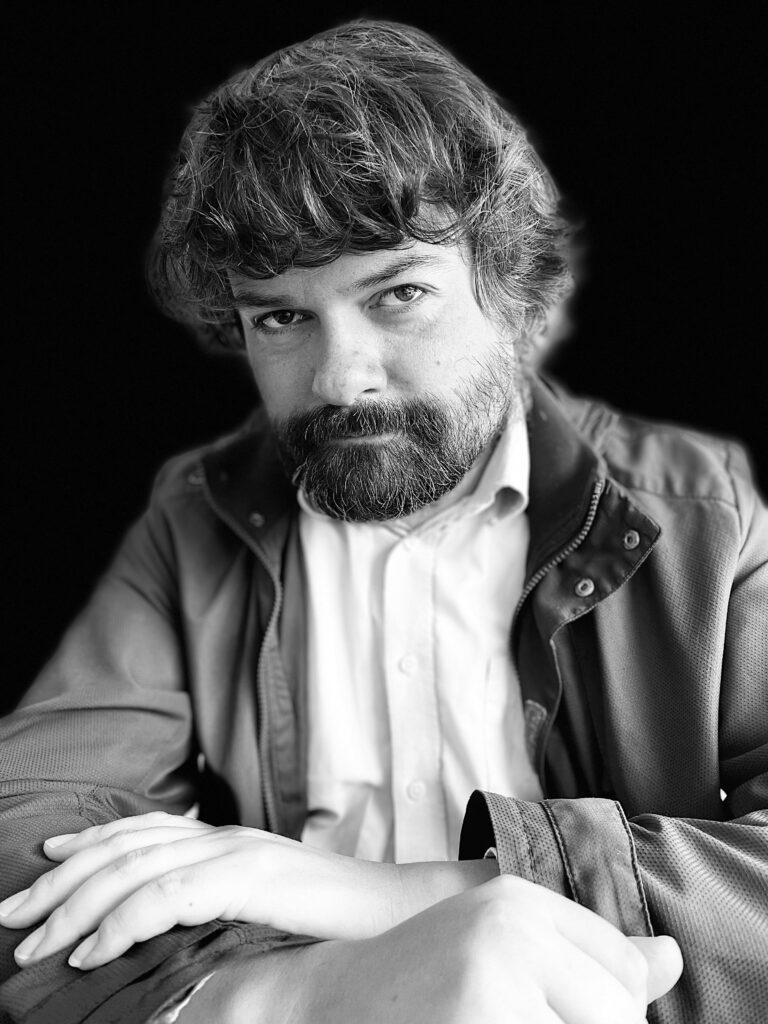
Francis Young is a historian of religion and belief based in the UK. He teaches for Oxford University’s Department for Continuing Education and is a lay canon of St Edmundsbury Cathedral, Suffolk, as well as a Fellow of the Royal Historical Society, a series editor for Cambridge University Press, and Secretary of the British-Lithuanian Society.