
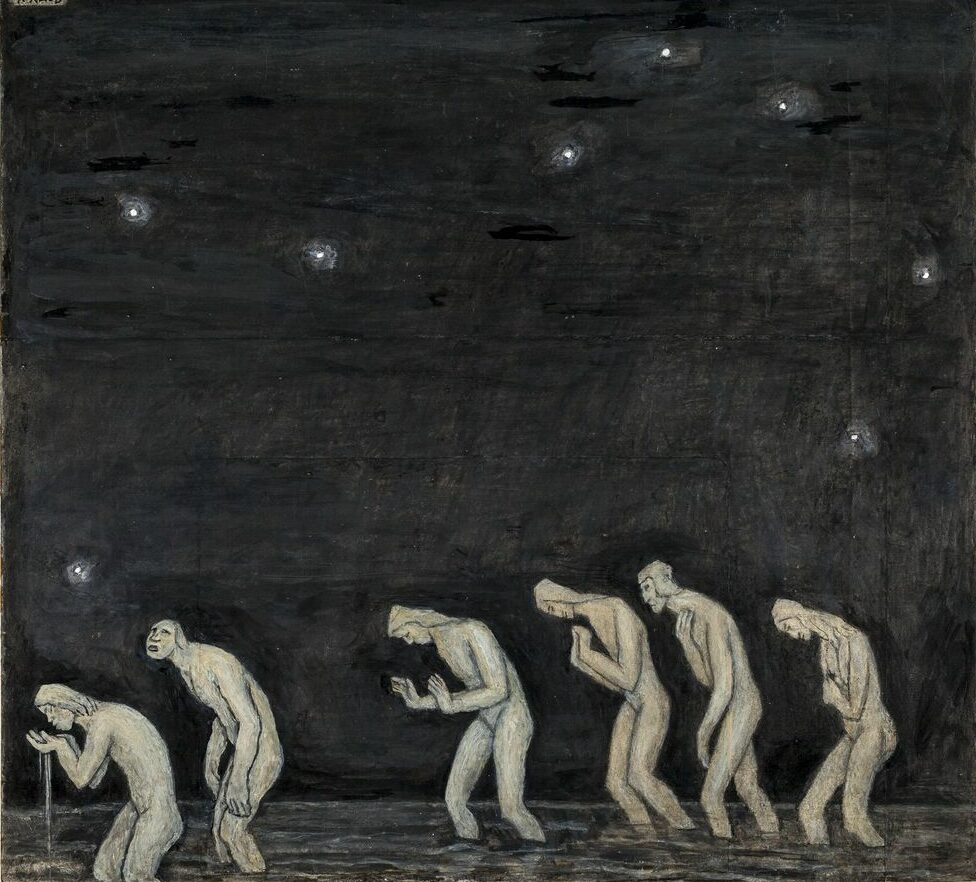
Live Freely or Die
Weigh the sunlight on a scale of leaves,
confess to each gust of wind,
on your forehead bear the well’s reflection –
live freely or die.
Kiss the stones and azure keys,
beasts amid thunder and oblivion,
sing with a voice of snow in the desert,
live freely or die.
Gather each word lost
and yield to the ecstasy of flowering
that breaks the opaque sky into shards,
live freely or die.
Listen to the fountain of righteous blood
speaking in the baleful herb garden,
know the worth of avengement and stars,
live freely or die.
Remember, the decayed eyes of traitors
shall become the flesh of hopeful fish,
howl of ferns and iron –
live freely or die.
Mourn the petrified bees
and find a chasm of the moons reborn
in the face of a whirlwind, smile…
live freely or die.
Watch the black cloud blooming,
above the shimmer of barren lands,
embrace the statue of madness translucent –
live freely or die.
Remember shame, remember the sea,
understand the child’s soil-stained query,
stay loyal to an ice floe melting,
live freely or die.
Watch dawn growing as a tree in the valley,
from the ridge of a mountain of hatred,
merge a butterfly and hail into the human face,
live freely or die.
Live as flying fish live,
live in winter fire and the night of goodness,
live boundlessly as those perishing,
live by endurance in the wondrous mist.
Live as grass lives on a killer’s grave,
live with a rock in one hand and joy in the other,
live to discover the heart of the waves,
live freely or die.
The End of the Anchor Chain is the Beginning of a Song
It was childhood with its snowy wisdom.
On starry branches and in stones’ clocks,
amid soap bubbles of thunder and behind the curtain
where palmprints glimmered,
grains of sand played
their quick and obscure game –
as though the wind was softly blowing over a laid table,
as though water could transmute into the gold of birds.
Fish travelled, up and down stairs,
slept beneath the haystacks,
born from the sun’s moments of forgetfulness.
Their death was a gentle breeze
stroking the hair of crystals
in the pitch-black hollow of a well of smiles.
The majesty of lightning bolts reigned in the silence
over the sea’s sheet of paper, brimming with poems.
Dreams still wandered naked
and marble still carried the taste of milk,
translucent birds continued to breed
from the years’ brief caresses.
It was the blood-spattered window of youth.
Lines of aspens woke on the banks of steel rivers,
unveiling the horrendous seashell of the milky way.
Drums stirred, buried in salt and crumbling from the mouth plaster
gaped in the livid wall –
its tongue flapping,
its teeth turning to ash.
O flying eagle, carrying your epileptic rock,
O sharp hay in the depths of love’s abysses –
ears had splintered like shields,
listening to the dog skeleton’s drool,
had whispered in the roots of leafless trees and beneath the hooves of pale horses
that stood upon the shore to behold the aquatic war.
They dreamt of quicklime,
falling in flakes from the armpits and vulvae of nebular virgins –
a tender, long-awaited winter.
They dreamt and smiled,
as the vacuum pillar gyred ever faster
in the heart of an overpopulated metropolis,
like a black key in the lock of a full moon,
like the vengeance of all silenced words.
This is manhood’s salty spring of azure.
The wind blows and heavy keys of clouds
hang from slender branches.
The lucid algebra of noon, the festive sea,
beneath the clapping fabrics of joy
hold a memory of a death, delicate and cool.
The moose moans, and on the cliffs, lights flicker,
humid at the tips of flower stems.
Who melted the wreck
together with the sky?
On what midnight did the transfiguration of machine oil
into heavy water (red as kisses) take place?
Who was silent for so long
that the snow of crimes
began shimmering faintly on birdwings
as if the sky had bared its gloved hand?
The end of the anchor chain is the beginning of a song.
The fissure in the cliff is too deep
for the bedecked city
to comprehend its own dark blood again –
other than by playing with the letters of forgetfulness,
elsewhere than on the glacier of the medal’s reverse,
other than in-between deaths.
The end of the anchor chain is the beginning of a song,
when fingers disintegrate to pieces,
and each becomes a slim, fingerless hands.
When the bluish handle disappears from the clouds’ fringe,
the stake of freedom will rise in the field.
Then, the largest and most unforgiving prism
(love’s), forms in the truth of soot and lightning,
behind it, many vertiginous wells.
The end of an anchor’s chain is the beginning of a song,
The end of a ray of light is the beginning of a dance.
Behind water, behind fire,
the endless bread of the northern lights awaits.
ABOUT THE AUTHOR
Ilmar Laaban (1921–2000) was among the central figures of Estonian surrealism and one of its first deliberate practitioners. In his work, the Estonian language becomes an experimental field: neologisms, loanwords and sound play unsettle ordinary logic and open poetry towards the irrational.
His major collections, Ankruketi lõpp on laulu algus (‘The End of the Anchor Chain is the Beginning of a Song’, 1946) and Rroosi Selaviste (1957), were published in exile in Sweden. Defying the poetic conventions of their time, they introduced a subversive and linguistically inventive voice into Estonian literature. During the Soviet period Laaban’s work remained banned in Estonia, circulating informally among readers drawn to its liberating force.
Laaban was also a philosopher, art critic, translator and pioneer of sound poetry. From the 1960s onwards, his vocal compositions extended surrealist experiment beyond the written page. His understanding of surrealism is perhaps best captured in his own formulation: ‘The aim of Surrealism is not to replace scientific reality with that of the Unconscious, but to merge them, thus forming a new surreality.’
Links: https://estlit.ee/person/251/biography