
Black Watering Can
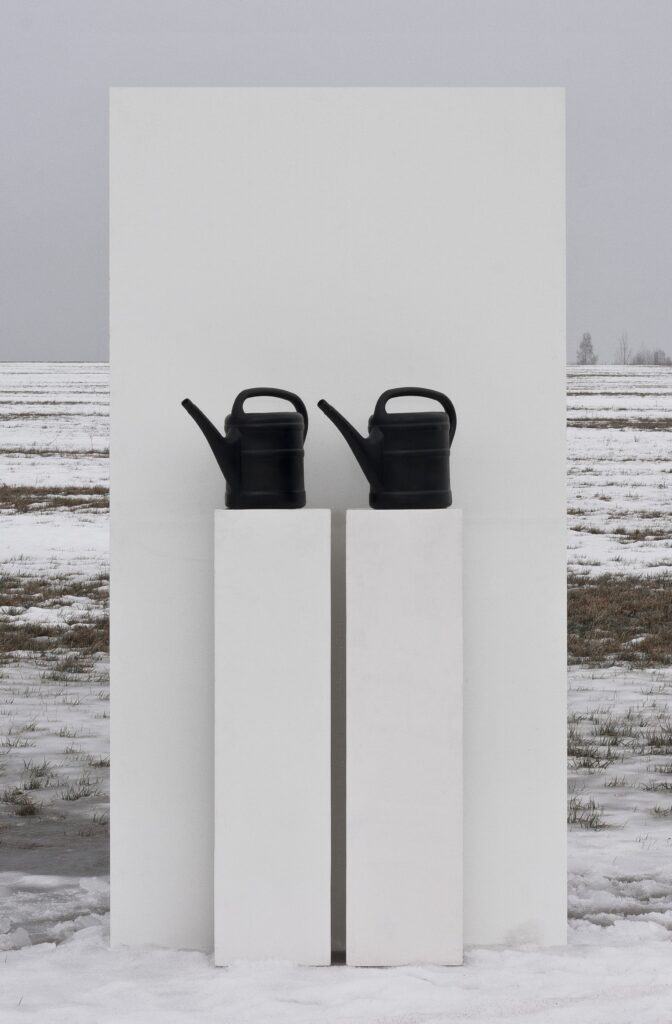
The form of the watering can is reduced to an extreme laconicism (with the handle and spout left aside as user interfaces). Within it, two universal – one might even say primal – forms are joined: the protrusion and the cavity, to which all other possible forms can be reduced or of which all other possible forms are modifications. The watering can is androgynous, a closed libidinal circuit and an eternally self-referential system. Why black? Presumably because, in its restrained dignity, black is the only possible hue for an object so archetypal. From the spout of the object flows white noise – a sound whose frequency spectrum within a given band is continuous and uniform, its power per hertz within that band a constant value. White noise is obtained by combining all sound frequencies. The adjective ‘white’ is used as an analogy with light, where the combination of all spectral tones produces white light. One may speculate that white noise contains within itself all codes, languages and modes of speech, that these can be filtered out of it.
White Globe
The white globe was made at a factory where globes and atlases intended for educational use and orientation are produced. It is a blank globe shell on to which maps have not yet been affixed or printed. Thus it is impossible to identify which celestial body it represents, although we may assume that it was meant to become a reduced-sized replica of one specific planet. Inside the globe is a light; when switched on, light glows from within the white sphere fixed to a base. When viewed in darkness, it appears to be an uninhabited, empty planet in an infinite galaxy. The possibility of observing this in such a miniature form creates the perception of a special situation through which penetrates the acrid smell of plastic.
Museum
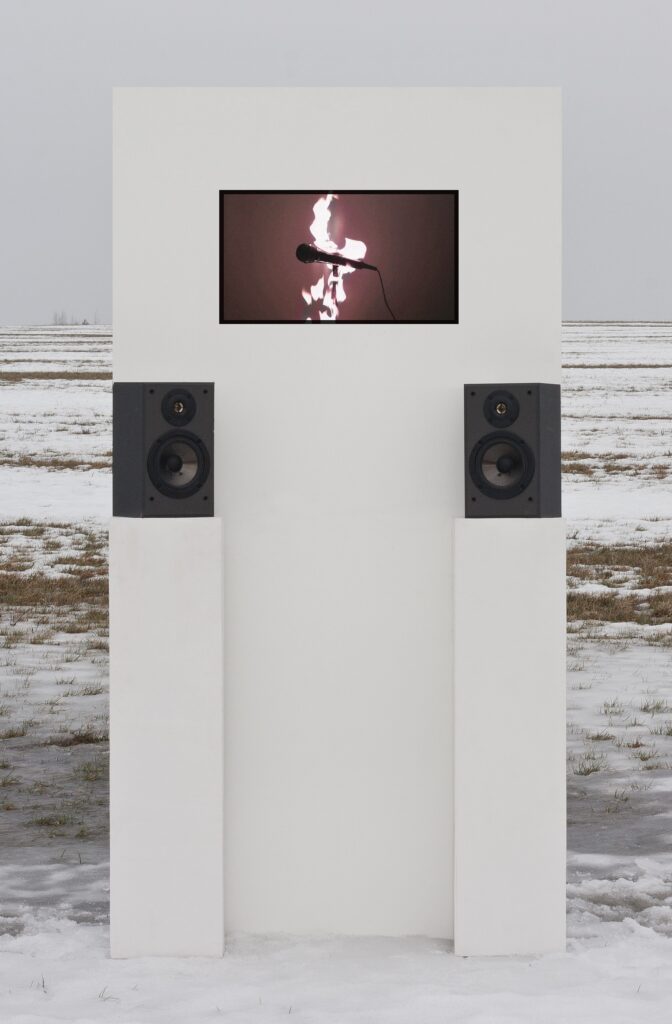
This is a museum whose collection and exhibitions consist of empty or monochrome images. A separate section is devoted to white-primed canvases left empty, untouched by any colour or substance – left empty for a number of reasons: either the framed, painting-ready canvas already seemed to the author a perfectly complete object to which it felt impossible to add anything, or the creator decided, as a sign of non-violence, to leave the canvas unpainted. Some aim for pure sensation; some depict, from very close up, the vanishing point of perspective. Some white canvases are covered with various transparent substances. Some are placed so that the alternation of light and shadow forms temporary, vanishing shapes on their surfaces. Some are intended as screens for the viewer’s perception or for the shadow created as they pass by. Some have never been seen by anyone and some were once painted canvases that, as a logical resolution, led to the removal of layers of paint, until the canvas was once again empty.
My favourite hall is the one where those empty pictures are gathered for which it is unknown why they were left empty.
Black Box
By object, here we mean a physical or logical device. Object number 1 is presumably a black box. It is a small black box, the proportions of which are unimportant. From one side a cable enters the box; from the other a cable exits. This cable is connected to every object in the world that transmits a signal by wires. Inside the box, what happens is equally simple – the ends of the wire are either connected or not, and, accordingly, the transmission of signals either takes place or is interrupted. Whatever it is that connects or disconnects the wires inside the box remains unknown. Thus what happens inside the box is an eternal mystery and endless secret for which no solution is prescribed. The random factor operating inside the box dictates the functioning or non-functioning of all electronic systems in the world.
Page
Both the next page in the book and the next room in the house were empty, thereby seeming to take everything preceding as a certain definite proposition and, through this, arriving at the next one, drawing from it something further-reaching, which was undoubtedly the next page/room, which, as one might expect, was just as empty. This time only the conclusion was missing, and from this followed the inability to move onwards into the next room/page.
Door
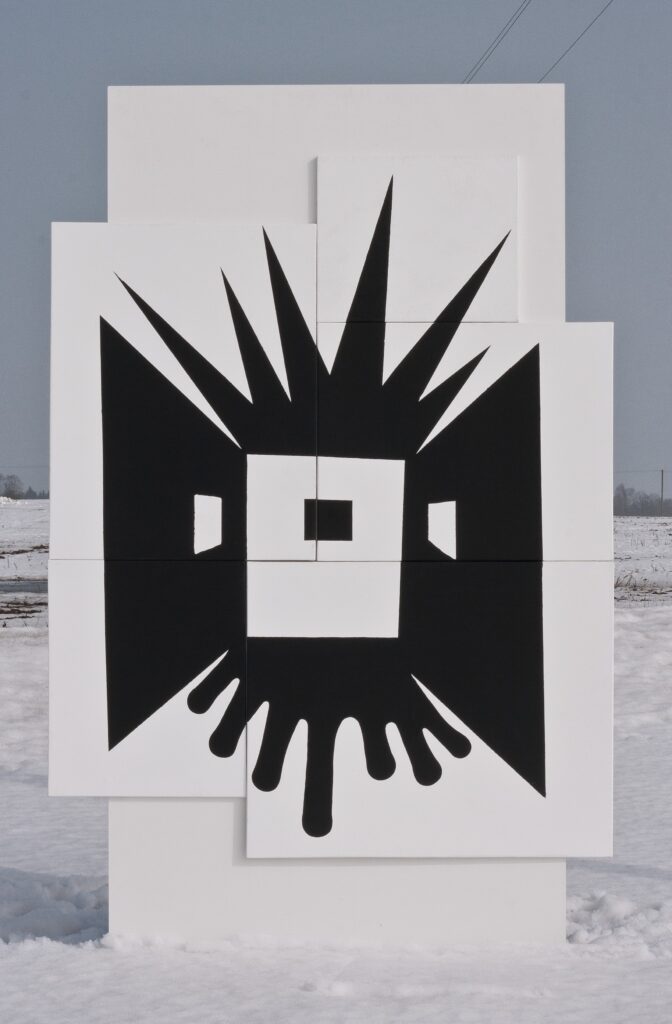
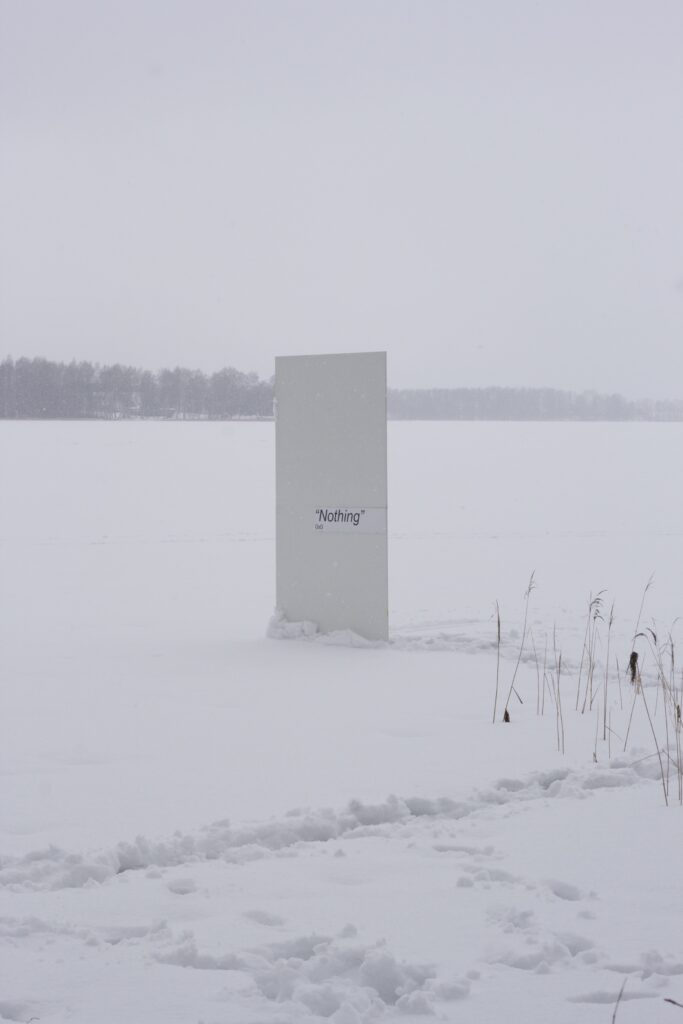
I have somehow ended up at the terminus. It might just as well be the end of the planet, the last inhabited point before the edge. The buildings have been rebuilt; architecture has begun to dominate the people, has become so total that human presence is no longer necessary. And thus there is not a soul to be seen here. I am very hungry. Once, on the ground floor of one building, there was a canteen. I know that the former canteen spaces have been merged with the hospital located inside the building, but I enter anyway. In the room is a patients’ communal area; through a glass partition the kitchen in the adjacent room is visible. Patients are drawing and playing with colours on the floor; I walk among them, lifting my feet high. I do not want to confuse them, but they do not notice me at all. I ask one of the staff whether food is still served here. It is not, answers the orderly. I walk back, lifting my feet high through the patients playing with colours. Behind the glass partition the kitchen in the adjacent room is visible. I open the door. Outside it is drizzling. It is spring. The first spring rain. I pause in the doorway. It is a solitary door with a frame, fixed in the middle of an infinite landscape stretching away on both sides.
Phantom Section
As you see, while inside this house we see that same house entirely from the outside.
Indeed I saw before me some structure that could just as well have been a house. What was visible, due to its reduced dimensions, resembled a model, and I stood above it.
I could confirm that it was indeed the same house into which we had just entered.
Under normal circumstances we are small, like inhabitants of a large house that surrounds us on all sides. But the effect of being inside this house is that the house is small, and we surround it, seeing it – as you see – from multiple angles.
This in no way means that I suddenly was the house or vice versa.
It simply accompanies this house and is quite easily understood. Yet if we inspect the exterior of this house carefully, we notice something altogether more important.
I looked closely. Above all the house resembles regularly arranged rectangular prisms placed side by side in fog.
While inside the house, at any point one may assume that, regardless of which prism – that is, spatial point – one is in, this being-there exists in symmetry; that from the standpoint of the overlap between being and the house, this symmetry would be universally symmetrical, such that the missing part (the prism) would be as if it were not missing at all. We may call this the phantom-prism syndrome. As we walk through the house, we always assume it to be symmetrical, and the absence – or rather the presence – of the missing section always thoroughly startles us when we reach it again. The assumption of the missing section’s presence is always (from the standpoint of both the house and its inhabitants) so intense that, independently of the stated symmetry, the more important and whole-defining part of the house seems to concentrate precisely in this phantom prism. Although symmetry is disturbed, the house has lost nothing. The missing prism is an integral part of the whole (that is, the house), which – take it or leave it – simply is of such a shape.
In the past it was thought that the shape of the house referred to, or attempted to model, the structure of the brain, in which case the missing prism was supposed to signify the self, the spirit, a higher power, the creator, the beyond, the meaning of life, etc. It is interesting to note that most schools indeed projected all of the above – ideas expressing indeterminacy in one form or another – into the phantom prism. The house’s integrity, by the way, is so convincing that no one has dared to claim that it is simply the result of running out of building materials, an architectural mishap or the carelessness of the builders. One not particularly credible school, with obvious difficulties of justification, has tried to claim that the missing spot was intended for a guardhouse or a guard and that it is not a missing spot at all but an orphaned canopy in case it should start raining and the guard would not want to get their uniform wet (the canopy, allegedly, was once carried away by a strong wind). Scattered references also speak of the house as the embodiment of the macrocosm or a system of systems, whose accompanying circumstance – that while inside it you see it entirely from the outside – is merely an illusion peculiar to the house. Inhabitants who are firmly able to believe that while inside something it is not possible to see the same object from the outside nevertheless do not deny the absence of the phantom prism. On the contrary, after a while they begin to claim that there are in fact several phantom prisms, and they usually end by asserting that the entire house itself is phantom.
Ring
You open your eyes and see above you in the ceiling a rectangular opening.
You are slightly dizzy from the fall, but you quickly gather yourself and stand upright.
You are in a closed room without windows. In one wall there is a door. A lift door. You press the call button; you hear how the lift breathes itself into operation and comes to you from an upper floor. The door opens. You step inside, the door closes behind you, you look for a floor button, but there is none; at the same time the lift has already begun to move, it goes one floor up and opens the door. You step out.
In front of you is a staircase. You walk up the stairs. Where the stairs end, there is a rectangular opening in the floor. Since there is nowhere else to go, you jump down.
You open your eyes and see above you in the ceiling a rectangular opening.
You are slightly dizzy from the fall, but you quickly gather yourself and stand upright.
You are in a closed room without windows. In one wall there is a door.
ABOUT THE AUTHOR
KIWA, aka Kiwanoid, is an Estonian interdisciplinary artist who has been active since the early 1990s. His work moves across sound, visual art, performance and text, forming an ongoing hypertextual enquiry into meaning-production, cultural codes and the construction of collective and personal mythologies.