
Like an earthquake, I think. And I am petrified right there in bed – the room is unfamiliar. Completely unfamiliar. There is a carpet on the wall. Red, with patterns. There is also a carpet on the other wall. And on the floor.
I carefully get out of bed, move slowly towards the balcony door, and the closer I get, the clearer the sounds become. Now I’m starting to tell them apart. The car alarm, the screeching of tyres, a foreign language, someone screaming and probably someone crying.
On the other side of the door, I’m hit by a hot, dry heat. I carefully take myself to the balcony and take a look. Pink houses, made of great stones, right in front of an expansive park. I see a policeman wielding a baton. A desert-coloured mountain, with snow on top. The mountain is beautiful, both near and far in its size. Clutching onto the balcony railing, I look at the mountain. I look at a man running along the main square. The noise is deafening. The man screams, even shouts: Azatutyun![i] A tricolour is flying in his hand.
I stand for several minutes, and after that I simply go back into the room.
And then I wake up.
It haunts. At first, just a dream, but now all it takes is to close my eyes for a moment, and I almost believe I am back there. Dreams have a way of continuing. As with all my daily activities – I end up visiting the same places and seeing the same people, walking the same path day after day, going to the kitchen in the morning to make coffee and cook for the children, then to work and the ten thousand steps home, then the children and their homework. It is the same with dreams. Here I am again, in an apartment that reminds me of the home I once lived in, with the red patterns on the wall-carpets and the smell of fresh bread and coffee coming from the courtyard, and the noise that takes my thoughts to the earthquake. And in the main square, people flushed with victory.
‘Stop daydreaming,’ Ivar interrupts my train of thought. I know that the sharp tone is deceptive. It’s me who scares him when I get distracted and stare into the void.
Sometimes I think I should tell him about my dreams, but I don’t bother. There is no point, other people’s dreams are always so confusing and boring.
‘You’ve switched off again, and you can’t hear what I’m saying. It’s like you’re not even here.’
Like in Krabat, I think to myself.[ii]
Ivar sometimes says that I don’t know how to delve deeply. That I am impatient. I don’t know how to play with the children on the floor, I’m always trying to do something useful with my other hand.
‘Like in Krabat?’ I now ask. But Ivar just mumbles uncertainly because he hasn’t read the book.
Thinking of Krabat again, and I am child once more, thirty-five years have gone by in the blink of an eye. I remember exactly how it was when I read it and the pungent sweet smell when Grandma cooked jam in the kitchen. I find myself in trouble when reminiscing. Random scents, colours – and everything comes back. The injustice in the third grade at school that still takes my breath away. My classmate’s mum tearing into me because I got in her way on the class excursion, and the form teacher simply looking on. At other times I recollect something positive. I run through the woods, so the branches hit my face, I feel the twigs breaking underfoot, but I reach my goal. ‘Olly olly oxen free!’
‘What are you thinking about?’
‘That I am tired.’
I take a big glug of coffee, even though I shouldn’t. It’s the third this morning. The first two I downed when taking the children to nursery and school – and I know my heart will start pounding now.
Besides, coffee doesn’t taste half as good as it did since I started drinking it without sugar.
When the twins were born, it was coffee that gave life meaning. Sometimes I’d go to bed at night, and the thought of coffee in the morning excited me with such anticipation that I couldn’t sleep.
Perhaps the thing is that coffee is associated with freedom? With youth? With the time I had no idea of the existence of Ivar, not to mention three children. Or a job with responsibilities and a massive mortgage on an apartment.
Instead, I was an exchange student in Armenia, discovering my ancestral roots. The coffee was black and strong, deliciously bitter and loaded with sugar. Sometimes I try to brew it here in the same way, but it doesn’t work. The coffee beans are too coarse. I have bought three coffee mills, but none will grind the beans fine enough, no matter what the shop promises.
It took fifteen minutes to walk to Yerevan University and only five minutes on a marshrutka.[iii] ‘Ah, that’s our studentka! You made it! That’s the call of the roots,’ the lady with purple hair nodded. And I nodded excitedly along.
‘We’ll draw up a lesson timetable for you right away,’ said the woman. ‘Irina Armanovna,’ she introduced herself. ‘Is there a fiancé?’ she said herself, ‘No, too young. Don’t worry, we’ll find that here!’
‘What are you thinking about, seriously?’ Now I finally look at Ivar. ‘I wonder when it gets easier. Nora and Mark are five. Soon to be six. Stefan is twelve. And most mornings, I feel like I’m going to die. Running from the first moment, the endless screaming and demands.’
‘They’re starting school next autumn,’ Ivar says at last, as if that should console me.
As if that will make things any easier, I think. They will start coming home even earlier.
It was a fractious start to the morning. At first, Mark didn’t want to get out of bed. Then to go to the nursery. Then to brush his teeth. When he finally got to the bathroom and found his sister there, he felt the need to take the cuddly toy out of her hand. Nora, already upset, dishevelled and sleepy, added a full-throated scream.
‘Please! Don’t do that! The neighbours can hear!’ I ran from the kitchen where I was making Stefan’s sandwich. Finally, I hauled Mark into the kitchen with me. ‘Rice porridge!’ he shouted at the scent of oats.
And there he was, thrashing about on the floor, wearing his little shirt and no pants. I threw, as a last resort, rice flakes into the pot, without hearing that Nora had been begging about something in my ear for a while, only noticing Stefan’s hands tightening into a fist at the screaming – he tolerates noise as badly as I do.
‘Why don’t you put that song on?’ Nora’s existence suddenly reached my consciousness.
‘Which song?’
‘The one we listened to in the countryside.’
Which song?
Someone was talking about a triathlon on the radio, and I had no idea what that might be. The speakers’ voices mingled with the howling of the children. While I was just standing there with my heart pounding, Stefan crept up and attached himself to my neck. Stefan is my height, and his hug is limp and heavy. As if someone has hung a bag of flour around my neck. The last thing I want at a time like this is someone touching me. I also know I shouldn’t say anything to him because it is his way of comforting me. Of being supportive.
Except that he is not.
I pushed him for a moment, as gently and but as forcefully as possible, and released myself from his embrace. And I felt the flow of different sounds directing my vision according to where the ruckus was coming from.
‘What are you waiting for?’ Ivar asks me now. ‘For them to be silent or not to move? They are children. And there are three of them. Of course they are noisy.’
It was noisy in Armenia, just like in the dream I have. But it didn’t bother me. I was younger. And the noise didn’t affect me. Like contemporary symphonic music, organically swelling and fading, before gaining momentum again.
‘I’m going to work,’ I tell Ivar, who is already behind the computer, meticulously programming something. I wrap a scarf around my neck and leave, taking a longer route. I don’t want to get to the office too soon. These twenty minutes are mine. Straight down Kunderi Street, through Police Park, past the front of the department store, and over Freedom Square. I think about putting on Gasparyan playing the duduk – to extend my dreamlike feelings – but I abandon the idea at the last minute and instead play some new postpunk on Spotify. It anchors me to reality. Connects with young people who wear the same kind of clothes that I used to wear when I was their age long ago.
The drum beat hammers in my ears, and it seems to me that I’m as cool as the music. But when I notice my reflection in the glass door of the beauty salon, I see the dark circles under my eyes, a poorly kept fringe, and slightly swollen cheeks. The illusion disappears in an instant.
Who am I kidding? Of course I’m different from them. And they all know that.
It’s warm in Armenia. The sun is shining Armenia. There is no seasonal depression in Armenia. Armenia has good food, with a pure taste and no e-numbers. And the music that envelops you in its own timeless stream.
I’m not different in Armenia, I thought as I was going there.
*
I am fifteen minutes late for work. No one seems to have noticed. I throw my handbag under a desk and I feel my cheeks flare. The same crap every spring, allergies make my face swell and turn red.
There are dozens of us in the company, a typical modern office where everyone works in one open space; no one has their own desk, let alone a set of drawers. If anyone wants anything, they shout across the room. It is our office policy that we talk to people, not to chat online or text. ‘The human touch,’ says our boss. ‘Like in the old days.’ Except in the old days, people didn’t sit together in a big barn, they sat in cubicles, and the doors were closed. If someone wanted to come in, they knocked. Our solution should be modern, back to people and back to basics, but deep down I hate it, because every cry and outburst is accompanied by a break in my thought process.
‘The next software development meeting will be in Baku,’ the boss says straight off when he sees me. We have branches all over the world, ideas flying over the net, and innovation teams in major cities from Europe to the Middle East. The boss is younger than me, talkative and unpredictable. He gets some idea in his head, conveys it in a mixture of Estonian and English, and expects us to fly with it.
‘You will represent our team. The trip is next month.’
Is he joking?
‘Are you kidding? You can’t go to Baku,’ Aram looked at me as if I was a little stupid. We met at university. He studied history, while I was studying information technology. ‘You will be killed, you have an Armenian name.’ My cheeks began to flush with shame.
‘I can’t go to Baku,’ I tell the boss. ‘Send Zahra, she’s from there.’
We have an international team – there are Estonians, Italians, one Azerbaijani, one Portuguese and a whole bunch of Russians and Ukrainians.
The boss looks at me with a face that clearly says – so what?
‘I am Armenian. We had a war. They hate us.’
‘You’re not being overly overdramatic? This is an international meeting. What do you think will happen?’
‘Armenians are not safe in Baku. I would be very happy to go to Baku, honestly. My grandmother comes from there and lived there until she became a war refugee. Seriously, what do I have to prove now?’
And at the same time, I realize that I have gone too far, my voice is shrill. Not that I wouldn’t want to go to Baku.
Another recurring nightmare. The border is formed here, as if someone had taken a black marker and drawn a random line across the paper. I am in the ordinary, sweet-smelling Estonian pine forest. I know if I go straight, I’ll reach Azerbaijan. Which is what I want – to see the place that could also be my home. For even ten minutes, to see the place where my family lived for centuries.
I keep on walking.
And out of the forest I find myself heading straight to the big oil city of Baku, a far cry from pink, dry, rocky Yerevan. The grand white marble homes, the old majestic opera houses with glass skyscrapers, donkeys and Mercedeses, the suffocating heat and the sea air. Women with straightened noses and men in pressed Armani suits, making their way among the beggars.
I’ve got ten minutes, and then I see her. On the periphery between the city and the forest, there is a little girl with long black plaits. Is she five? Or six? She looks like the woman I had seen in my childhood in the ENEKE encyclopaedias showing the traditional dress of different nationalities.[iv] Dreams are fucking clichés. But I am collecting myself, because what is an Armenian girl doing alone in Azerbaijan? I extend my hand to her, she takes it, to lead her back to the pine forest, back to Armenia, to safety. But each time, the dream fades the moment we reach the edge of the forest. And I wake up with an agonizing feeling.
‘That’s clear then, Zahra will go. We’ll connect you on Zoom,’ says the boss. ‘Please talk through how this is going to work!’ I nod and sit at my station.
Zahra has already dragged her chair to my desk and is scribbling something in her notes. She looks like a princess from the Arab world, big dark-brown eyes and long eyelashes like in a fairy tale, dark curls down to her hips. Black, not brown like me. She’s got a resonating laugh, and she is tiny and cute, a little doll. And she thinks it’s infinitely terrific that we both have Caucasian roots. Not so in my opinion; my great-grandmother fled the genocide in what is now Turkey, the Ottoman Empire, in 1915, in which one and a half million Armenians were killed. Including my grandmother’s family. And what on earth is this forcing the Armenians of Karabakh to flee other than genocide by other means, I think in my head.
Once I talked about it in the coffee nook, after we had worked together for a year.
‘It was a war, everyone escaped,’ Zahra replied. ‘Not just you.’ – ‘Did your family also? What did they escape from?’ I asked in reply, the irony hidden in my voice. – ‘We have been here for three generations,’ she smiled at me. ‘My great-grandmother came here during the Russian–Turkish War, she always said she had escaped with her lover from the Sultan’s harem.’
‘My great-grandmother arrived in Baku from western Armenia at the turn of the century. Because of the genocide,’ I answered laconically. I couldn’t help but add, ‘She was the only one of her family to survive. Everyone else was killed. Killed on the spot by the Sultan’s soldiers, dying in the Syrian desert. I’m not sure we can compare the systematic destruction of a people to harem adventures. Or my grandmother, who thirty years ago had to flee her home again, this time to Estonia.’ – ‘Believe me, the harem is only fun in a fairy tale. And men are men, whether they are Azerbaijanis or Turks or Armenians or Estonians or Russians,’ Zahra replied with a laugh. ‘I’d like to see what your Armenian men would have done in the last war if they had got hold of an Azerbaijani girl.’
How can I explain to her how I felt when my grandmother told me about her mother? How she was found wandering alone in the desert, speaking a few words of Armenian. I imagined a caravan of people in the Syrian desert, and a child who had become lost on the road. I thought of my grandmother, who lost her home at the end of the Soviet era, had to leave Baku, where she had grown up, married, raised her children – and I felt anger towards Zahra. That she trivializes my pain. My grandmother and great-grandmother’s story. To compare the destruction of generations to the romance of the fairy tale One Thousand and One Nights.
The phone on Zahra’s desk rings and she runs to pick it up. In a moment, I will hear her sonorous voice. I look at her coffee mug and momentarily think about spitting in it. Not that Zahra is evil, but just as a punishment for her ignorance. But I start to worry about cameras and hold back.
*
The journey from Tallinn to the centre of Yerevan, from there to the pine forest, and from there directly to the chaotic traffic of Baku takes seconds in my dream.
You can reach Yerevan via Lai Street, slipping under the archway that should lead to Suur-Kloostri Street, although it has been firmly locked behind a gate and padlock since the beginning of the new century. Ah, that’s why they locked it up, I realize in my dream. Because when I enter, I will be right on the main square. And just like that I find myself out of the quiet grey dimness of the old town, in the midst of squint-inducing sunlight, police whistles and honking cars. Pink tuff buildings tower over me, while the newlyweds keep circling the square in their cars. Between the Volgas, a man trundles up in an open ice cream van, a cap on his head, his stomach spilling over his trousers. The van is decorated with a laughing face on an ice cream cone, the paint peeling off. I look at the people and think of the silent Armenian girl who was left behind on the border between the pine forest and Baku. Where did her parents go? Is she not speaking because she fears they will understand?
The radio is playing. The TV is playing. Stefan’s tablet is playing. The children are playing. Ivar is watching football with a friend who is on a Skype speaker. Every sound penetrates my brain separately. Like a thousand different lines, and I don’t know which one to focus on, which one to listen to.
‘Turn it down,’ I bark, making borscht in the kitchen. I don’t even know what they are supposed to turn down. If I closed my eyes now, I’d be back in the forest.
The first time Grandma saw such a thick forest was in Estonia. In Baku, she had grape vines and apricot trees. Sometimes neighbourhood children would come and steal from her. ‘Why would they sell unripe apricots?’ Grandma asked the first time we went to the Central Market together to get food. By that time, she had been living with us for a week, and I still felt reserved around her. ‘It’s a different kind,’ Mum tried to convince Grandma, but Grandma shook her head doubtfully. Later, at home, she made cabbage rolls with minced meat, and the whole kitchen was filled with a strange, sour smell. Mum ate and said it was good. And later she said to Dad – Look what the war has done, this is poor people’s food, Mama used to despise it. These should be stuffed aubergines and Bulgarian pepper, tomato and vine leaves. Not cabbage.
‘You’ll never guess what happened to us at school today,’ Stefan interrupts my thoughts.
‘The Year 12 students gave us a German lesson, and at the start we watched some sort of march, then Hitler’s speech, and then the whole class made that hand gesture.’
What gesture? You mean Sieg Heil?
‘Are you kidding me? And what did you do?’ I’m freaking out and see by the look on Stefan’s face that he knows that something went wrong. ‘You don’t do things like that! Not ever!’
‘But we were only joking!’
‘Things like that aren’t funny! Were the Jews amused when they were sent to the gas chamber with Hitler’s salute?’
Stefan runs to his room and throws himself on to the bed, a lump in his throat. And I know I was unfair. I should have explained. I go after him, sit on Stefan’s bed and put my hand on his back.
‘I’m sorry I yelled at you. It’s just that genocide is a truly horrific thing. He looks at me, his lips quivering. ‘We were just being ironic. About Hitler.’ – ‘Yes, but the irony is very difficult to understand from the outside. You know what Hitler said when he started sending Jews to the gas chamber? That no one remembers the Armenians. But your Armenian great-grandparents’ parents also died in the genocide. All the more reason why you shouldn’t joke about things like that. You understand how directly this affects you? You’re an Armenian yourself and maybe the only reason you exist is because your great-grandmother somehow managed to survive, by some miracle.’
He looks at me from under his light fringe, a little defiant, or so it seems to me. ‘Yes, but I am Estonian.’
I want to argue with him, but then I give up. Indeed, who am I to say who he is?
It is already ten o’clock and the children are in bed. ‘You shouldn’t have yelled at them,’ Ivar says. ‘I know,’ I answer. And then I feel the need to justify myself. ‘But I just can’t cope. They whine all the time, demanding something, shrieking and nagging. They are doing just fine, they get new toys every week and go to cafés to eat pasta. They can’t imagine how scary things might be.’ – ‘Don’t you realize how demagogical you are? You live in events from a hundred years ago,’ Ivar snaps. ‘But you have three children who need you – here and now. Do you really think you’d be happier without them?’ Yes, I would be, I’d like to answer him, and I believe it myself. But I don’t say anything, I just turn around and go to sleep.
*
I had a strange dream today. That I have three children and a husband. A big boy and two little ones, a girl and a boy. The big boy hugged me as if he were drowning, and as I held the smaller ones, I felt a tenderness I had never experienced before. I woke up, still feeling the warmth of the child’s body and his weight against me and an overwhelming sense of regret that it was just a dream.
I shake off my sleep and put my arm around the little girl. Lately, she’s always with me when I wake. We must get to the darkness of the forest.
I wonder what her voice sounds like.
It seems impossible to get her out of Baku, but I will try. We are moving quietly through the thronging streets – two Armenian women – surrounded by big, dusky, sweaty, barking men. Where are all the women? I think. I can see the men are angry – in the way they scream, repeat the same words, chant. They are burning flags whose colours I can recognize even when they’re scorched. I calculate our every move, the girl’s warm hand firmly on my arm, afraid to walk too fast, and I feel a paralysing fear that they will notice us.
We are on the edge of the city; one stride more, we step into the forest – and suddenly we’re there, instantly. The air feels different. In a flash, the relentless humidity has disappeared, and dry air is scorching my arm. The new cars are gone. And people are strangely dressed. Like thirty years ago. We are on Yerevan’s central square. A man, the tricolour on his shoulder, screams something. That we won, we showed them. Those murderers and rapists, those Turkish animals, the Azerbaijanians.
We have no electricity, no food, the earth is trembling and shaking, but the most important thing is – we won.
‘Everything is fine,’ I whisper to her. ‘You can talk now.’ She looks at me and her lips hardly move.
Bəli.[v]
I go cold inside, I look around and I see endless men, not a single woman. Sweaty, yelling, big men with brown eyes. I restrain myself from putting my hand over her mouth. This is a little Azerbaijani girl.
We are moving with measured paces, going forward through the crowd, down the dusty street, and my heart is pounding because I’m afraid they will notice us.
The dry heat, the pink houses and mud, the oil spills, white buildings, the heat and the humidity, it all blends together. Armenian men, Azerbaijani men, I don’t know who’s who. Two women in the middle of shouting men.
We ascend the stairs; I nod to the old man next door in passing. I unlock the door, take the girl to the room, and I am exhausted all of a sudden. There are dark-red carpets on the walls and the floor. I can feel the shabby, rough fibres under my toes. ‘Do you want to sleep?’ I ask, and I think that maybe the dream will return, a warm and heavy child’s body against mine. She nods. I turn on the boiler in the bathroom to heat the water. I cook for us in the meantime. There isn’t anything besides lavash with herbs. I tie her long plaits into a bun. We undress and crawl under the shower into pitch darkness, because at that exact moment, the electricity is turned off, the daily limit has been reached. We empty the tank until there’s not a drop of hot water left. We dry ourselves with coarse terrycloth towel, so that our skin feels rough, and get into bed, between the sheets. Before that, I undo her hair, and her curls spread out across the pillow. I am so tired of the war, I miss my dream children so much. How can you miss someone who doesn’t exist? But if I fall asleep, the dream might come back. I reach for the girl, I smother her with cuddles, and we disappear into the silence together.
[i] ‘Freedom’ in Armenian.
[ii] Krabat: 1971 children’s fantasy novel by German writer Otfried Preussler. Set in the eighteenth century, it is a tale of a young apprentice, Krabat, who acquires magic powers.
[iii] A privately operated shared minibus, common in many former Soviet countries.
[iv] ENEKE was a set of encyclopaedias aimed at children and a general readership, published in 1982–1986 during the Soviet occupation of Estonia.
[v] ‘Yes’ in Azeri.
[vi] ‘Yes’ in Armenian.
[vii] ‘Yes’ in colloquial Armenian.
ABOUT THE AUTHOR
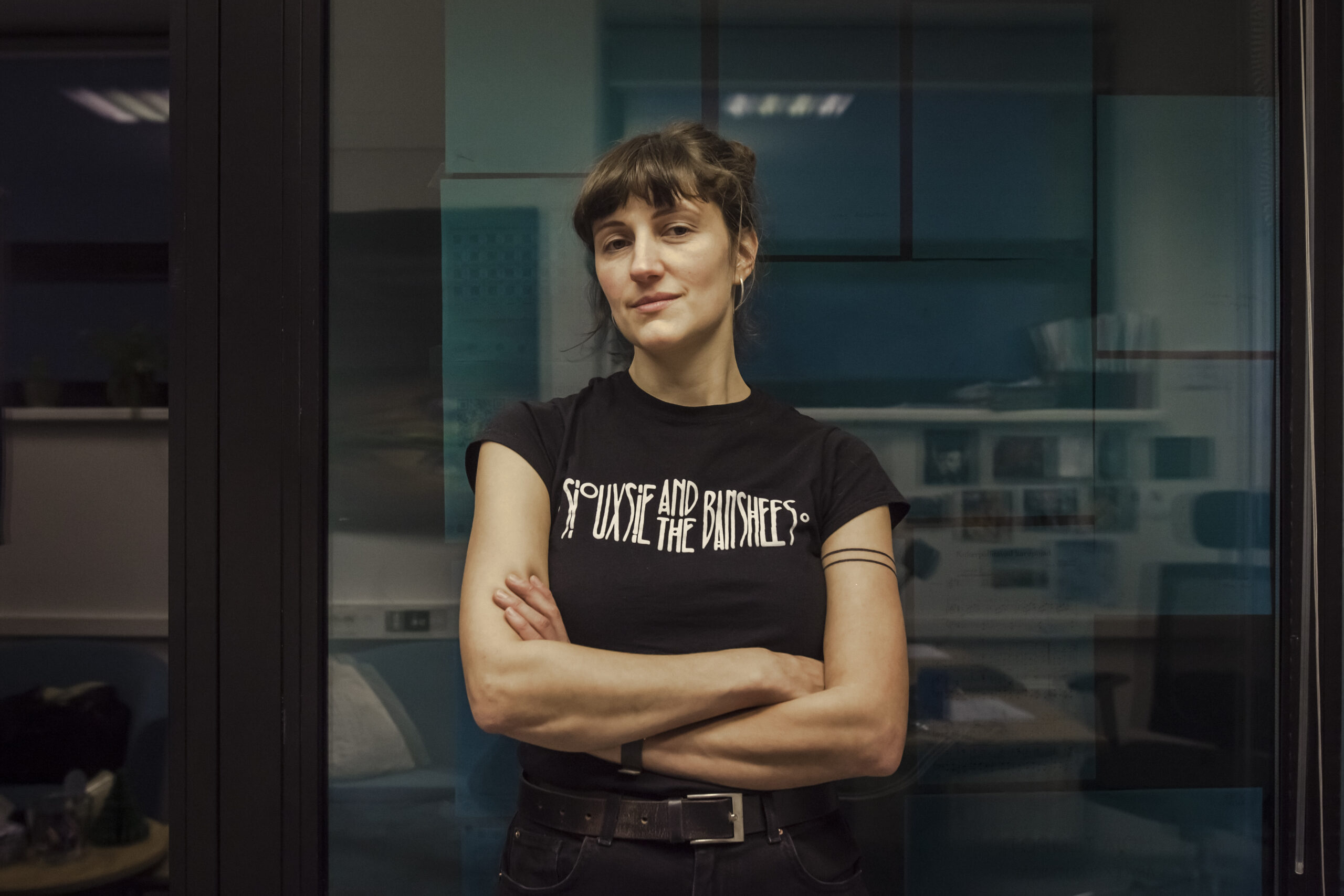
BRIGITTA DAVIDJANTS (b. 1983) is a prose writer, as well as a musicologist, researcher, music journalist, and lecturer, who also plays in a band. In her academic work, she has explored Armenian national identity formations, while her present focus lies on subcultural marginalities. Her 2025 collection Explosion at the Gum Kiosk and Other Stories resembles a short novel composed of interconnected stories. Davidjants is also the author of J.M.K.E.’s To The Cold Land (Bloomsbury,
2025), an English-language study of Estonian punk centred on the band’s seminal album Külmale maale.