
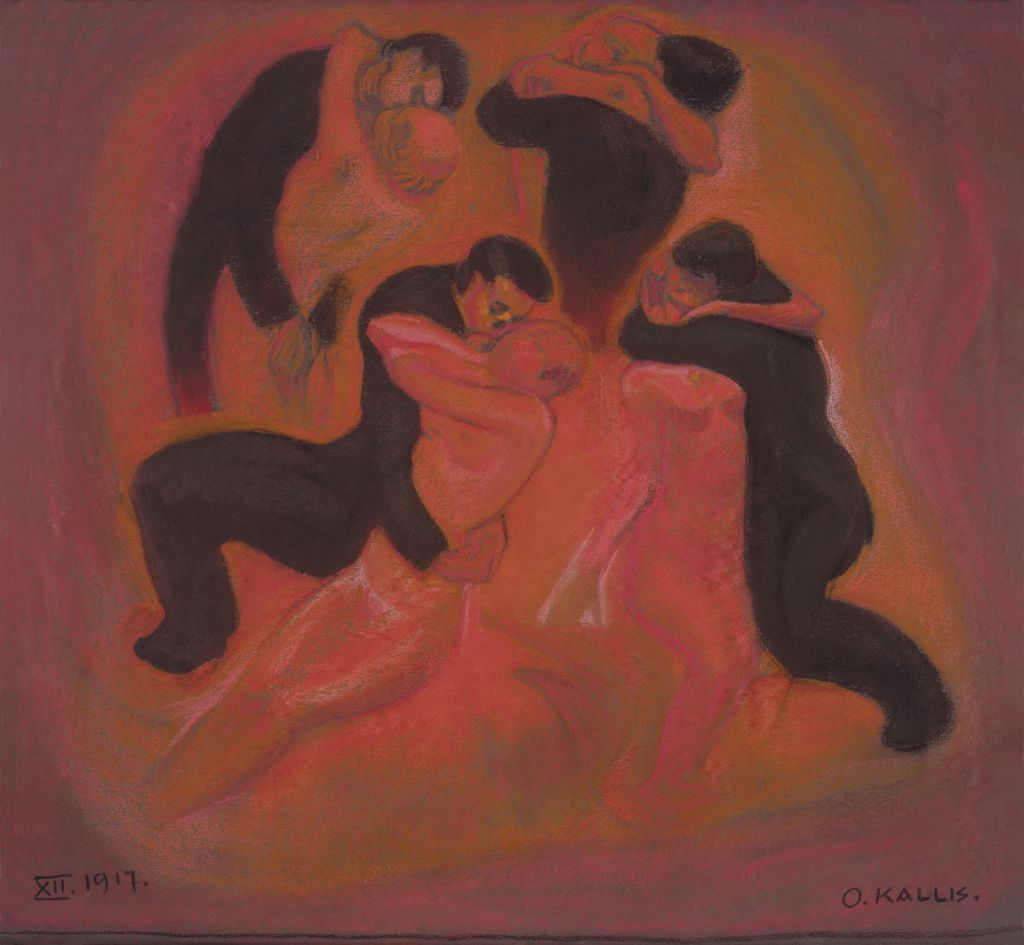
The flags, mostly turquoise and bright yellow, gave the cemetery a charmingly athletic air. Thousands of flags with a utopian energy, big ones and little ones. It was like that all over the place, wherever there were flags out. In cemeteries, at memorials, by monuments. Death inside a youthful, hopeful frame. There were red and black flags, too, but they weren’t the kind of superficial Westerners who took these symbols the wrong way.
Like a zombie, Iti roamed around Lychakiv Cemetery on the Field of Mars. Before the Great War, people had sunbathed and had picnics on the lawn here. It had been an Austrian military cemetery before the big war started, she was told, and then a memorial to the Red Army, but then the bones of the Red Army soldiers had to be moved because the old grounds no longer had enough space for those who had fallen in the new war.
She took a picture on her phone and looked at the face. Senior Lieutenant Ilona Orlova, fallen in battle at thirty. And thirty-year-old Natalya, nicknamed Vitaminka. I wonder if she was Vitaminka because she was a medic, or because of a joke with her comrades on the front?
Uniforms make things tricky, you could see that. Not everyone can break free of them. You can explore Merleau-Ponty or evidentialism in different languages, but as soon as you put on a uniform, you’re clumsy, simple, even needy somehow. Iti imagined her loved ones wearing mottled uniforms. Some of them had been in uniform at some point, even the Soviet one, or an Estonian, Finnish, or Polish one, but most of the people she knew hadn’t been involved in military service at all, in many countries they didn’t have to any longer, and even when they did, they found a way of not having to.
There were some whose uniforms clung to them: mainly people with smooth, broad cheeks and broad chins. The uniform didn’t happily swallow up people with eyes that were more deeply piercing or narrower of face, or had hollow cheeks, though. Imagine putting a uniform on Schiele’s self-portrait? Juhan Liiv, Rilke, and Nietzsche would have retained an anxious look as well, despite their broad noses.
But some chubby man who’s spent his life doing nothing but brain work – no two ways about it, the uniform swallows him! It looked like Iti’s impression was unforgivably superficial.
People came, some brought a candle or fresh flowers to a grave, although most of the flowers were plastic – understandable, it was cold this time of year. Some visitors sat down on a bench next to a grave, lit up a cigarette and looked at the photograph of the deceased. A boy, dead before his twentieth birthday.
Wonder whether or not they want Estonian war tourists taking pictures of their loved ones? A complete stranger’s phone retaining a memory of your Maxim or Ihor, at sunset, in beautiful colours.
Three fresh graves had been dug in the hard, cold, light-brown soil; empty holes still. Three people from the Lviv region had been killed, identified, and their relatives informed; soon, they would be brought there.
How do you think about someone on the front line, there like Schrödinger’s cat, always having to be prepared to hear that they are actually already dead? Or with the stubborn, inevitable hope that nothing will happen?
If I’d known it was so cold here, I would have brought my woollen-lined mittens with me.
Sanna, Tom, Teele and Rainer also arrived at the fresh graves. They looked sympathetically at the windows of the apartment buildings, which looked on to the rapidly filling cemetery field. Drink coffee, watch funerals. Then the next funerals.
‘Is it getting quieter?’ Iti said. ‘It’ll be dark soon, let’s go and have something to eat.’
The night train was leaving at 12.12 a.m. and arriving in Kyiv at 7.02 a.m.
The waiting room was labelled VIP Salon and the entrance was forty hryvna, ninety euro cents. You could get coffee, chocolate, beer and brandy at the bar.
The poets threw their rucksacks on to the chairs and got their phones and computers out. Iti walked around the hall, one of the walls had a large screen on it showing a soap. It seemed to be Turkish; the sound wasn’t on. Nobody was really watching it anyway.
She ordered black tea and listened to the station announcements. Шановні пасажири. Dear passengers.
It was so similar to Polish. Szanowani pasażerowie.
Not that she knew Polish. A few phrases, some words. But it was a language that gave her erotic pleasure, took her back to her student years, when she had had a Polish boyfriend, two, in fact, but one was the main one and introduced her to the band Kult. She liked the Slavic languages west of Russian; they had a pleasantly different feel. As a Gretškina-era schoolchild, she began learning Russian in the first grade, with meaningless words such as фартук and халат to make the alphabet clear, and then Russian became the default Slavic language. When she then saw that many of the Slavic languages, even the Eastern Slavic ones, were quite different, the shift made them charming.
She listened to the announcements of the arriving and departing trains. Who wouldn’t love railway station news: modern classics. Шановні пасажири. Language is a time machine, she thought; a small distraction is a time machine, too.
Rainer had also come to the bar to order tea and smiled at Iti because he realized they were both listening to the station announcements. He asked, ‘Do you know where the word шановні comes from? The root, I mean?’
‘Um, that … shan …? I think …’ Where the hell was it from, Iti had no idea either. She googled. The Polish dictionary told her it was from the German word schonen. Like Dach is roof in Polish and Ukrainian. Those bloody Germanics.
Rainer, yes, he was well-versed in languages. He even wrote poetry about language, but when he wrote poetry about other things, it had a good level of absurdity to it. He had witty children’s stories about lice, moths and café pigeons, so maybe he’d appeal to Ukrainian children.
She took a sachet of black tea and looked at her colleagues.
When even Lithuanians were reading their poetry in Ukraine, Estonians couldn’t allow themselves be outdone. And they weren’t. Then again, what do the Baltics have to say to Ukrainian poets anyway? More than the Dutch, perhaps, but they’re still sitting comfortably, despite their geopolitical anguish. Let’s talk about how we feel sorry for Ukrainians from our warm apartments and mentally stick it to the rampaging rulers. Because if our hearts weren’t aching in our warm apartments or we weren’t sticking it to the rulers, it would be a bloody sorry story. And then Teele can read to you about her climate anxieties and clear-cut forestland and the traumas of laying hens. Meanwhile, here in Ukraine, flaming pieces of a broken drone fall on the roof of a henhouse and hens that have already lived an unhappy life squawk: white feathers, blood and fire. Sanna half-reads, half-chants about how poets menstruate in the face of dazed old men, great, but who cares if poets menstruate under bombs as well. She didn’t want to think about her own poetry. Observations of the Champagne Socialist: Oh, my conscience is so fat, tra-la-la, yeah-yeah-yeah. What’s it all about, what is she trying to say: no one understands the existential issues of the bourgeoisie right now.
But anyway, they’re going to Kyiv, they’re going to Bucha, Irpin, Chernihiv – and maybe they’d write something completely new this week, gather creatively fertile material about the suffering of others. They can read it aloud at the Lviv festival.
Estonian children’s books for the school children of Chernihiv, oh yes. Oh, I’m sure they’re short of those there.
A Ukrainian poet had told her how a Norwegian poet had read about their own little ecological concerns at the festival, and then she thought about the dam in Kakhovka that the Russians had blown up. No, she didn’t want to be disparaging about a colleague. Just that –
If you write about nursery porridge or fridge magnets here, it’s something else. If you write about the smell of your blood here, it’s something else.
We EU people, though – even our attempts to shock are homely, our provocations, our transgressions are kind of sweet, because there is no artistic transgression in wartime!
Damn it, she thought. There’s nothing wrong with a poet not being a fool. We’re not fools. We’re here! Byrons of the new era, or well, no, not really.
Sanna’s brother Tom, a photographer, had come along with them specifically to take photos, for his own business and not with any Cultural Endowment funding.
Attention! Air raid alert! Proceed to the nearest shelter! Don’t be careless! Your overconfidence is your weakness!
The expressions on the faces of the people in the VIP room did not change.
‘Ooohh,’ said Teele, fiddling with her phone. ‘I’ve already set up this app for Kyiv.’
‘I think there’s an air raid there every night,’ Tom said.
‘That’s Mark Hamill,’ Iti said. ‘That guy, who, um, was in Star Wars.’
‘Luke Skywalker?’ Tom said.
‘That’s him. I’ve started to think better of Star Wars,’ Iti said. ‘You never know how life will turn out. I used to have a Ukrainian-speaking woman on the air alarm app, I liked it more, it was for language learning.’
Pronouncing it as carefully as she could, she said, ‘Увага! Повітряна тривога! Пройдіть найближче укриття!’ Attention! Air raid alert. Go to the nearest shelter.
Teele looked up from her phone and gave a sneaky grin.
‘My parents don’t even know I’m in Ukraine. We were chatting just now.’
‘Hey, I even told my partner I’m in Poland,’ Sanna said.
‘I didn’t tell my mum either; she wouldn’t sleep a wink the whole time,’ Rainer said.
Iti said, ‘My mum knows, she’s ordered lard.’
And they all roared with appreciative laughter, and Iti was pleased.
It was a blue train that looked like a train, not a space shuttle. They walked wearily towards the sleeping carriage because they didn’t have sleeping compartment tickets; those sold out quickly here. You paid very little; you could travel nearly six hundred kilometres for seven euros. The carriage was hot and quiet, several people were playing cards in silence, and some were staring at their phones. Lots of people were already asleep – the train came from Uzhhorod. They climbed into their bunks with only a souvenir bottle of Medovukha.
Oh, and Iti also had a bag of cashew nuts bought in Poland, light green. She tore the bag open and offered them to the others, but nobody except Rainer took any.
She bit into a nut. Oh no. Ew.
‘Fuck!’ Iti whispered, and the girls went, ‘Shhh, people are sleeping here, shhh.’
‘Rainer, were your cashews okay?’
‘No.’
‘Ah! Jesus!’
‘What’s up?’ Teele asked.
‘There are moths in these, nesting in the cashews! There’s some kind of white fucking moth web wrapped around everything. I’ve already swallowed some.’
‘Euuuugh!’ said Sanna.
‘Pass me that Medovukha, Tom. Mmm, great.’
‘You washing it down with that?’ Tom asked.
‘No, I’m doing an experiment. How to accelerate the multiplication of cells with alcohol, moth metastasis.’
‘Oh no!’
‘Let’s see if it makes the baby moths develop faster … from egg to caterpillar, from caterpillar to pupa … boom!’ Iti opened her mouth into a gawp.
Rainer sniggered.
‘Shhh, people are sleeping!’ the girls said.
‘Look, the next time I open my mouth, a kaleidoscope of butterflies will flutter out! Let’s have another sip. You want some, Tom? And now, flutter-flutter!’
‘Shhh, quiet!’
The train was overheated. Iti thought she was being clever and quick, dashing into the toilet at the start of the journey, pulling on leggings and a thin T-shirt, but it was still hot. Especially on the top bunk. The blanket she’d taken from the third shelf made no sense, even the white sheets were too much. Still, you had to have something around you; you couldn’t relax otherwise.
A socket, a socket. Without getting flustered, Iti found one behind the pillow. Phone charging, headphones on. The right Spotify playlist.
Her colleagues wrapped themselves in blankets and sheets and turned their faces towards the wall, but Iti swung on to her back on the bunk and mumbled to herself. She tried not to mumble too loudly.
Я хотів би сказать I would like to say
Вова, їбаш їх, блять! Vova, fuck them, fuck them!
Я хотів би сказать I would like to say
Вова, їбаш, їбаш їх, блять! Vova, fuck them, fuck them!
А ми тобі будем помагать! And we’ll help you!
Oh, she would have liked everyone to hear this, at least her colleagues. Musli UA, what a band! The singer was the manager of the football club who had initially opposed Zelenskyy but later declared that he would give his life for the president.
Їбаш, їбаш їх, блять!
А ми тобі будем помагать!
Iti punched the air, first in one direction, then the other – just as long as it wasn’t against the wall.
She was so happy! A swig of water, Morshynska mineral water, no need for alcohol; it was a frenzy that raged on its own.
It was a wonderful, powerful feeling, being at the right time in the right place. At a shite time in the right place, right, right!
Dear, dear colleagues, now on the night train to Kyiv, dear, dear, wonderful local colleagues, with whom they stand in solidarity!
Shite time, right place, їбаш, їбаш їх, блять!
Religious people felt that kind of radiant satisfaction when they believed they believed steadfastly in something. The high of conviction! Wild!
Я кайфую, я кайфую! I’m on a high, I’m on a high. That was Musli UA’s next song, also really amazing. A text by a journalist, Lesya something, about how he would be on a high at Putin’s funeral. Or something along those lines.
Я кайфую, кай-кайфую!
If she were a soldier, she wouldn’t need to take speed, she’d be able to keep going on mineral water, in a stifling train between the sheets.
Impossible to sleep. But maybe there was no need to; she felt so hyper. Я кайфую, я кайфую, fuck, still should, though.
Sleeeep. She turned off the music and roaming. And then she turned the roaming back on because no sleep was coming, but suddenly the phone network was faint, no more connections, just one bar, and then that went too.
Gentle snoring from the bunks, but only gentle. Were her colleagues really asleep, or just trying to stay motionless?
She looked at Teele’s pink handbag, frayed at the edges. The artificial leather underlay was mercilessly exposed. Teele wore those Eskimo-like chunky laced booties. Not chic bootlaces, but with Eskimo laces, once white, but now vaguely sheepskin coloured. Teele was a lovely person with a beautiful marten-like face, but she could have found slightly nicer accessories. Rainer could have taken his black coat instead of his brown jacket, for God’s sake. In Iti’s imagination, the Estonians could have made a lasting impression in Ukraine: mm, shining, glittering, dazzling with their style! Could have, that is.
She turned to face the wall, then turned back to the open space, on her left side. On her stomach, on her back. Я кайфую, я кайфую.
When sleepiness finally began to creep up on her, a man walked through the carriage and bellowed: ‘Доброго ранку, доброго ранку! Кава? Чай?’ Good morning, good morning! Coffee? Tea?
Outside, the light was greenish-blue, then greyish-pink. Kyiv. Industrial daybreak, nothing cosy about it.
The taxi driver took the five of them in a small car. Iti tried to utter some kind of hybrid language that wasn’t proper Ukrainian but was no longer Russian either. But the taxi driver spoke blatant Russian. Shamelessly, just with h sounds instead of g sounds.
‘Ну, эстонцы молодцы! Крутые ребята!’ Well, Estonians are great! Cool guys!
That’s right, Iti thought, why are you Estonians not coming here? Why go to Finland or Sweden when you can come to Ukraine? There’s solidarity here, there’s strange and great history here, there’s psychotherapy here.
Hotel Ukraina, Institute Street, Street of the Hundred Heavenly Heroes. But do they know the hotel used to be called Moskva? Imagine, Moscow sprawling out in the centre of Kyiv. Oh, when was it built? Um, in the sixties, 1961.
‘So, Hotel Viru in Tallinn is ten years newer,’ Rainer said.
‘Looks like it,’ said Sanna.
They couldn’t get into the hotel rooms with a view of Maidan from the tenth floor that early, but they could have breakfast in the second-floor restaurant, and, exotically enough, the food offering also included marinated tomatoes, which were a bit too vinegary. Iti was completely sleep deprived. They were all sleep deprived, the morning-grey Maidan was visible from the window, the pink sun had disappeared and a van with a Norwegian plate in military colours passed the hotel. Iti felt overflowing joy as she ate her boiled egg. Now they were here, they really were! Should she be ashamed of the emotion?
A black Mercedes, a V-class Merc with white leather seats and a mirror roof, drove them around Kyiv, Irpin, Bucha, and Borodyanka. The driver was a Ukrainian-speaking, bearded man with fine facial features from Your Driver Company. Everyone here was Ukrainian-speaking now, in fact, the cityscape was Ukrainian-speaking. The old taxi driver had been something of an exception.
Ahead of them drove PEN Ukraine’s white van, already slightly rusty. Write to Exist.
The people at PEN were truly charming. What would the word for that be in Estonian? Sweet, grazioso. How can they be so sweet and young, so fresh-faced and intelligent! Was it chauvinistic to wonder? To think that she wouldn’t have expected it, but they’re so refined and young and intelligent here! Would she have been amazed if the literati in Germany had been so intelligent and refined and at the same time so young and beautiful – if they had been, that is.
They had to spend some time walking around Bucha church until the EU Parliament delegates had finished their tour. Inside was an exhibition of press photos: the bodies of those murdered in Bucha and their exhumation. The noses of the dead were black.
‘Those are the milder versions,’ a tall cleric told Iti. From somewhere inside his long robe, he took out a phone and showed her the photos that weren’t shown in public because of the foreign visitors and children. The images on his phone showed red, half-burnt, darkened body parts, decayed wounds on naked bodies.
They must have been the people whose names Iti had photographed on the large memorial wall near the church, quite randomly, not recognizing any of the names. The fact of someone’s existence and their horrible death was stored on her phone. It didn’t give the deceased a pass to eternity, but now they were there, in yet another stranger’s phone memory. Also an existence.
As they travelled around, Iti tried to get an emotional handle on what had happened, the traces of the terrible events, the facts. She was terribly tired, they were all tired and serious, they took pictures, charming Maksym talked, explained. It seemed that Bucha and Irpin were comparable to Kyiv, a bit like Tabasalu and Viimsi were in relation to Tallinn. Borodyanka was considerably poorer.
Bullet holes in the walls, apartments bombed to bits, with wide-striped pale wallpaper, a house shot in half by a tank barrel.
How could anyone grasp the feeling of what it really was like? Take your loved ones, make them sit in the kitchen or on that beige sofa that’s now a mess. First, there’s a person, and then they’re mush. It seemed wildly important to her, right now, that she could feel it more acutely – the hideous, corrosive regret, the incredible horror. Since she was already here, she had to access the trauma, through shocking impressions, that would be right. Isn’t she capable of more than anger and rational compassion? She needed some proper, affective meditation work. Iti tried to concentrate. Someone had once looked out of those windows.
Tom and Sanna appeared at Iti’s side.
‘That big colourful teddy bear was here,’ said Tom. ‘Blue. Green.’
Iti sighed. ‘Yeah.’
‘I guess it was put there for people like us.’
‘Felt that way to me, too,’ Iti said.
‘I took a picture of it anyway,’ Sanna said.
‘Of course,’ Iti said. ‘So did I. And of the Banksy.’
‘Sure.’
There was a sign next to Banksy’s graffiti of David and Goliath, saying it belonged to the city of Borodyanka. And that the glass booth around it was alarmed. Alarmed, in the middle of ruins.
PEN took them out to eat at one of the first restaurants to reopen in Bucha after the massacre. There was a statue of a frog outside it.
They climbed out of their baroque Mercedes. Iti talked to the bus driver in English to start with, saying, come along, we’re going to eat, they say the food’s very good, borscht and pierogi. Then, in Russian, what did it matter. The driver smiled, shook his head and replied in Ukrainian that he wasn’t hungry, thanks. He was a quiet, smiling man, but maybe already over sixty, so military service was no longer a threat. University lecturers weren’t at risk either.
On the way back, Iti started writing a postcard to a friend that she’d bought in the Sensi bookstore in Khreshchatyk. Хуй вам, а не Київ. Screw you, not Kyiv. She fell asleep in the passenger seat beside the bearded man.
The breakfast of marinated tomatoes, we’ll eat them up again.
Iti galloped energetically down the stairs to the columned foyer, its white, shiny floor covered with red carpets. Then up a second staircase again … but what? Teele, Sanna, Tom and Rainer were climbing out of a hole under the main staircase. White blankets under their arms.
‘What the hell. Morning!’
‘There was a heightened air alert,’ said Sanna, looking at Iti with indignant incomprehension.
‘Oh, right’. Iti wondered whether to hide her snigger.
‘You were sleeping in the room upstairs, right?’ asked Tom.
‘Well yes. I slept well, too, the rooms here are perfectly cold. When it started getting light, there was this sudden loud bang, an anti-aircraft gun.’
‘And Tetyana in Lviv told us to always go to a shelter if there’s a raid when we’re in Kyiv,’ said Teele.
‘She did, she did. I mean, when was the last time anyone in Kyiv was killed. It hasn’t happened in a good while, for a few months, I don’t remember.’
On Khreshchatyk Street, maybe 700-800 metres away, was the location of Klitschko’s city government. Across the street was the Trade Unions Building, the burnt top of which Iti had photographed in the Maidan spring. Right behind them, a kilometre away, were Mariinskyi Park, the Ukrainian Parliament, and Zelenskyy’s residence. Bombing this district would have meant a world war. Of course, the Kremlin could have been set on fire in retaliation.
‘I wouldn’t want to die for anything,’ Tom said.
‘Me neither,’ said Rainer.
‘Oh, by the way’ said Iti, Terevisioon called. Do we want to talk about our trip tomorrow morning at 7.50 a.m. On Skype.’
‘Oh, right. But we have to leave for, um, Chernihiv at 7.30 a.m.’
‘Well, that’s a bummer. I won’t be coming then. Kuku Raadio rang, too, they want an interview as well.’
‘You’ll miss the event completely then.’
‘Well, a promo for a big event.’
The person from the network had suggested that either Iti or another of them could talk. Which of them could? Well, Teele Sibul comes across very convincingly in the media? Hm, does she really? Iti had promised to check with her colleagues, and then ten minutes later, having had a shower, sent a message that in any case, she had to take on the responsibility. To perform, to perform herself, to keep her head high in front of the camera, if at all possible. It was a habit of hers she couldn’t stand. She felt awfully sorry about the school in Chernihiv, a city that had been razed to the ground.
‘Yes, and you’ll have to perform for the children without me. But today we’ve basically got a day off!’
Musafir, the Crimean Tatar restaurant that the PEN people had recommended, was packed almost to bursting. People stepping in from the cold twilight had to wait ten minutes for a table. The Crimean Tatar theme was the draw. They did lentil soup, dumplings called manti with potatoes, lamb and chicken shashlik, a Genghis Khan kebab and meat salad with coriander. Again, Iti wondered at how little her colleagues ate. In the old days, poets had been hungry, they ate the last of your tinned goods and stale olives and drank, drank, drank. Now Iti, who had only ordered lentil soup and chicken shashlik herself, had to eat half of Sanna’s lamb shashlik, a quarter of Teele’s potato dumplings, and one of Genghis Khan’s kebab rolls. Only Tom finished his bidet, no, pide, a massive meat pie, all by himself. Iti looked at him appreciatively, like a good person who responded to the world with gusto. The food was very nice, and the Kolonist wine went well with it.
‘You know what, I feel like a well-fed bird that can no longer get out of the birdhouse,’ Iti said.
‘I reckon you’ll manage,’ Rainer said.
‘If I do, I’ll circle around the city and not immediately head back to the hotel. There is still time until the air alert.’
‘Air alert?’
‘Fuck, I meant curfew. You can’t tell if there’ll be an air alert.’
‘You can. It’ll happen,’ said Sanna.
And they all walked on, along Bohdan Khmelnitsky Street towards the beige-and-green opera house, looking at the posters, Carmen, La Sylphide, Le Corsair. I wonder what kind of opera Natalka Poltavka is, Mykola Lysenko? But they’ll have already left Kyiv by then.
Seeing Ivan Franko Street, they turned on to it, not knowing what awaited them there. It led to Shevchenko Avenue, Schevchenko prospect.
‘Poets on the Poets’ Prospekts,’ said Iti.
‘Yay!’ said Rainer.
‘Who knows, maybe one of you will get your own street one day,’ said Tom.
‘Oh definitely,’ said Sanna.
St Volodymyr’s Cathedral, the big Hilton glowing blue. Was that where the EU Parliament delegates stayed?
‘We’re 2.8 kilometres from the hotel, I checked,’ said Sanna.
‘Not far then,’ said Iti. ‘Wait, let’s turn on to this street. I wanted to take a look, I think you can see … You can see the station from here, yes?’
‘Symon Petliura, who was he?’ asked Rainer.
‘Um, a Cossack?’
But just there, on the right side of the road, the nose of a red-and-white car looked out from the side of a house. A two-tone car, optimistically cubic.
‘Caribbean Club, ooh, get that!’
‘You heard of it?’
‘No, but look: Night Club! The ice is starting to shift!’
Well, well, Astor Piazzolla’s ‘Libertango’.
Pa-ram-pam-pam-pam-parap!
Iti hummed loudly; Rainer nodded in time.
Tom returned from the bar with a bottle of red wine, mmm, Odessa Black. He was followed by a waiter bearing a tray with five glasses.
‘Oh my, people have certainly dressed up,’ said Sanna.
Yes. They had, at least some of them. Little red dress, black suit. Some even had simply a white sweatshirt or a striped sailor’s shirt. The women, though, all wore skirts or dresses.
‘Well, будьмо! Cheers!’ Iti shouted and raised her glass.
Cheers! Cheers! Kumbaya!
A few curious glances from the tables beside them. At least a few.
The Piazzolla came to an end and the dancers stopped.
‘Oh, listen, yeah!’ Iti moved her wine glass carefully to the rhythm of the tango. ‘This is the mother of all tangos. At least to the uninitiated!’
‘Only girls in jazz?’ asked Tom.
‘”La Cumparsita”,’ said Teele softly.
‘Wow, you actually know! You know the names!’
‘Go and dance, then,’ Sanna muttered wryly.
‘I did quite enough dancing as a kid, I’m not doing any more,’ said Teele.
‘If you snooze, you’ll lose out on the tunes!’ said Iti. ‘Rainer! Would you dance with the bride?’
‘No, I can’t. The people over there look like complete … experts?’
‘The honour of our table must be saved! Rainer! Tom! Sanna!’
Rainer shook his head.
Iti got up, strode like a semi-lunatic up to Tom and bowed like a small boy at a school dance.
Yam-pam-pamp-pam.
‘Oh, you two are crazy!’ Sanna shook her head.
Yeah! Pam-pam-pam-pam, parapa-para! Yam-pam-pam-pam!
Neither of them could dance tango. They turned their heads with a theatrical stiffness, yam-pam, and moved, hands stretched out ready to attack, across the floor. They descended from one knee to the next, slid their feet along the parquet, with a large arch. Iti was surprised at how nonchalant and flexible her dance partner was, an intelligent man who let himself be led. Not that Iti had any way of leading the whole thing other than farcically.
She began to enjoy the situation. Tom’s warm back under her hand. A warm, living hand, now under her paw, but otherwise, morally, not her territory at all, ahh. She put her hand more tightly around her partner, drawing their bodies together, it was irony, an ironic tightness.
Real hormonal food. Who could have seen that coming!
No one, that’s who, but here it was now: a warm, new body against her, sparking her imagination.
And Iti thought about how chaste her imaginings had been all her life! She used to think about the man’s back, shoulders, cheekbones, and neck. What about his dick, how often did she think about that when she’d been having fun with someone? Very little, very little indeed! Shoulders, hands, hips, thighs, smell, eyes, but the dick, well, no. How much did she visualize it and how much was in her imagination as tactile, haptic? Lust, lust, lust, yet so fucking chaste!
At that moment, Tom twisted himself free and turned under Iti’s arm.
‘Lost the plot!’ Sanna murmured. She shook her head, laughed, and shook her head again.
Wham! Tom collided with a couple, oh yes, the little red dress and the dark-haired guy in the black suit. Didn’t make a face, just pulled away. Iti took a dramatic step backwards, and now it was her turn to bump into a couple. ‘Mm, sorry. Вибачте.’
Some of the dancers slowed down and stopped to look, some kept on dancing as if nothing had happened.
It suddenly dawned on Iti that all the others there were really dedicated, flashing with their legs, swish swish, watch, watch. Well, whatever. We have our own vision of tango!
Her upper body tilted backwards as if she were going to make a bridge. Her body walking back and forth in a circle. Going full punk. Another tango had already started playing, it was no longer ‘La Cumparsita’. Tom giggled and slightly imitated the movement by arching his upper body, albeit to a much lesser extent. Nothing connects people more than a stupid dance! Iti took a decisive long step towards Tom, and she landed on the toes of a dancer in a sailor shirt. The couple looked at them as if they were Martians. Iti shrugged her shoulders in a tango rhythm. Whatever, we’re skanking, we’re robots, everyone has the right to dance for fun! She rushed dramatically to their table, put a long, foamy spoon between her teeth, with which someone (Rainer?) must have stirred their latte, and tried to pass the spoon to Tom with her mouth. The spoon fell on the floor; a blonde girl gave a jump. Iti once again took on a more intimate pose with Tom and wanted to trample with him across the stage at a belligerent pace, when a woman, a skinny creature with dark-red hair, maybe ten years older than Iti, approached them in high heels.
‘Excuse me! Excuse me.’
She tapped Iti on the shoulder.
‘I’m sorry, but this is a tango evening. I need people to stay in the logic of tango.’
Several couples had stopped dancing, but a few carried on.
‘Okay, okay, okay’ Iti smiled at the woman. ‘Okay, Вибачте нас, ми не yміємо … не вміємо танцювати. Excuse us, we can’t, we can’t dance.’ She began sniggering helplessly, ‘I can’t dance, you know, like Phil Collins once sang. I can’t dance! Sorry, really.’
‘Didn’t want to ruin your evening,’ said Tom.
The woman nodded. Iti raised a hand in farewell, and they returned to their table.
‘Oh you Judas, heh heh.’
‘You two were totally crazy,’ Sanna shook her head.
‘And so what’
‘They’re offended. Hey, maybe they’re right, I might have been, too, in their shoes. Some slutty people came in.’
‘Being slutty can be very agreeable,’ said Tom, and Iti flashed a glance at him.
‘Oh well,’ she said, ‘we’re alive. But we didn’t make anyone else look stupid, just ourselves.’
Teele said, ‘I’ve also been thinking about this kind of dance. I was forced to do folk dancing when I was a kid. Otherwise, none of us, and maybe not me either, can dance like that any more. Even so, we can go and make some moves.’
‘Dance belongs to the people!’
‘Yes, dance belongs to everyone. Like words or sounds. But when I see someone who’s really good at dancing, I wonder, do good dancers feel like the people who are flailing around cluelessly are like someone bashing piano keys? That it’s absolutely unbearable?’
‘Don’t people have the right to be an amateur? Where can you be an amateur in a democratic world?’
‘It was creative dance, you know,’ Tom said. ‘Freestyle.’
‘No, but it’s like when someone comes onstage to read a poem,’ said Sanna, ‘someone who’s a total enthusiast, and then just won’t leave. We also think it spoils the whole event, don’t we?’
‘Oh, I don’t know,’ Rainer said and squinted analytically.
‘There is a cabbage without hair!’ Iti quoted in a hollow voice, at which Tom sneered, and Iti waved him away. In the meantime, the others had almost finished their wine, and Iti emptied the final drops in her glass.
‘Hello. Where are you from?’
A man in a sailor shirt stood at their table holding a wine glass. Somehow, it seemed odd for a man in Ukraine in a sailor shirt to be holding wine rather than beer. But then it was tango after all. The man asked if he could join them.
‘Oh, Estonia, Estonians are tough. You’re awesome.’
The poets smiled.
‘Дякую, дякуємо, thank you, you’re awesome.’ Iti raised her almost-empty glass, at which the man went and got a new bottle, even though it was already 10.30 p.m.
‘We have tango evenings here,’ he said. ‘Every month. People come, practise. Take courses, and some practise at home with YouTube. It’s a big thing for us.’
‘Yes, yes, of course.’
‘Sorry that we messed things up with our freestyling,’ Tom said.
The man waved it away. ‘Oh, no problem.’
Iti tried to decide how old he was. Fifty-two, -three, -five? Definitely under sixty. Not on the front line, danced tango, and drank wine. Important job, large family, sole carer of sick parents? A health issue that wasn’t visible?
Where did this stupid habit come from of wondering why a man is not on the front line? It’s stupid.
His name was Danylo and he was head of purchasing at a fruit company. And what were they doing in Kyiv? Well, they were poets, what could you do?
‘Yes, we are, apart from him,’ said Sanna, yanking Tom’s wrist.
‘Oh, poets, nearly all of you! And I thought you were on vacation in Kyiv, it’s a comfortable place to rest, isn’t it? But really, it’s powerful that you’re here, we appreciate it. We appreciate it.’
‘Seeing as we don’t dance tango,’ said Tom.
A very dainty girl in a dark-blue dress came up to Danylo. She was like a model. Olena. Olena said they needed to leave; they had a long way to go. She was about to take a taxi. She said it first in Ukrainian, then in English. Olena was another of these beautiful people. Why are people so beautiful? Iti looked at Tom; Sanna was now holding her brother around the shoulders.
‘Oh, so you’re going to Chernihiv tomorrow, very good,’ Danylo said.
‘I’m not,’ said Iti. ‘Unfortunately, I’ve got to do a TV interview at some godawful hour – basically at dawn.’
‘We’re leaving crazy early, too,’ said Sanna.
‘This place is about to close,’ Olena said. ‘Most places close at eleven, so that people get home by the midnight curfew.’
Almost as soon as they were outside, the sirens went off.
‘Your overconfidence is your weakness,’ Mark Hamill said on the telephone. The roaming was still on.
‘The usual evening routine,’ Danylo said. ‘Are you already used to it?’
Although the traffic had thinned out, the cars that were there drove fast. Very fast.
‘You won’t all fit in one taxi,’ Danylo commented, and Iti offered to walk, it was about two kilometres, and the drones wouldn’t strike Khreshchatyk. But the girls had already ordered two taxis, and she was put in a Mitsubishi with Rainer.
Again, people were taking mattresses and blankets down into the cellar.
‘Right.’ Iti stood at the bar, deciding what to buy with her cash – now the only option – another glass of wine or just a bottle of water.
‘Quite right, that’s what upstanding citizens do.’
‘You’re still sleeping upstairs, right?’
‘Well, yes, to be honest. I want to rest properly, as I have to look more or less presentable tomorrow. The computer camera could make me look like a complete Chomsky if I flake out.’
‘Eh?’
‘A zombie. One water, please!’
She opened the Morshynska bottle. If she kept drinking wine, she’d definitely be a Chomsky.
Sanna nodded. ‘It’s actually good that the likes of us can’t do the nightlife properly. Good for the gods of health!’
‘I’ve thought that, too,’ said Iti. ‘The massive plus of curfews. If I could just apply it to myself back home.’
‘But we’ll see each other at breakfast tomorrow?’
Teele had headphones around her neck and a white blanket under one arm.
‘Yeah, I’ll try and be there. You’re setting off about the same time as I have that silly interview.’
The lift was working, even though it shouldn’t have been; you weren’t allowed to use the lift during air alerts. The thought didn’t cross her mind until she’d reached the tenth floor.
She opened the balcony door once more; outside was blue and cold, St Sophia’s Cathedral was still illuminated. She stepped on to the balcony, which sloped outwards slightly, looking at the quiet Maidan. No anti-aircraft guns could be heard.
Take a melatonin, long-acting, and be up right on time for a quarter to eight.
But sleep didn’t seem to want to come between the white sheets. She thought about how that warm shirt had felt under her hands. What kind of fabric was it? Something very smooth. The warmth and sinews that lay underneath it. She should have been thinking through tomorrow’s interview, as interviews only succeed when you say what you want to say rather than answering the journalist’s questions. But she slid her hand over her body. Uwaga. Your overconfidence is your weakness.
Damn! No time left to eat now, so what can she do? Maybe she can get herself something in between the two interviews. The others have already left. Argh, twenty minutes, brushing her teeth while taking a dump, hair wash, the sachet of hotel shampoo won’t open, gah, fuck, well, dry hair, now clothes, clothes!
But what kind of clothes? A khaki shirt to echo Zelenskyy? An intellectual black jumper with a rollneck? A burgundy jacket on top of a khaki shirt to make a more respectable impression? She took the Ukrainian Defence Forces’ supporter badge off her jumper, put it on the jacket, took it off. Pinned the light-blue brooch of PEN Ukraine on the jacket instead, took it off. Let’s have a flag, then. Blue-yellow and blue-black-white, from the market for three euros. She stuck the metal badge on the jumper, took it off. That left a khaki shirt without a jacket, and with the PEN badge.
When appearing on screen, you need to make some kind of effort for it to work. Make sure your face doesn’t shine. The camera turns a human into a mummy anyway.
Interview, oh, interview, why do you always leave that hangover taste in my mouth? And, as always, the way it’s been her whole life, feeling like she’s pathetically throwing out the ballast: anxious, abundant ballast. Speak slower, she tells herself, you don’t even know what to say; think, but don’t say, maybe the conversation would be more human that way. But she had to babble on like a fool. She needed to show that, um, hopefully, we also have something to say in this context, our experience is quite different: we’re coddled, the world’s failure is hypothetical for us, but they experience it here every day. She had also tried to do a live reality-performance: do you hear the sirens? The air-raid alarm just ended, and now another one. A proper bang went off just now, as if a huge gong had been beaten. Did you hear that? Not much could be heard at the other end of the Skype call, and running to the balcony with a computer would have been too dramatic. Interview, oh interview, why should you succeed at all?
The piece with Kuku Raadio turned out better, though, because her voice had already grunted its way awake, and between the two interviews, she had also managed to sleep for an hour and a half. She had sacrificed breakfast to sink into a therapeutic stupor, half-asleep, half-awake, thinking about yesterday’s dance. By now, the marinated tomatoes had long been cleared away.
But sushi. Once upon a time, there were a lot of sushi places around here, you know, maybe there still were. That was what she was going to go and eat now, cream cheese sushi, with no one to see. A hybrid with baked salmon that the Japanese wouldn’t consider sushi. She deserved a little time to eat after her half-celebratory interviews.
She put on her black woollen sweater, threw a coat on top, and was just opening the hotel room door when the phone rang. A Ukrainian number.
‘Yes, hello?’
A male voice asked in English if she was Iti H.
‘Yes.’
He said he was calling from Your Driver Company and asked where she was now.
‘Ah, well, I’m at the hotel still, Hotel Ukraina.’
‘Right, you weren’t on the excursion.’
He said he had very bad news. Dreadful news. It was already on TV, had Iti not seen? Their Mercedes had been struck by a missile.
‘That’s impossible,’ Iti said blankly.
‘Unfortunately not,’ he said.
‘What? Er …’
‘An Iskander, apparently.’
‘Where?’ Iti asked.
‘Not that far away from where you are. On the border with Lukyanivka. The police will be in touch with you.’
‘I,’ Iti stammered, ‘I – was your driver killed, I’m sorry to hear that, I –’
She didn’t understand whether he broke off the call or she herself pulled away.
It was impossible, it was such a small miscalculation that it had to be rewound somehow. She picked up the TV remote. Kyiv was on the news: the fire department, people in hi-vis vests, a deep hole in the asphalt, and the entrance to the metro station caved in. Could that grey ruin have been the glossy black Merc a few hours ago? She couldn’t see Teele’s Eskimo boots anywhere.
She dialled Tom’s number. ‘This number is not in use.’ What the fucking hell.
Before she had time to ring Sanna’s number, the phone began vibrating, a call from an unknown number. A police officer began talking in formal English.
She slammed her fist against the wall and knew that she needed to scream now, right now, it was right that she screamed like an animal. She even opened her jaws wide: four-sided, hideous. Then she shut her mouth again. She closed her eyes and counted to four, maybe four seconds. One, two, three, four. When she opened her eyes again, the world was the same. A room with dark-red flooring and a pseudo-baroque chair. The world has the ability not to restore itself to the default settings. It was all fucked up.
Her phone vibrated again. An unknown number from Estonia. Listlessly, she tapped the green symbol.
‘Hello, is that Iti H? I’m calling from Aktuaalne Kaamera.’
Finger on the red dot. She’d go to the site. The sun had come out; the wings on the angel figure were gleaming.
The phone rang again and Iti picked up.
‘Hello? Are you listening? It’s me from Aktuaalne Kaamera here still.’
‘Yes,’ said Iti and cleared her throat. ‘I think you were cut off just now.’
Translated by Darcy Hurford
ABOUT THE AUTHOR
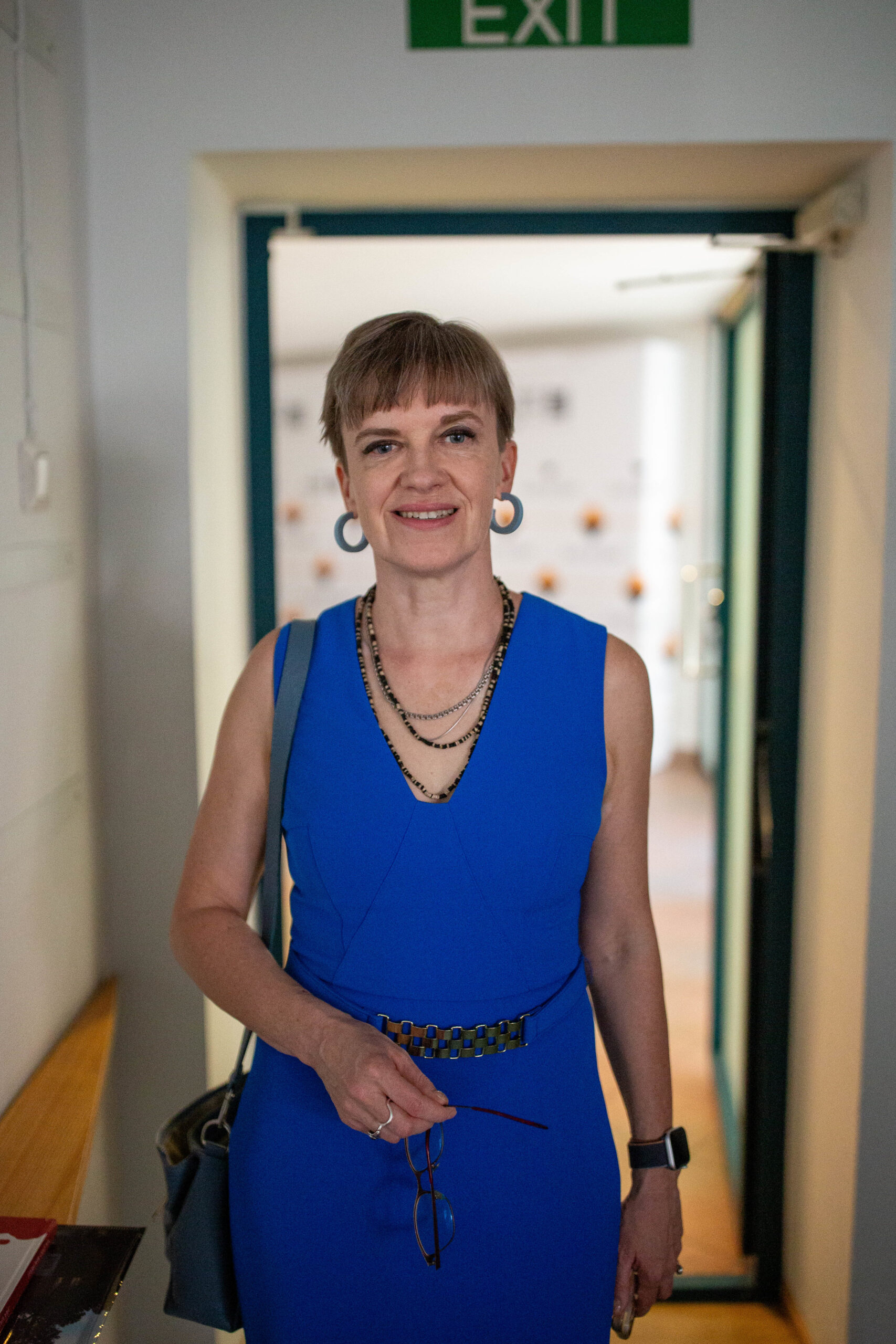
MAARJA KANGRO (born in 1973) came to the Estonian literary world as a translator of Umberto Eco, Andrea Zanzotto and Valerio Magrelli and became a poet somehow and somewhere through translating. After three collections of poetry Kangro has been drawn to prose, where she stays as witty and unexpected as in her poetry. For her short stories she has been awarded the prestigious Friedebert Tuglas Short Story Award in 2011 and in 2014. In April 2024, Maarja Kangro was elected the chair of the Estonian Writers´ Union.
More by Maarja Kangro in EstLit: Glass Noodles