
My partner is Estonian; my daughter speaks Estonian. I have been visiting Estonia at least once a year since 2010. Whenever I’m in an Estonian bookshop I go to the ‘Estonian Literature in Other Languages’ section. I usually find a few translations into English, one into French but no others – but I do discover names previously unknown to me.
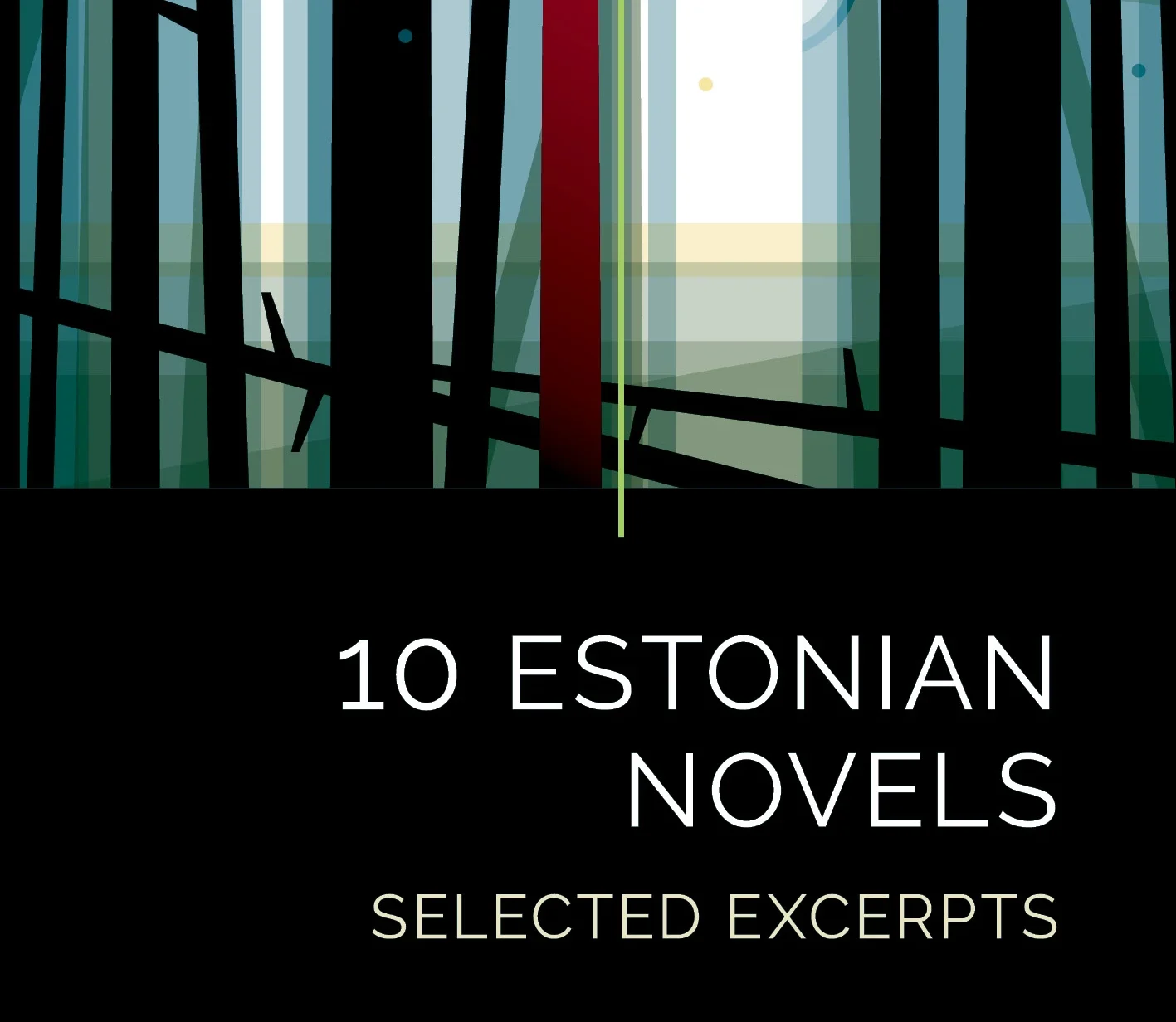
On one of those shelves my partner spotted 10 Estonian Novels: Selected Excerpts and bought it for me. It’s a thin book, black, published by the Estonian Literature Centre. I looked down the names (three female, seven male) and found that the majority of the books had been published in the previous five years. In some cases, I hadn’t read anything by that author; in others, I’d never even heard the name. I found new voices that I now treasure. I also tried to explore just what all the hype was about with some of those names – and I didn’t always go along with the received wisdom. I’m glad that I was unable to find any common denominator that linked the novels, other than the fact that they were all written in Estonian. Even though some themes fly from one book to another, I wasn’t able to group them into distinct clusters.
Each excerpt runs to around ten pages and gives a first impression of the novel. In the following paragraphs, I’ll offer my own thoughts.
Kuu teine pool (The Other Side of the Moon, 2023) by Urmas Vadi (b. 1973) is a humorous account of the difficulties of childhood. The narrator recalls a domineering mother prone to emotional blackmail, illness and being overly protective – and you cannot stop laughing. Neither can you deny the depths of the love described.
Vadi’s prose reminds me of Fernando Vallejo. The ability to revisit difficult memories without giving in to the temptation of sentimentality, while still making us laugh, is present in both authors – just like the capacity to follow the line of memory without losing the thread and, of course, how the impact of mental illness in a family is addressed.
I am also reminded of Natalia Ginzburg. Love goes beyond the clumsiness of everyday language. Mothers and fathers in every family make use of stock phrases, words and leitmotifs. And Vadi, just like Ginzburg, employs the parents’ clichés and habitual responses to tell the story, invoking their expressions along with their limitations – and the son’s opinion of them.
Klaaslaps (The Glass Child, 2016), by Maarja Kangro (b. 1973), is full of tension, and is a striking novel. Kangro’s capacity to keep up a steady rhythm is admirable, just like her ability to change the topic, register or mood abruptly. You keep wondering whether the text emerges from improvisation or from rigorous self-editing.
In the book of excerpts, the novel is introduced with a question: ‘What harrowing thoughts and emotions does a woman face when she finds out that the foetus she is carrying has no chance of survival?’ – and this book is the answer. The pace of the facts and the intermissions of ordinary life are present, as well as the landscape, the news and the atmosphere of the hospital and its characters. Kangro’s novel portrays the thoughts that – maybe – anyone might feel in a such difficult situation (full of rage, trivializing, in denial or ironically detached), while avoiding sentimentality or cliché. You have to admire the work of anyone writing about this subject – but, more than that, you admire someone who has the strength to write it, finish it and let people read it or offer an opinion. (PS Frankenstein’s monster surfaces as a metaphor for the narrator’s fragile access to ordinary life.)
I’m thankful when writers forge their own paths. The events in Punkti ümber (Around a Point, 2023) by Meelis Friedenthal (b. 1973) seem foggy, distant: memory – always arbitrary – revisits where it wants to go. The context may seem obvious (or unnecessary?) to the narrator, but the reader (at least, to someone who, like me, has no idea about life in Odessa at the beginning of the 20th century) has to walk through the recollections as if the context were obvious (or unnecessary?).
Some writers don’t rely on plot to hook their readers. This is precisely the case in Paradiis (Paradise, 2009) by Tõnu Õnnepalu (b. 1962). Here, the responsibility lies with the prose, the voice and the craft. The novel practises the eloquence of the specific. The tiny village of Paradiis is evoked through a narrative voice, and the memories that this paradise recalls, along with a description of its recent history, create an intimate atmosphere, a personal mood. The prose – the place it creates – invites the reader to contemplate or invoke their own personal paradise.
What is a paradise after all? It is a village, yes, but it’s also the place we call paradise: the one we already have; the one we miss; the one we’re looking for. Paradise places itself in the tradition of lost paradises and the search for them. The book opens by presenting a remote village as a paradise, yet this image serves only as a point of departure, giving way to other, more intimate experiences of paradise. The question remains open: what is a paradise after all?
Lõikejoon (A Cut Line, 2024) by Carolina Pihelgas (b. 1986) explicitly positions itself in dialogue with Ariana Harwicz’s Die, My Love: both novels invoke violence in their titles, are comprised of short chapters and have female narrators speaking in the present tense. In both, a young woman spending time in the countryside describes a toxic heterosexual relationship.
The connection is made explicit from the outset: A Cut Line opens with an epigraph from Die, My Love, and its first sentence introduces a knife, suggesting a cut – just like in the first sentence of Harwicz’s novel.
What to do with this heritage? I’m afraid that some people will judge A Cut Line through the prism of their opinion of Die, My Love and will approach the novel with those expectations in mind, but I am also sure that others will celebrate this move. Pihelgas takes this risk, follows another path. Her novel deals with similar relationship issues – power, isolation, punishment, religiosity, aggression and lack of intimacy – but works its own way through them. The tension, the need to set things straight, is present, just like the need for silence, distance or time.
Katkurong (Plague Train, 2023) by Rein Raud (b. 1961) feels like a pandemic novel, one written during – and about – the lockdown. The introductory paragraph presents it as a tale of ‘a young army medic of Estonian origin … on a train speeding east through the Russian Empire to Manchuria, straight into a plague epidemic’ in 1911.
Plague Train reminded me of the time in which everyone was re-reading Camus’s The Plague and saying that it was showing us more than what we could have remembered, foreseen or imagined. It recalled a moment when we were searching for metaphors or clues to make sense of the plague. It also reminded me of what we thought we were beginning to understand.
Raud’s prose reminded me of the mental cartography of some Estonians. It astounded me to see the breadth of their mental map of wounds and hearts. When I speak to or about Estonians of Raud’s generation and older, I feel like one of the characters of Plague Train, who didn’t know ‘exactly where the train was headed (even though any could have pointed it out on a map)’.
Seltsimees laps (Comrade Kid and the Grown-Ups, 2018), by Leelo Tungal (b. 1947), addresses the fundamental question of how best to write about childhood experiences – and, as the book progresses, how to write from a child’s perspective. And, further on, how to narrate from childhood? What should be shown and what withheld?
Later, after the ‘what’ has been chosen (a child’s experience of her mother’s deportation in the 1950s), new questions arise. How do you make the reader understand what is happening while showing that the narrator does not fully understand what she is witnessing? What does a child notice – and what don’t they notice? Leelo Tungal chose to employ the present tense and write from the child’s perspective. The reader only knows what the narrator thinks or sees.
It’s interesting to note that this premise, with its dramatic irony, inspires filmmakers to turn similar tales into movies. The Little Comrade is one inspired by this novel, and it resonates with films such as La Faute à Fidel (Blame It on Fidel) or La lengua de las mariposas (Butterfly), which are also taken from books and children’s voices. Each of them deals with the difficulties of the task with different levels of success.
When I began reading Madis Jeffersoni 11 põgenemist (The 11 Escapes of Madis Jefferson, 2021) by Tauno Vahter (b. 1978) and encountered the scene in which a woman discovers a stack of letters, my first thought was, ‘I don’t want another novel about a manuscript found by chance.’ But I was wrong. It doesn’t employ the device of the ‘found text’. Nevertheless, it does take one theme from such novels: the narrator can be an Everyman, someone you’ve just seen on the street.
The other tradition invoked is the picaresque. From the very title and the description of the novel – a tale about a ‘restless soul, constantly fleeing something: home, conscription, work, Siberia, prison camps and psychiatric hospitals – the book is episodic, with scenes of a tough life set in different places.
The first episode describes the protagonist’s ‘stay’ at a psychiatric hospital in the Soviet Union. The anecdotes at once defy our imagination, confirm several fears – and make us laugh.
The novel deals with survival, with the abyss between the ‘values of a society’ and what normal people have to do under different regimes. Moral orders and their imposition are questioned; the picaresque trickster emerges as a figure of survival, whose escapes can offer relief but also leave scars.
Why aren’t we speaking more about Mati Unt (1944–2005)? When I read the synopsis of a novella from the seventies – Sügisball (Autumn Ball, 1979) – that ‘follows the lives of six characters one autumn in the late 1970s in a new residential area’, I was expecting a heavy text from the time urging me to interpret it, dense with layers of meaning. I was expecting one of those local literary stars that people recommend with authority because he’s the one you’re made to read at university.
But I was wrong again. Yes, it’s obvious when the book is set, but the twist that Unt gives to some of the artistic tropes of the day is refreshing. Even the bleakness that surrounds some characters is presented with the kind of irony that took decades to flourish in other places. The text is self-reflexive, like many from the time, and intertextuality is part of the game, too, but Unt includes all these elements without the highbrow tone that pervaded literature at the time. There are no intellectual riddles – at least none that I noticed. Unt removes these layers in advance, teaching the reader how to keep distance without pretension.
Beeta (Beta, 2023), by Hannes Parmo (b. 1988), tells the story of a collaborator – but not just any collaborator: this one is an Estonian writer in the 1940s. He even ‘helped’ the Soviet forces to choose the ‘socially alien elements’ who were to be deported in 1941. All this is towards the beginning of the book. It is reasonable to expect that his collaboration will become deeper and more problematic as we read on.
The novel is told from the perspective of the writer himself: a man, poet, former owner (but current manager) of a second-hand bookshop. The style and vocabulary felt old-fashioned to me, but I couldn’t pinpoint the period or context they came from. I thought that maybe this voice was alluding to (or parodying) a particular writer. And I found it brave for a novel to address the question of literary voice in this way.
NB When I started to read Beeta I thought it was science fiction or alternative history. I didn’t recognize some elements and approached the book as a dystopian piece. I recommend activating this mode of reading. History is always about the present.
I’m happy to live in a time when nationalisms (or quests for identity) don’t impose standardization. I grew up in a time when some said – believed – that the literature from my own country, or any country, had a common style or shared characteristics. I don’t know whether Estonian literature suffers from being pigeonholed in this way, but the evidence from this anthology suggests anything but.
But there is one characteristic found in Estonian arts that I would like to highlight, something I haven’t seen in my language or country, nor any of the places I’ve lived in. I have the impression that artists in Estonia, compared with other places, face fewer barriers to being heard or published by their own compatriots. Large economic conglomerates appear to have less influence on the arts and, therefore, less power to unify or silence them. And both conditions foster freedom – guarantee variety. Seen from the outside, I can only be thankful for such diversity and would be happy to see artists elsewhere receiving similar acclaim in their own cultures.
ABOUT THE AUTHOR
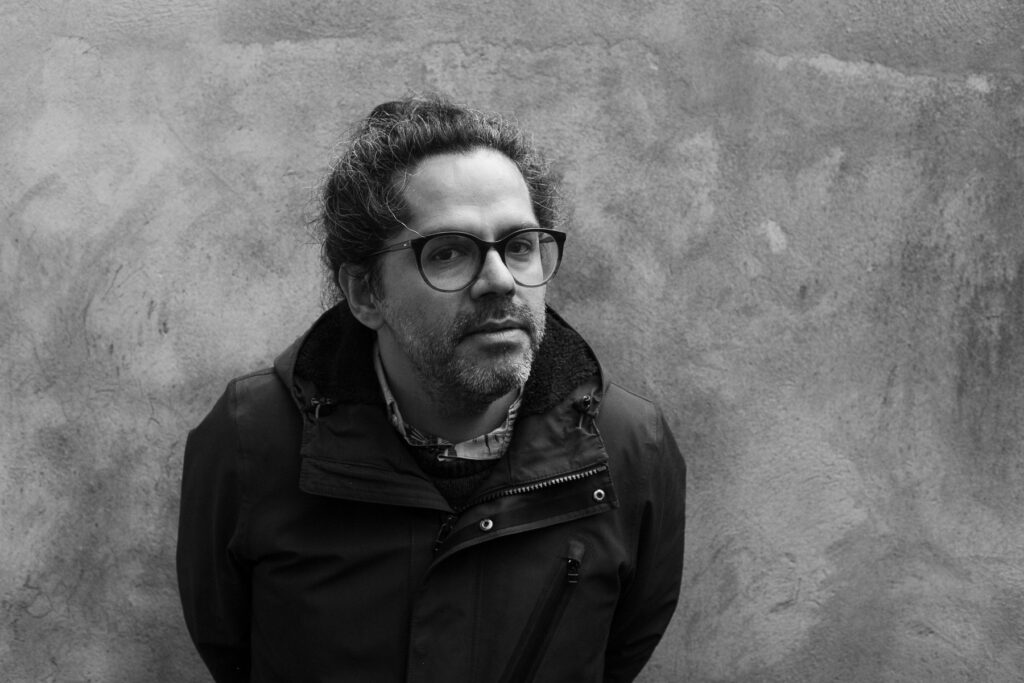
Juan Rodríguez Pira is a Colombian writer and translator based in Berlin. He studied economics and literature in his home country and later earned a master’s degree and a PhD in literature in Berlin. Over the years he has worked as a translator, bartender, teacher and statistical analyst. More information (in Spanish) is available on his website https://www.rodriguezpira.com/.