
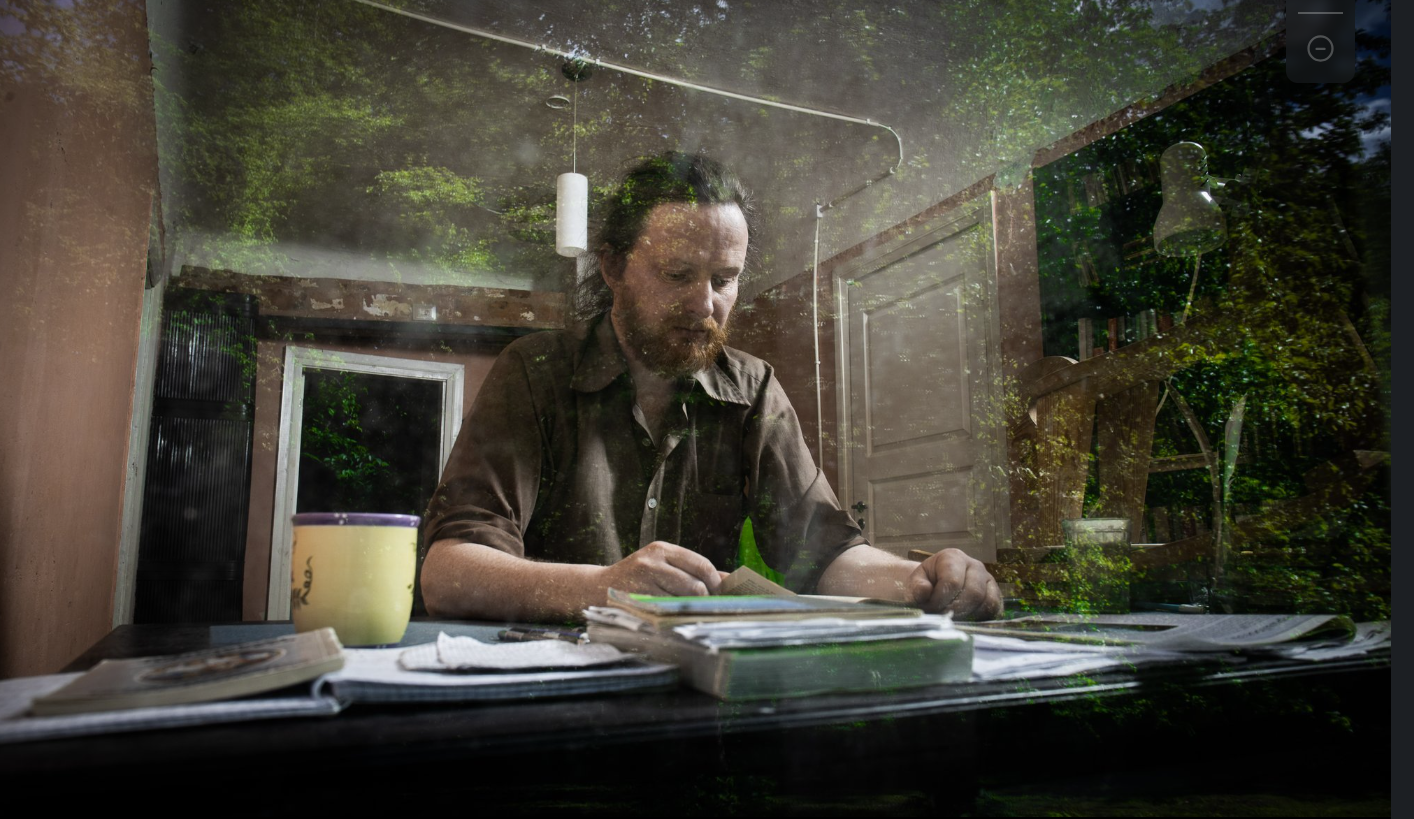
Aadu Vassel used to be quite the man about town, studying chemistry at Tartu University, playing the flute in an early-music ensemble and having grand designs for his future, until one day he found himself head over heels in love. A first love, pure and true, the kind that strikes like a bolt of lightning from a clear sky. Aadu had been seeing his beloved for three months before he found the courage to profess his feelings – but the girl only laughed at him and rebuffed his declaration of love.
Deeply hurt by her slight, Aadu vowed that if the most beautiful words in the world can be dismissed and cast into the mud he would never again utter a single word. And it’s a fact, from that day forward Aadu Vassel never exchanged a single word with anyone.
Disenchanted with people, with life and with himself, Aadu moved to Tuhkja Farm in Soomaa, a land of forests and bogs. This was a place where he could find peace and quiet, far from the noisy city, removed from culture, media and electricity. Forests, bogs and wetland meadows populated only by wolves and bears stretched for kilometres in every direction. Here Aadu Vassel settled into a new and solitary life. He cultivated a vegetable garden around the old house and ate whatever the surrounding forest, bog and the Raudna River could provide. When he needed to he found work on neighbouring farms. As the Soomaa people were tight-lipped by nature, they easily came to terms with Aadu wordlessly, through gestures and facial expressions alone.
During the first few years friends from Tartu still came to visit Aadu Vassel. He was always glad to see them and happily served them tea and grilled fish with oven-roasted potatoes, albeit in silence. There, under the tall oak trees, they would laugh, drink wine and make music together around a fire. But, as the years passed and their lives in the city became busier, Aadu’s friends in time began to forget about him. They had work to do, children to raise and, if truth be told, it was no easy task to visit Aadu in the remote, densely wooded bog.
Sixteen years passed.
One lovely spring day, Aadu’s classmate Maarek came to think of his reclusive friend living alone in the forest and decided it was high time he paid him a visit. Although his wife and children had other plans for this fine day, Maarek stood his ground, put off more important tasks and set off to visit his friend.
Maarek travelled by car from Tartu to Viljandi, then on to Kõpu, where he continued along narrow woodland roads as far as he could. But he didn’t get as far as he had sixteen years before. The road had become overgrown with nettles, ground elder and burdock, and Maarek had to trudge through the chest-high weeds for some considerable distance on foot. His arms outstretched for balance, he crossed a tumbledown old bridge supported by only one beam. He crossed a boggy field brimming with meadowsweet and globeflowers. Finally he made his way along a barely discernible trail through a dense thicket of fir trees to the old house beneath the tall oaks.
Everything was as before. The clear water of the Raudna River flowed slowly past the old house with its roof of moss-covered wooden shingles. A man with matted hair was by the bank of the river drinking tea and smoking. Upon spotting Maarek, the man leaped behind a bush to hide, but then his face broke into a broad smile as he recognized his old friend. Aadu’s clothes were tattered and torn, a heavy beard covered his sooty and solemn face and his hands were rough and leathery from the years spent outdoors. Both men became teary-eyed as they embraced for the first time in a long while.
Aadu rushed to show his friend the improvements he had made at the farm – the intricately carved tables and chairs he had crafted during the long, dark winter months, his vegetable garden behind the house surrounded by a slatted wooden fence where he grew potatoes, turnips and tobacco. Then he introduced his guest to Mikk, his pet magpie, who stood on the kitchen table suspiciously eyeing the newcomer, his head tilted to one side.
After sunset they built a fire at the river’s edge where Aadu cooked buckwheat porridge in a pot over the open fire while Maarek pulled three bottles of red Primitivo wine from his rucksack. Before long the two friends took out their instruments, a flute and a drum, and began to make music together. Mikk, the magpie, hopped around between them chattering a song of his own. Around midnight they put a kettle on the fire for tea. Both men lay on their backs, hands behind their heads, gazing at the stars through the tangle of treetops, each lost in his own thoughts. After a time Maarek sat up and began to enquire in a roundabout way what it was that Aadu had been doing and thinking all the years living in the quietude of the forest. Aadu fixed his gaze on the dark forest on the other side of the river as if fascinated by what he saw … No doubt the recluse had seen and heard much, living deep in the heart of the forests and bogs. Still he held fast to his vow of silence.
The friends spent two more days together – catching fish from the river, drinking tea and wine, eating grilled river chub and bream, playing their instruments.
On the morning of the third day, Maarek put forth the idea that Aadu should come with him back to Tartu and spend a few days with him in the city. He could see his old friends, visit old familiar pubs and discover new ones, and he, Maarek, would do all the talking. Aadu need not say a word. At first Aadu waved his arms, rejecting Maarek’s proposal. Perhaps it was the effects of the wine he had drunk or nostalgia for the people and places of his younger days, but Maarek finally convinced his reclusive friend to come with him, and they set off for Tartu the very same day.
Aadu and Maarek’s children hit it off right away, but Maarek’s wife furtively glowered at Aadu as if seeing a savage beast. Maarek somehow managed to smooth the situation between the two of them over, thereby avoiding conflict in the household. After Aadu had taken a bath and combed his hair, Maarek’s wife even offered to cut his hair and trim his beard. As the men were more or less the same size, Aadu was given one of Maarek’s suits to wear.
Walking around Tartu the following morning, Aadu stared, mouth agape, at the new, modern, glass towers that had sprouted like giant mushrooms in the intervening boom years, rising high up into the sky. They visited old familiar haunts from their student days, the sites of many mad and outrageous incidents. By evening they arrived at the Illegaard pub, where they were joined by former classmates and other old friends.
For many the reappearance of long-lost Aadu came as a surprise, and out of curiosity they came to see the hairy, quirky, reclusive woodsman. Rounds of beer and wine were ordered as they engaged in idle small talk, reminiscing about their student days at university, how many children someone had, who and where someone had built a summer cottage or perhaps even a proper house, which exotic country someone had visited on holiday. Simply put, they drank, laughed and were happy to be together again. Aadu drank wine and beer along with the others, and little by little became quite drunk.
He was interested to hear the local news, but the questions posed by his friends went unanswered. His former classmates ordered Aadu round after round of increasingly strong drinks, taking pleasure in treating their old friend, whose life seemingly had not gone as well as theirs and who now sat in their midst like an exotic creature, astonished at everything he heard and saw. They were all curious about Aadu Vassel’s life in the wilderness, but still he shook his head at their incessant questions or looked away without answering. His old friends were beginning to wonder if the poor chap could even speak at all – perhaps he had lost the capacity for speech altogether. Eventually Maarek answered on Aadu’s behalf and explained that, of course, he could speak, but years of living in the forest had made him very self-conscious and to speak now would require too much effort.
The group around the table nodded in understanding.
At some point the group began making toasts. They rose one after the other and raised their glasses to friends, to life, to love. They wished one another strength, good health, a long life or recited other beautiful words. When it came Aadu’s turn to propose a toast, he stood up like the others holding his wine glass and looked upon his former classmates and friends with a frozen smile. You could hear a pin drop. The silence became awkward. Secretly everyone hoped that the eccentric Aadu would sit down again so the toasting could continue, thereby relieving the tension caused by his silence.
Maybe because he was tipsy from all the wine and beer, or perhaps there was something Aadu had suppressed for many long years, but it seemed that he now wanted to address his old classmates and friends, even the love of his life who sat among them, looking up at him, a nervous smile playing on her lips. Yes, it seemed that he wanted to say something profound and beautiful to everyone in the room. Then the man who had remained silent for so long suddenly opened his mouth wide as if he were about to sing or call out … still he uttered not a word. Seeing Aadu’s face twisted into a bizarre grimace, those around the table silently thought how ridiculous a wild man looks when he’s had too much to drink.
But just as someone was rising from his seat and tapping a glass with a fork in an attempt to defuse the uncomfortable situation, something strangely mysterious began to issue forth from Aadu’s wide-open mouth, from his nostrils and ears. It was the nightly fog that rises from the wetland meadows that was now slowly flowing over the chairs and tables, filling the entire pub with fresh, damp air, enveloping the bewildered people in a milky light. As they breathed in the long, silent years of this solitary man, the scent of the forests and the peaceful flow of the river, the people in the bar were slowly overcome with a sense of strength, clarity and inner peace. They began to understand what Aadu was saying and nodded at him in acknowledgement.
In their souls they could hear the sound of an acorn dropping into the calm water of a river in October, the dreamy quiet of long winter days, the gentle flow of the river on a murmurous summer’s day. With their eyes closed, some began to sway in a gentle rhythm like the crowns of fir trees in an April breeze. Others slowly rose from their chairs like water lilies stretching towards the light from the dark riverbed, their mouths opening like the petals on a flower. Startled birds flew forth from their gaping mouths – greenfinches, yellow wagtails, kingfishers, robins, wrynecks and chaffinches. Dragonflies and may bugs also emerged and flew among the birds. The entire pub had become a springtime meadow thrumming with insects and trilling with birdsong. Emitting a low-decibel hum, honeybees, dragonflies and beetles flew around, occasionally crashing into a wall or against someone’s head, birds perched on the backs of chairs, on tables or the mouth of a bottle, their enchanting melodies filling the air. And when woodland ferns and intoxicatingly fragrant watermint blossoms began to emerge from the cracks in the stone floor, when ivy vines and young hop shoots began to entwine around the swaying people, casting shadows over their eyes and open visions, only then did Aadu Vassel close his mouth.
He had said what he had to say and left the pub filled with a lightness of spirit.
The new dawn found Aadu Vassel already as far as Puhja as he hurried towards Viljandi. A magpie flew up to meet him, landing on his right shoulder, where it swayed in rhythm with the walker’s stride as it observed the rising sun.
Translated by Tiina Otema
ABOUT THE AUTHOR
Mehis Heinsaar (b. 1973) is a writer and poet, and one of Estonia’s most distinctive writers of magical prose. His stories tend to open in a world that all would recognize before slipping into another order of being. He is a three-time recipient of the Friedebert Tuglas Short Story Award.