
Editorial note
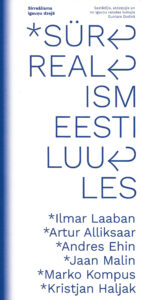
The following essay by the Latvian poet and translator Guntars Godiņš accompanies the anthology Sirreālisms igauņu dzejā (Surrealism in Estonian Poetry, Neputns, 2023), compiled and translated into Latvian by Godiņš. The volume brings together poems by six Estonian poets from different generations – Ilmar Laaban, Artur Alliksaar, Andres Ehin, Jaan Malin, Marko Kompus and Kristjan Haljak – whose work reflects the development of surrealist tendencies in Estonian poetry. In addition to the poems, the book includes an extensive introductory essay by Godiņš and a study by the Estonian poet and literary scholar Hasso Krull on the poetics of Ilmar Laaban.
Surrealism in Estonian Poetry
Guntars Godiņš
The book Surrealism in Estonian Poetry, which came out in Latvian in 2023, features poetry by six Estonian poets from different generations – Ilmar Laaban (1921–2000), Artur Alliksaar (1923–1966), Andres Ehin (1940–2011), Jaan Malin (1960), Marko Kompus (1972) and Kristjan Haljak (1990), poets in whose work one can discern all the many and varied characteristics of surrealism – along with essays by Estonian poet, translator and literary scholar Hasso Krull as well as my own reflections and commentary on the subject. Included also are reproductions of hand-written manuscripts, drawings and photos, which are used to illustrate the book.
The phrase ‘Estonian surrealism’ is used deliberately. Estonian surrealism is not simply an imitation of French or German surrealism; it is a unique literary movement forged by Estonian poets over the decades, the foundation of which is in the experience and main traits of classical surrealism (along with Dadaism), although it is a unique and homegrown phenomenon in Estonian poetry in its own right. In contrast to Latvian poetry, in which themes of surrealism can be found infrequently, there are poets in Estonia who have been and are still loyal to this literary movement and continue to help to broaden and develop it.
In the introduction I attempt to introduce Latvian readers not only to Estonian surrealism but also to provide a relatively broad overview of Dadaism and surrealism in Europe, the two movements’ characteristics, what is similar and different between them as well as the political and literary context of the times. Hasso Krull’s essay ‘Imagination Policy: Ilmar Laaban and a Thousand Year-Old Tradition’ lends particular weight to the uniqueness of surrealism in Estonian poetry.
Twenty years ago, before the publication of Surrealism in Estonian Poetry, a volume of selected works of Ilmar Laaban came out that I compiled and translated into Latvian; it was accompanied by a CD of Laaban performing what is known as sound poetry. Individual collections of works by Artur Alliksaar and Andres Ehin have been published in Latvian translation. The idea of bringing together in one volume all those Estonian poets whose work possesses some of the traits of surrealism had actually been in my mind for a while, and it felt that the time had come to bring the project to fruition.
Estonian Surrealism in a Global Context
One associates Dadaism and surrealism with the soft, melting watches of Salvador Dalí, Marcel Duchamp’s Mona Lisa with a moustache and goatee (LHOOQ) and the upside-down urinal – to which he gave the name Fountain – Man Ray’s photography, in which a woman can be seen with glass tears running down her cheeks, René Magritte’s strange painting Golconda, to name but a few.
After the First World War, surrealism grew out of Dadaism, with the poets’ initial desire to create both a political as well as an artistic revolution, attempting to unite Sigmund Freud’s psychoanalytical methods, the Marquis de Sade’s erotic and sadistic storytelling style and the Comte de Lautréamont’s nightmarish visions in Les Chants de Maldoror (The Songs of Maldoror) as well as works by a number of others. The civilized world had been destroyed by the war, while literature both pointed to the ruins and hastened to create something new.
The term surrealism was first coined by French poet Guillaume Apollinaire. His experimental play Les Mamelles de Tirésias (The Breasts of Tiresias) was staged at the Théâtre Maubelin Paris on 24 June 1917. A few weeks before this, on 18 May, Apollinaire had written in his programme notes for the ballet Parade that: ‘When man wanted to imitate walking he invented the wheel, which does not look like a leg. Without knowing it, he was a surrealist.’
The French word surréalisme translates as ‘beyond realism’ or ‘above realism’. The writers, poets, artists and composers of the time recognized that this so-called beyond realism exists in parallel with reality. The horror and death of the First World War, the Industrial Revolution and the dominance of rational thought forced poets and artists to look for a new spirituality in the irrational world of visions and dreams. Before the appearance of the Dadaists and surrealists, French writer Arthur Rimbaud had exclaimed, ‘You need to change your life!’ When the Bolshevik Revolution began in Russia, the Futurists heralded a new age of technology in Italy, while Rimbaud warned that politics wouldn’t seem interesting in France.
In 1924 André Breton’s Manifeste du surréalisme (The Surrealist Manifesto) was published by Éditions du Sagittaire. In it he wrote: ‘Beloved imagination, what I most like in you is your unsparing quality. The mere word “freedom” is the only one that still excites me. I deem it capable of indefinitely sustaining the old human fanaticism.’ In fact, it was André Breton who best defined surrealism: ‘SURREALISM, n. Pure psychic automatism, by which it is intended to express, verbally, in writing or by other means, the real process of thought. Thought’s dictation, in the absence of all control exercised by reason and outside all aesthetic or moral preoccupations.’
The art of surprise and knocking people out of their regular routine – those were the revolutionary tools of art and literature at the time. It is not possible to change ways of thinking gradually: spontaneity and shock are required. That is how the Dadaists acted at first, and after them the surrealists followed suit.
Unlike Dadaism, surrealism was a long-lasting movement, branching out, developing and diversifying. It would not be accurate to state, as some have, that this movement in art and literature ended with the Second World War or with André Breton’s death. Surrealism spread all over the world over decades: to the USA, Italy, Spain, Germany, Sweden, Denmark and elsewhere. In Estonian art and literature, surrealism has, in contrast to Latvia and Lithuania, been enduring, and even now its remarkable features can still be found in modern-day works.
Estonian Surrealism
Old Estonian folk songs, known as regilaul, hold great meaning for the foundational principles of Estonian poetry, including the phonetic rhyming of words (assonance and alliteration are often used) and head rhyme. In these old folk songs, it is as if one word is looking for another. Examples of this can be found in the following: lähme meie merda mööda (let’s walk past the sea); tõuse, tuuli, paista, päävä (rise, wind, shine, sun). Often, the unique musicality of Estonian folk songs creates surreal visions. For example, sibulasta tegin silda (I made a bridge of onions); Riia rikumine (Riga’s destruction); ma laulan mere maaks (I will sing the sea into soil). Over time, these strange and paradoxical joinings of words become habitual and therefore natural in a person’s mind. One could state that language itself is surrealist and, using phonetical musicality as a foundation, has employed the use of automatic writing. The Estonian word sibul (onion) matches with the word sild (bridge) sound-wise, and the destruction of Riga is neither a historical fact nor a call for war by Estonians against Latvians but rather an alliteration, the repetition of the letter r, which has created a paradoxical construct. The principle of the phonetical musicality of old folk songs has also influenced poetry written in Estonian, for which it becomes easier to shape and adopt a surrealistic way of thinking.
One can clearly see features of symbolism, expressionism, constructivism and decadence in Estonian poetry at the beginning of the 20th century. In 1905 the first literary almanacof the group Noor Eesti (Young Estonia) was published. The group included such poets and writers as Gustav Suits and Friedebert Tuglas as well as artists Nikolai Triik, Kristjan Raud and Konrad Mägi. In 1917 the literary group Siuru was established (Siuru is a legendary bird in Estonian mythology), which writer August Gailit and poets Johannes Vares-Barbarus and Johannes Semper joined.
Interest in Sigmund Freud’s psychoanalysis emerged in Estonia in the 1920s and 1930s. Johannes Vares-Barbarus’s school classmate and friend Johannes Semper, basing his work on Freud’s teachings, published an extremely important essay in 1924 titled ‘An Analysis of the Folk Song Motive in Kalevipoeg’. One should remember that Johannes Semper was also fascinated by French literature of the time and translated works by French authors. Estonian artists, poets and writers were all familiar with the vibrant cultural scene in Paris, and it was precisely at that time that surrealist journals, manifestos, performances and absurdist theatre stagings experienced a boom.
It was in the 1930s that well-known Estonian artist Eduard Wiiralt created the graphic works Hell and Cabaret, in which one can clearly observe symbolic and allegorical meanings and a concentration of poetic expression. In examining these pieces, it seems that the artist has etched them spontaneously, without rational thought. Wiiralt lived in Paris between 1925 and 1938, a time when the minds of many were possessed by artists who associated themselves with surrealism, including, among others, Salvador Dalí, Pablo Picasso, Marcel Duchamp and Francis Picabia. Other than Eduard Wiiralt, one can also discern elements of surrealism in the paintings and graphic works of Estonian artists Ülo Sooster, Ilmar Malin, Andrus Kasemaa and Enn Tegova.
During the Soviet occupation, Estonian surrealism was like a toothache for ideologues. It didn’t adhere to socialist realism and its demand that real life be depicted, so one could have considered it a kind of protest against the Soviet way of thinking and fragmented understanding.
Literary historians have underscored more than once that the father of Estonian surrealism is considered to be Ilmar Laaban – a poet who in his teenage years composed poems in which one can clearly detect the basic principles of surrealism. An interesting fact to note is that his mother was Latvian; until her death, when Ilmar was thirteen, they spoke German in the family, which is why his early poems were written either in Estonian or German. Laaban was talented and multifaceted. While in his final year at Tallinn Boys’ Gymnasium he was admitted into the Tallinn Conservatory, where he studied piano. In 1940 he began his studies in philosophy and Romance languages at Tartu University. The following autumn he returned to the Conservatory, where he studied composition with composer and pedagogue Heino Eller. In 1943, fleeing from being drafted into the German army, he reached Sweden via Finland and once again took up philosophy and Romance languages at Stockholm University. After quickly learning Swedish, he created a cycle of broadcasts about French art for Swedish radio, translated French modernist poetry into Swedish and gave lectures about surrealism at several universities around the world. Together with his friend, Swedish poet Erik Lindegren, he compiled and translated a notable anthology titled Nineteen French Poets into Swedish.
Laaban can’t be considered a classic Estonian refugee. In one interview he admitted frankly that ‘Even if Estonia hadn’t been occupied, I am sure that I would have gone abroad in my twenties.’
When I started to translate Laaban’s poetry some years ago, we exchanged letters, in one of which he wrote that he was very happy that his poems were being translated into his mother’s language, Latvian.
Laaban’s early poetry leans on André Breton’s statement that ‘beauty will be convulsive or will not be at all’. Associations in poetry are ten times faster than radio waves, they are like sparks which crackle and set your mind and feelings on fire. French surrealist poet Paul Éluard poetically and precisely composed the formula for creating associations: ‘Logically, a glass belongs to a table, a star to the sky, a door to a threshold, which is why we don’t see it. One should place a star on a table, a glass closer to a piano and angels and a door in the ocean.’
In Surrealism in Estonian Poetry I have included Laaban’s poetry from his first collection Ankruketi lõpp on laulu algus (The End of the Anchor Chain Is the Beginning of Song, 1946), his experimental collection Rroosi Selaviste (1957), whose deliberately nonsensical Estonian title echoes Marcel Duchamp’s surrealist alter ego Rrose Sélavy, as well as from selected works and poems published in newspapers and magazines. Laaban wrote palindromes in Estonian, English, French and Swedish as well as in other languages, so in Surrealism in Estonian Poetry some of his palindromes have been published in the Estonian original with literal translations into Latvian. Laaban didn’t limit himself to writing poetry, palindromes, anagrams and paragrams but also focused his attention on sound poetry, for which he suggested the term häälutus (ringing, chiming).
Arthur Alliksaar cannot be considered a pure surrealist, but his free-thinking and difficult life full of paradoxes, as well as his unique poetic language, testifies to the fact that one can find surrealist features in his poems. So what is the evidence for this? His early poetry was written in strict, classical stanzas marked by the influence of Rainer Maria Rilke and the aesthetic refinement of the group of Estonian poets of the 1930s called Arbujad (sorcerers, soothsayers). Later he turned to free verse and largely wrote long, paradoxical poems rich in wordplay, the primary preconditions of which were aphoristic expression and surrendering oneself fully to free association, something strongly encouraged by the phonetic qualities of the Estonian language and its poetic tradition. If the automatic writing of the French surrealists was dictated by dreams and visions, then for Alliksaar it was alliteration and assonance – that is, phonetic musicality. A line from the poem ‘Traakia maagia’ (‘Thracian Magic’) proves that it is possible to write a poem using the repetition of one primary vowel or consonant:
Kuuldud uudis. Tuumaruum. Kuunar muulil. Tuubid luubis.
(Noted news. Nuclear space. Schooner on a mole. Tubes in a magnifying glass.)
Returning to Estonia after serving in the labour camps, and having begun an active literary life at the beginning of the 1960s in Tartu, Alliksaar rejected classical forms and turned more towards free verse, which possesses extremely varied and previously non-existent language tools and possibilities. The element in which he was most comfortable was in expanding the lexicon: the creation of compound words, the refashioning of existing forms of language and a unique musicality that was characteristic of him alone. Alliksaar’s poetic soundscape was based on the principle on which ancient Estonian folk songs were constructed – word harmony using assonance, alliteration, epistrophe and repetition in combination with an aphoristic, philosophical and often even surrealistic ways of thinking.
Unfortunately, one needs to speak not only about the original style, wordplay and intonation of Alliksaar but also about the possibility and impossibility of translating such texts. Alliksaar’s poetry is at best extremely difficult to translate if not absolutely untranslatable. If, while translating, I just preserved the preciseness of the idea, along with the rhythmic nature and intonation, while sacrificing the musicality of the language, then it would no longer be his poem. If, while reproducing the unique phonetic splendour, I lost the preciseness of Alliksaar’s thought and the aphoristic expression, then again it would not be Alliksaar’s poem. This is why I attempted to strike a balance between these two extremes, creating something of a kaleidoscopic effect. This kind of poetry depends an inner freedom from the translator, and the translation could be compared to improvisation on the piano of one’s language, meaning I had to perform the role of Alliksaar in Latvian on the language stage.
The poetry and personality of both Ilmar Laaban and Arthur Alliksaar have left an indelible mark on Estonian poet Andres Ehin, who has acknowledged on several occasions that both were his teachers. Of course, direct contact with Laaban, who lived in exile, was not possible, which is why, when Alliksaar returned from the labour camps, he became an object of wonder for Ehin, a young poet and Tartu University student. At the time neither Laaban’s nor Alliksaar’s poetry could be read in the Estonian press or in book form; however, Laaban’s The End of the Anchor Chain Is the Beginning of Song, published in Stockholm, reached Estonia by clandestine means, while the ‘King of the Tartu Bohemians’, Alliksaar, could be heard reading his poems at the top of his lungs in the Werner Café.
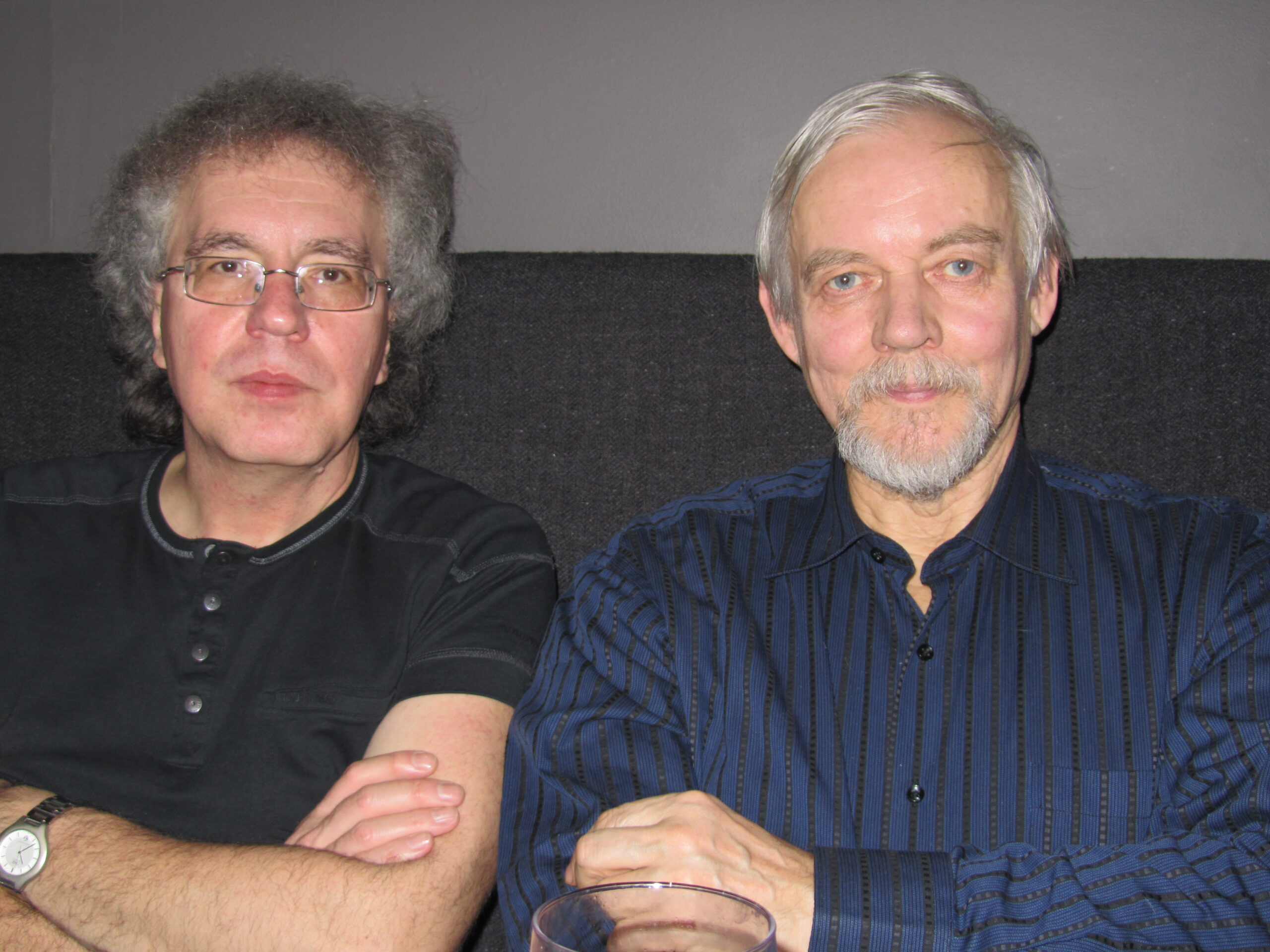
Ehin’s youth passed during the period when Soviet realism and ways of thinking were the norm, which is why in his early surrealistic poems one can find such words as tractor, director and general secretary. Although the Dadaists and surrealists from France and elsewhere in Europe expressed Marxist views, the word surrealism possessed more of an anti-Soviet meaning during the occupation in Estonia – as it did in Latvia and Lithuania – an antithesis to socialist realism. It is no accident that the publication of Ehin’s first poetry collection was delayed. Ehin has said that at the beginning of his studies he was called to the Secret Services Committee, where he was warned about fraternizing with Alliksaar, who was so hated by the authorities.
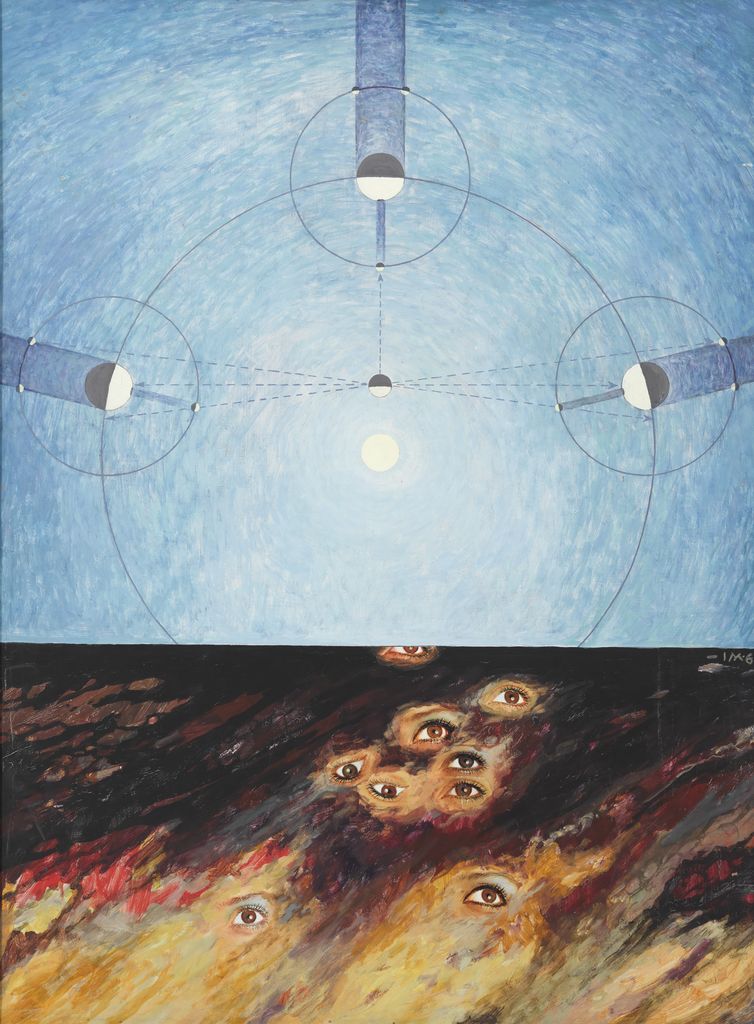
I mentioned Estonian artist Ilmar Malin. While visiting the Moderna Museet in Stockholm in 1966 together with Ilmar Laaban, he was so inspired by the surrealist works there that one can clearly observe the influence of this movement in his subsequent paintings, drawings, graphic work and installations. Ilmar Malin’s son, Jaan Malin, continues his father’s interest in surrealism in his own poetry, as well as in researching Ilmar Laaban’s oeuvre, compiling books of his selected poetry and creating a bibliography of his work. His father’s surrealistic paintings, drawings and graphic works have been known to Jaan since childhood, so his interest in surrealism feels entirely logical. Of course, later, thanks to Jaan’s friendship with Laaban, his fascination with surrealism only became stronger. While studying at Tartu University he wanted to write his thesis on Laaban’s poetry. Knowing that the exiled Laaban’s works were banned in Estonia, his teacher suggested he undertake research on the poetry of Andres Ehin. Jaan supposedly agreed because he was aware that while writing about Ehin one could not avoid mentioning Laaban.
Marko Kompus has been called a surrealist by Estonian literary critics, but he himself disregards this. Although Kompus has had access to good schooling in the tradition of home-grown surrealists Ilmar Laaban, Arthur Alliksaar, Andres Ehin and others, he has confessed in interviews that his manner of writing, style and way of thinking are nothing but his own perception of life and his attempts at avoiding repeating his existing texts. In one interview he stated, ‘In reality, in my poetry there is a revolt against language, against normal language. I am not revolting against society but against language. In a sense. There is a difference. I am revolting against language with language. It’s absurd, but, you see, that’s how it is.’
In a similar fashion to the works of Laaban and Alliksaar, Kompus’s poetry is built upon the basis of a unique and unexpected image or joining of words – for example ‘aubergine jazz’, ‘rain pizza’, ‘lilac jaws’, ‘grasshopper coffins’ and ‘cloud harvester’. Doesn’t that remind one of Lautréamont’s ‘chance encounter of a sewing machine and the umbrella on an operating table’ and Éluard’s suggestion that a star should be placed on a table?
The most brilliant surrealist of the most recent generation of Estonian poets is Kristjan Haljak, which is why I did not hesitate to choose him. He has translated André Breton’s Manifesto of Surrealism, Charles Baudelaire’s My Heart Laid Bare and Artificial Paradises, the Comte de Lautréamont’s The Songs of Maldoror and other works.
Translating the Surrealists
The American poet Robert Frost once said that ‘Poetry is what gets lost in translation.’ In some sense he is right, but there’s no one who can read all the languages of the world, which is why the translation of poetry has great significance, and not just in an informative sense. I believe translating poetry is an art that demands linguistic and poetic language skills combined with a poet’s talent. If the texts written by surrealists are difficult to understand for those who read in the original, what can one say for those who read them in translation?
Over many years in my profession I have translated the most varied of texts, beginning with ancient folk songs and epics and ending with modernists and contemporary poets, striving to find equivalents in language, mythology, poetic language and hammering out my own principles for translating poetry so I can preserve the original’s richness of meaning, style and form. It is important not to freeze in front of the original but instead be free in the space of your own language and the language of poetry – to breathe in the original text and breathe out the translation. The translation of a poem is somewhat similar to improvisation in jazz, especially when it is something written by Ilmar Laaban or Arthur Alliksaar.
I have long fostered the notion of acquainting Latvian readers with surrealist trends in Estonian poetry, expressing my thoughts on it and translating it. Surrealism is a unique and extremely powerful way of thinking, for which it is important to knock oneself out of one’s regular routine and suddenly find a new, as-yet-non-existent continent in the ocean of our subconscious. Wasn’t Alliksaar right when he wrote:
Why do you lose that which you have not found?
Why do you search for what you have not lost?
ABOUT THE AUTHOR
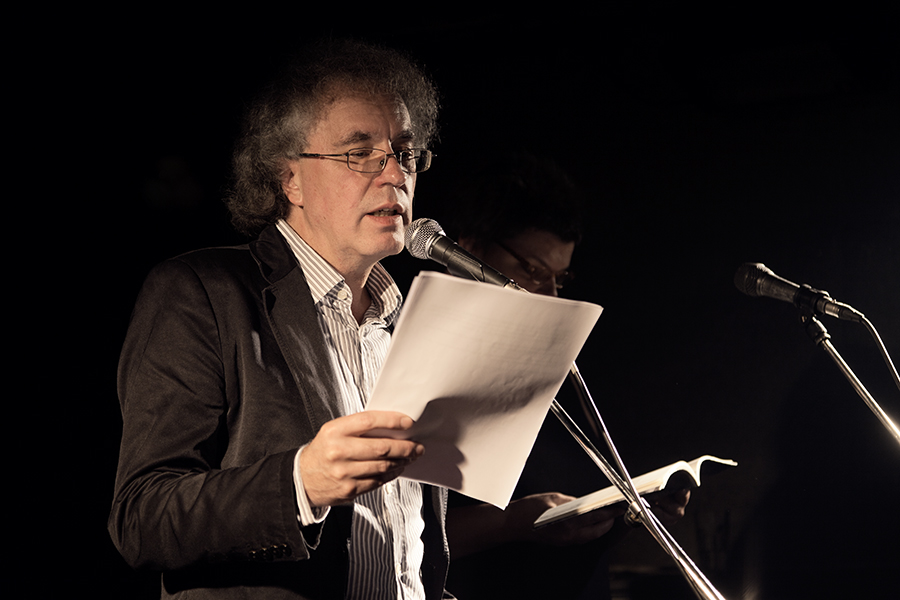
Guntars Godiņš (b. 1958) is a Latvian poet and translator. He studied Latvian language and literature at the University of Latvia (1978–1983) and later Finnish language and culture at the University of Helsinki (1994). His early poetry collections, Tas nepasacītais (The Unsaid, 1985) and Ar atpakaļejošu datumu (Retroactively, 1989), were heavily censored for their ironic, subtext-rich anti-Soviet tone. Later books include Ēnu nesēji (Shadow Carriers, 1993), Nakts saule (Midnight Sun, 2000) and CV (2008).
A major mediator of Estonian literature in Latvia, Godiņš has translated numerous works of poetry and prose, including Ilmar Laaban’s selected poems and the Estonian national epic Kalevipoeg. From 1998 to 2010 he served as cultural attaché at the Latvian embassy in Tallinn.