
The Moon
The moon glows, sometimes cloudier, sometimes brighter. As though a gust of wind is polishing its phosphorous mask now and then to help it shine anew. Sometimes it appears mysteriously as through from a faraway realm, yet then again it could be a Chinese lantern, a few hundred metres away. And, with every wrinkle in the mask visible, just as deceptive!
It looks as though some wanderer is exploring the moon’s distant mountains, bearing a silvery staff. He treads on the rims of craters and snow quakes off below. Then another gust of wind blows the fine moon dust into the air, and the outlines of the celestial body soften. Like a disc of sugar, dissolving in the sky’s colourless kümmel. Now each and every wanderer has vanished.
And there it smoulders – the god of the lunatics, that master of apparitions, a silversmith of the forests. There it watches – above earthly founts, castle spires and sighing maidens, that silvereye of heaven!
*
Hamlet reminisced:
Once with his rowdy gang he stumbled through streets of Helsinki at night. (All theories are grey, my friend, and green life’s golden tree!)[1] Then the full moon suddenly shone yellow at the end of the street before their hungover eyes. They tried to walk past it but came up against the moon each time they tried. They careered into the moon, holding hands with one another until it burst like a puffball mushroom and covered the street with yellow powder. A laughing woman was twirling and dancing, throwing her legs up in the air in a dance. Drunk, they ran after her and fell on one another, scrabbled in a tangle of limbs arounde glowing yolk of the sky. All night they struggled this way – only to wake up at noon the next day in the cloister tower, their beards full pigeon shit.
*
The moon lifts her dusky visage over the garden of our thoughts once again. There is only a blasé, bored, bald-head, an eunuch in the starry harem, the castrated planet in the company of the burning, engendering sun and tenderly birthing earth. Only the young songsmith may refresh her phosphorous mask.
Raise the earthen pitchers to the very bottom of the heavenly mug! All hail the petty intimacies with this distant wayfarer!
A Drama
The firmament swells over my face as a silken fabric. Wherever my gaze delves, it rises like a gothic arch into the heights, a tentpole holding up the sloping periphery. Like a blue-green-white tent nave, it has been thrown high over my being.
Like a glimpse into the abyss, this vastness makes my head spin. No longer can I bring motion to my limbs or my thoughts, and I have no action or will … only to melt into the eternal and boundless, disappearing into the rippling of the spheres … only a bit of ozone in the lungs – and that’s all.
– As if I had fallen asleep for a moment. When my eyes open anew, they are directed at the bare cliff before me. Eventually, a handbreadth of reality begins to clear up.
A narrow crevice in the cliffs’ ground, filled with a handful of soilnd covered in a microscopic grove. Some reddish, velvetyoss. Ants have worn their highway across the crevice and into the moss. A merciless, ancient drama is taking place here at the crossing point of this crevice and the path of the ants.
There, a small earthworm has stuck its headut from the mud. And a swarm of fire ants have clutched it in their hook-jaws. The earthworm curls into itself so as to get back onto the earth. And the burgundy troop of ants are dragged along by the earthworm into the sand, scrabbling and loosening particles of sand. But then, the worm goes limp and is pulled halfway out again. So they pry against one another up and down like a wood saw. One could imagine the hate of his angry panting, the mutual goading and the woeful desperation earthworm. Up and down, over and over, in the fiery blaze of the sun! The worm’s segments spread and press together like the iron armour around a soldier’s sleeve. And the ants exert themselves like a russet-legged horde of serfs jamming a post into a bottomless bog. And so it lasts, into eternity. The gruesome drama of destruction in a slice of the cosmos, no wider than a handbreadth! …
– The sun whispers his bounty of rays over the sea. They fall as red arrows upon the water. Like pins they sting my face, my hands. A whirring and whisper meet my ears.
My lungs engorge with ozone.
The Yearning for Life
It begins to rain, grey. Beads tap ever more frequently upon the window frame as the light grows more dim. The clatter of the wagon coming from outside ceases so suddenly, it’s as though the driver has sunk, along with the street, into the depths. For a while the hush of the rain falling, then suddenly it no longer reaches the ear.
The halls of the museum open to either side. Their open doors follow the line of perspective. The furthest doorjambs still glow white in the uncertain reaches as if darkly in a mirror. Somewhere in the distance, through the hush, the creaking of the parquet floor, although timidly it goes quiet again.
The more these surroundings sink into silence, the more powerful this country of spectres becomes. Visions of the long-dead masters take on flesh and blood, are beings again. In the twilight halls they sound with the slip of satin, the hush of trees, wings flapping … somewhere a sword is unsheathed with a swoosh, water bubbles around a ship’s stern, the earth trembles to the thud of horseshoes … Someone is sighing, another in tears cries and another breaks out laughing … lullabies, the wheezing of a curse, sweet nothings …
This is the yearning for life, from the distant past: only to come back again! To blush with red life and smoulder with passion! To feel once more an instant’s pleasure amid the deathly stillness of eternity!
1911–12
[1] “Grau, teurer Freund, ist alle Theorie,
Und grün des Lebens goldner Baum.”
Goethe, Faust. Der Tragödie erster Teil, 1808. Studierzimmer, Mephistopheles zum Schüler (The First part of “Faust,” in the Study, Mephistopheles speaking to the Student).
ABOUT THE AUTHOR
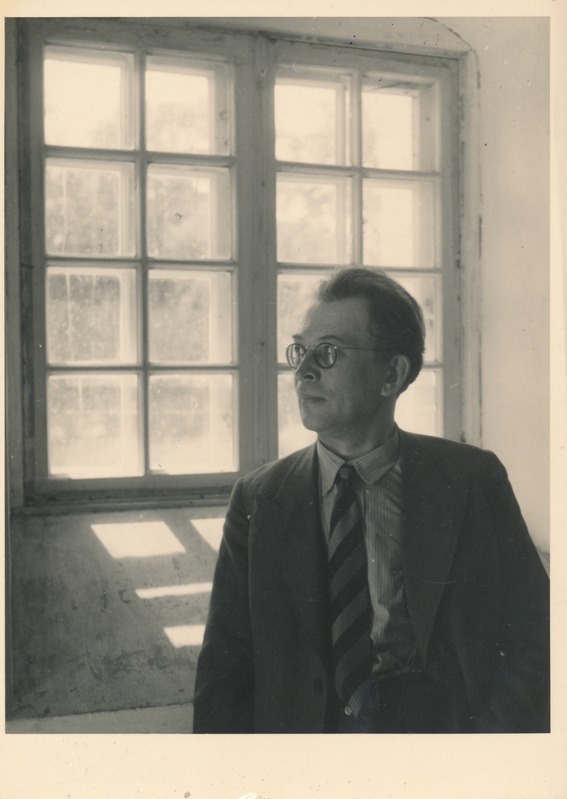
http://www.muis.ee/museaalview/1360888
Friedebert Tuglas (1886–1971) was one of the central figures of the Young Estonia movement and an important modernizer of Estonian literature. The collection A Shifting Rainbow (1968) gathers his prose poems written over several decades. ‘The Fourth Dimension’ is one of the philosophical pieces in the book, reflecting Tuglas’ interest in myth and the hidden structures of reality.
‘The Fourth Dimension’ and The Shifting Rainbow (1968)
Ian Tracy Gwin
Over his long career, the writer Friedebert Tuglas (1886–1971) helped establish a world literature in Estonian. Following his participation in the Russian Revolution of 1905 and his subsequent arrest, Tuglas began his writing career as a political refugee, living and travelling in Finland, Scandinavia and throughout Europe. During this period he published the novel Felix Ormusson (1915), which resembles the self-reflections of Joyce’s A Portrait of the Artist as a Young Man or the fragmented diary of Rilke’s The Notebooks of Malte Laurids Brigge. The novel represents the aesthetics that Tuglas had advanced in the Young Estonia movement and the dilemmas of the sensibility, consciousness and creativity of the transitional first-generation Estonian intellectuals. Upon returning to independent Estonia in 1918 Tuglas became head of the writers’ league, continuing to write short stories, his most acclaimed contribution to Estonian letters, as well as the psychological novel Little Illimar (1937) and literary criticism.
In 1968 Tuglas published a collection of poetic prose that had been written over a period of more than forty years (1903–66), A Shifting Rainbow (Muutlik vikerkaar), with the subtitle A Diary of Truth and Imagination (Tõe ja kujutluse päevik). As the subtitle suggests, Tuglas’s miniatures represent attempts in his search for a rhythmic, metred and poetic language in prose. The title refers to the rainbow as a symbol of a numinous reality, ever changing behind sensual appearance, and reflects his philosophical investigations in the genre into the crossing of mythemes and the mechanisms of the collective unconscious. Although the French Symbolists such as Baudelaire had advanced the cause of the prose poem, the Young Estonians were inspired by the Finnish writer Juhani Aho, whose ‘shards’ (lastuja) captured the moods and landscapes of the Baltic coast. Tuglas’s early pieces closely resemble Aho, such as ‘A Winter Wind’ (‘Talvine tuul’, 1905). However, they also draw on the revolution in poetics brought about by his contemporary Jaan Oks (1884–1918), who depicted the ‘mood’ (meeleolu) of the rural countryside as a psychic dissolution and degeneration merging folklore and everyday life.
‘The Fourth Dimension’ (‘Neljas dimensioon’) represents the philosophical depth and formal originality of the collection. The title alludes to a hypothetical dimension normally considered beyond human comprehension, situated as we are within three-dimensional space–time. Tuglas nevertheless achieves a literary representation of the fourth dimension through a combination of three distinct chronotopes, which create, as through the harmonic series of a sustained chord, the fourth dimension. The first section, ‘The Moon’ (‘Kuu’), begins with the writer’s aesthetic encounter with that celestial body, a symbol of profundity and madness. This is followed by an allegedly historical anecdote in which Hamlet, the legendary Danish king, runs drunkenly into the spirit of the moon one night in Helsinki. Tuglas characterizes the moon allegorically as a guardian spirit for earthly beings but also as a treacherous deity within the hierarchy of the planets.
In the second section, ‘A Drama’ (‘Draama’), the writer begins with the transcendence of the mythic cosmos but finds this realm divided by the cruel life of animals. The vastness of space contradicts life on earth, where natural forces continue a life-and-death struggle, pictured in miniature as a worm caught by a horde of fire ants in a mossy crevice. Finally, in the third section the narrator enters human culture apart from nature and the cosmos. A museum gallery, seemingly empty, evokes the vitality of human life through the process of archiving and the artifice of culture. The mood of the gallery turns into an eerie horror when the narrator reflects on this paradox, ‘The Yearning for Life’ (‘Elu igatsus’), which never ceases to be contained in the storage of human memory.
Starting with the mytheme of the moon, Tuglas depicts a trickster deity who presides over endless dramas, from the political stages to the smallest life forms, engineered by the will to live and the incessant yet untraceable yearning for life that repeats across time and space in a tesseract of affective drives and momentary moods. As in the other miniatures of The Shifting Rainbow, questions of existence pass through mythologies and literatures, from the Eddas, the Mahabharata and the Kalevala, transforming the profane world into the sacred, an everyday tree into the centre of the world, or Yggdrasil.