
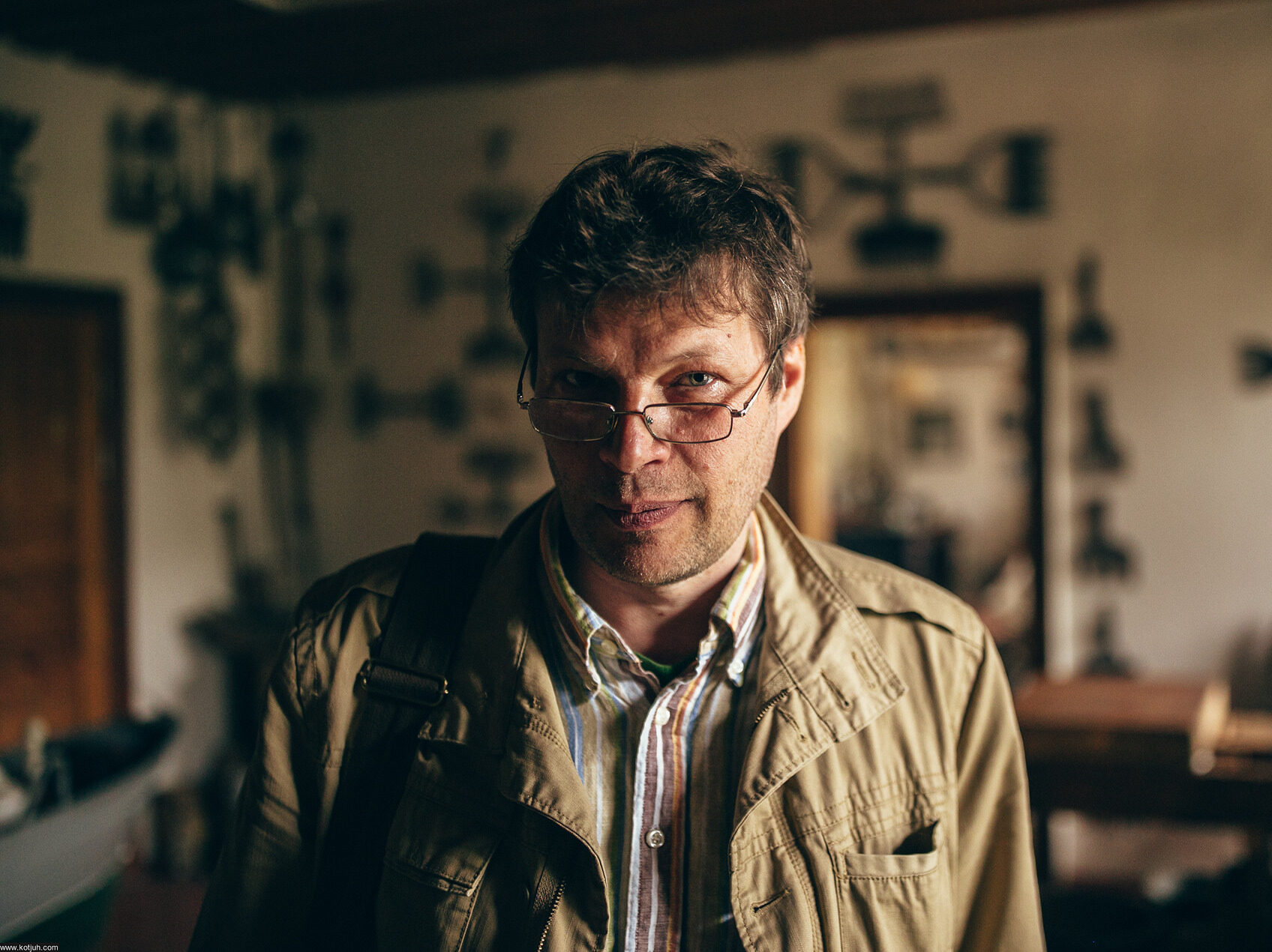
War does not care for prose writers. Yes, of course, I am obliged to generalize: the saying ‘when the cannons speak, the muses fall silent’ is meant to apply to all artists. But, like many such sweeping declarations, this one, too, despite its elegance, does not guarantee truth. Poets are able to create in wartime.
Even lying in the mud of a trench, they are able to write. In British poetry, for instance, Isaac Rosenberg wrote ‘Break of Day in the Trenches’ in December 1916, while on the Western Front, expressing sympathy for a cosmopolitan rat that scurries with impartial ease between British and German trenches, making no moral judgement on the soldiers of either side. Or take the German poet Walter Flex, who died in 1917 on the island of Saaremaa, but managed before then to publish his autobiographical Wanderer zwischen beiden Welten (Wanderer Between Two Worlds), which includes the poem ‘Wildgänse rauschen durch die Nacht’ (‘Wild Geese Rush Through the Night’) – one of the most iconic German literary texts of the First World War, later set to music, and translated into French. Like Rosenberg’s work, Flex’s poem was written directly in response to frontline experience. Yet rather than engaging with a rat darting between trenches, Flex turns to the wild geese flying above them, calling out as they cleave the night sky, bound north, away from their wintering grounds.
A person in the midst of unending horror encounters some living soul or is struck by a sudden emotion. He finds a scrap of paper in his pocket and jots down the first lines that come to mind. The poet’s muses never fall silent.
Prose writers have, as a rule, composed their great war novels only after the fact.
Hašek didn’t write about the exploits of the good soldier Švejk during the First World War, only afterwards. Im Westen nichts Neues (All Quiet on the Western Front) by Remarque, Voyage au bout de la nuit (Journey to the End of the Night) by Céline, In Stahlgewittern (Storm of Steel) by Jünger, A Farewell to Arms by Hemingway, Жизнь и судьба (Life and Fate) by Grossman, Catch-22 by Heller, and Names in Marble (Nimed marmortahvlil) by Kivikas were all written between two and ten years after the war in question had ended.
The authors needed time to gather themselves psychologically to make sense of what they had lived through. There is one exception, Henri Barbusse’s Le Feu (Under Fire), published in 1916, which is based on diary entries written at the front. The book influenced later war writers, including Hemingway, who valued Barbusse’s novel as the only successful attempt to depict war while it was still ongoing.
In truth, the situation is more dire still – prose writers are unable to write anything at all during wartime, save for newspaper articles, essays or a few inconsequential fragments, which today only interest specialists like literary historians or academics.
Thomas Mann’s Der Zauberberg (The Magic Mountain) was published in 1924, six years after the First World War. Doktor Faustus (Doctor Faustus) appeared in print in 1946, two years after the Second World War. This is not to say that Mann wrote nothing during the wars. He did, and prolifically. But that work only interests me as a historian – someone seeking to grasp the despair of a great author during an era when his people and society were collectively running amok.
Russia’s full-scale invasion of Ukraine, launched on 24 February 2022, did not come as a surprise. I had been following the speeches of the Russian president and his closest advisers with professional interest – that is, as someone educated as a historian – and I understood very well that his lectures on the non-existence of Ukraine’s statehood and people would inevitably culminate in aggression. And yet it still felt entirely shocking.
In the first months of the war, I was capable of doing only two things: sitting on websites broadcasting Russian-language news and thinking about what I personally ought to do if the war were to spread to Estonian soil.
Emigration was out of the question. I cannot imagine myself living anywhere but Estonia. Two semesters spent in Berlin a quarter of a century ago were enough to convince me of the impossibility of living abroad. Nor was quietly staying behind an option should war erupt. I have reason to suspect I’m on a list of individuals to be ‘rounded up’ in the event of an occupation regime. Not because of my literary work – no, I don’t think so highly of myself – but, likely because of my journalistic writing.
The only solution I saw to overcoming my fear was in joining the Defence League, taking part in military exercises and training with people who, should the worst come to pass, would help me face it.
Not to survive. But to retain the ability to choose how I die.
Struggling with all that anxiety, I abandoned work on the novel whose manuscript I had read aloud to friends before the war in Ukraine began – and received encouraging feedback.
In hindsight, I can name many reasons why I lost the ability to write anything more substantial than the usual weekly political trivialities. But the core reason remains the lightning-flash realization that struck me on 24 February 2022: in the face of global madness, no one would need my fiction any more. Even if the novel’s content directly engaged with the current war.
Contact with the reality around us lays bare a text’s weaknesses more cruelly than anything else. What is there left to say after Bucha? That what once happened is happening again? That next door to us, the atrocities of the Second World War are being repeated? And then what?
Wail, wring one’s hands, bang one’s head against the keyboard?
How can one go along with public calls, by Estonia and Eastern Europe more broadly, for the organizers of Russian aggression to face international justice, to be brought before a new Nuremberg tribunal, when one knows how ineptly the original Nuremberg tribunal was conducted after the Second World War?
And yet that same tribunal is one of the plot lines in my novel, which refuses to be completed.
Fukuyama’s dream, and even his academically grounded promise of the ‘end of history’, was little more than a series of clever quips. Humanity has not become wiser or more moral. Humanity remains just as ready to step on the same rake again, to repeat the errors of the past.
When this realization hits, your arms fall limply to your sides.
The same may have happened to the prose writers of earlier generations who, in the midst of the world wars, lost the ability to write anything grand or meaningful.
To realize you are but a tiny insect caught in the middle of catastrophe is paralysing.
The poet begins to scream.
The prose writer falls silent.
ABOUT THE AUTHOR
ANDREI HVOSTOV (b. 1963) is an Estonian journalist and writer who studied history at the University of Tartu. His works often intertwine historical and autobiographical themes, focusing on questions of memory and identity. Among his best-known books are the autobiographical novel Sillamäe passioon (Sillamäe Passion, 2011), which depicts his youth in the mostly Russian-speaking town of Sillamäe, and the intimate work Kirjad Maarale (Letters to Maara, 2017), a series of letters to his granddaughter. This year he published the essay collection Labürint all vasakus nurgas (Labyrinth in the Lower Left Corner, 2025).