
Once there was a famous king.
He had pillaged the nations and countries around him, desecrated their holy places, killed their people or deported them far away as prisoners. His horses and soldiers had trampled their fields and gardens.
He chose women for their beautiful faces or fine figures and gave them to his soldiers to perform unspeakable crimes: their virginity became a joke, and pregnancies worth nothing.
He went over high mountains and reached the horizon of the world where he could gaze only at the boundless sea. He waged war across the surface of the earth, from where the sun rises to where it sets, and met no one more powerful.
He had great pillars constructed at the ends of the earth and on them words written to his own glorification, for ever onwards from time immemorial, and words in thanks to God for the power he held in his hands. He had countless cattle and bulls slaughtered; they had been fattened nice green hills, so that god had sweet-smelling sacrifices for a long time to come.
But those few of the conquered who had escaped the sword’s edge ran to the bogs and to the hills and thus saved their souls; now they sat and cried at the smoking ruins of towns and villages.
Then this wise and god-fearing king built a proud and tremendous prison. No one could remember if ever it was empty.
Yet, the very first spring after the prison had been built, a nightingale began to sing from an alder nearby.
His loyal servants told him about it.
‘What does the nightingale sing about?’ he asked.
‘Of love and of freedom, our most gracious majesty,’ his servants answered him, bowing to the ground.
The king sank into thought for a moment. Then he opened his mouth and said, ‘It is unfair to sing of freedom, for life is a prison sentence. It is a crime to sing love’s praises, for life is revenge. I, your king, am the slave of slaves. Thus, I do not know what freedom is. I, your sovereign ruler, have only duties.
Thus, I know not what love is. And so I say, take this, the most vicious of my hunting hawks, to prey upon the nightingale.’
His loyal retainers obeyed this command without a word.
The next evening they informed him, ‘Our most gracious lord, silence reigns near the prison.’
Yet the following spring a new nightingale sang from an alder under the prison window. Again, the king had his cruellest falcon let loose, who sealed the mouth of that bard forever.
And the same happened each spring, for each spring a new nightingale sang in the alder branches.
But then it came about that the strongest and wisest king rose in battle against the people from beyond the edge of the world behind the faraway mountains, and he was defeated. His loyal servants were struck down, and his eyes were gouged from his head. And he was thrown into the very same tremendous prison that in his strength and wisdom he had ordered to be built, so that he would die of hunger.
An eternal darkness reigned over him.
The stars glimmered through a window in the rooftop above, but the king could not see them. The wind howled around the corners of the prison, but the king could not hear this, for the walls were too strongly and sagely built. Strange men romped through his former palaces and had their own fun with his young daughters, whose golden locks were festooned with gems and pearls. But not a word of this reached the king, for all his servants were dead.
Then, when the pain of thirst and hunger began to torture him, he cried out to god in despair.
And then god sent forth an angel and invited him into the eternal chambers. But at the very instant that the king had heard the words of god through the mouth of the angel and prepared himself to be received in paradise, a song could be heard in the quiet darkness of the prison.
The king forgot his hunger and thirst as he listened for a while. Then he turned towards god and prayed, saying, ‘Dear Lord, please, enlighten me. Whose voice trills in my ear? Just let me understand the message in the song, and then I will join you.’
Then god sent his angel and had it announced to the king, ‘It is the voice of the nightingale that you hear. It sits on the alder branch outside the prison and sings of love and freedom.’
And once more the king prayed, ‘Blessed Lord! Please let me hear the song of the nightingale, just for a moment, then I will come to you.’
But the song went silent, before god could answer. Then the king spoke again to god, ‘Calm my woe, oh Lord, and tell me why has the nightingale ceased its song?’
And God answered through the mouth of the angel, ‘The king, most gracious and merciful, who conquered your servants, who has gouged out your eyes and thrown you into prison so you might die of hunger – he has sent his most vicious hunting hawk to prey upon the nightingale. That is why it no longer sings. But next spring a new nightingale will come to sing of love and freedom until the hawk strikes him down again.’
Then the king prayed a third time, ‘Merciful and most powerful ruler of heaven and earth! I have always lived according to your wishes and fulfilled your commands. I have carried the sound of your name across many borders and to the very ends of the earth. For that, oh please hear my final wish and let me live until the next spring. Lock the gates of paradise before me and open them when a year has passed. And when hunger comes to torture me and my tongue dries and I call out to you in despair, then, oh Lord, deafen your ears and harden your heart and shut the doors of the soul to my prayers until I have heard the song of love and freedom one time more.’
And god heard the king’s prayer and granted him life until the next spring.
But since he knew neither the difference of night or day, winter or summer, autumn or spring, the king had to pass that year wide awake so he would not miss out on the song of the nightingale while sleeping.
And when the nightingale’s song of love and freedom, brief as a flash, could finally be heard, the king prayed once more for another year of life.
Thus the blind king pleaded again each spring, and each time the merciful Lord fulfilled his humble request, for the life of a king is holy and his prayers are pleasing to the Lord.
The alder by the prison has long since rotted away, while in its place a new, mature tree has grown. So, too, the king suffers thirst and hunger, wide awake and gladly waiting to hear once more the song of love and freedom.
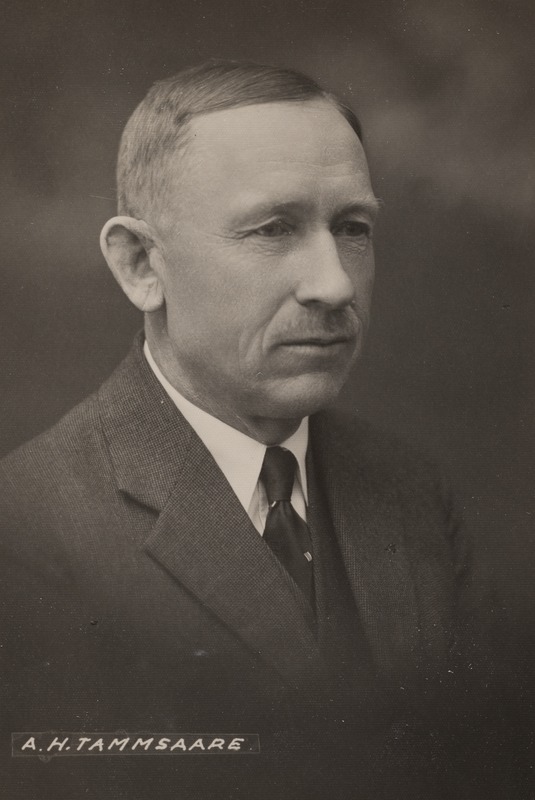
http://www.muis.ee/museaalview/3108018
Anton Hansen Tammsaare (1878–1940) is one of the central figures of Estonian literature and the author of the five-part novel cycle Truth and Justice, which explores the moral and social tensions of early twentieth-century Estonian society. ‘The Nightingale and the King’ (1910) is an early allegorical tale in which Tammsaare reworks the fairy-tale tradition to reflect on power and freedom.