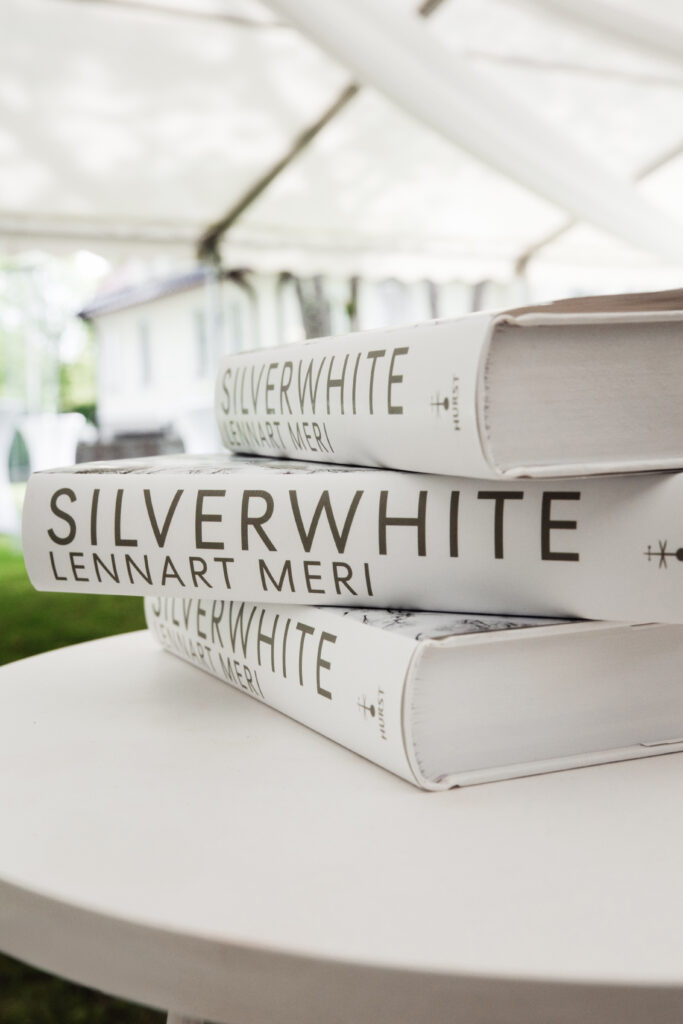
Silverwhite (Hõbevalge) by Lennart Meri – Estonian writer, traveller, filmmaker and later president of Estonia – was first published in 1976. Written during the Soviet occupation, the book traces connections between the Baltic region and the Mediterranean world. Drawing on classical sources, astronomy, mythology and geography, Meri reflects on the possible location of Ultima Thule, the legendary northern land in classical and medieval culture.
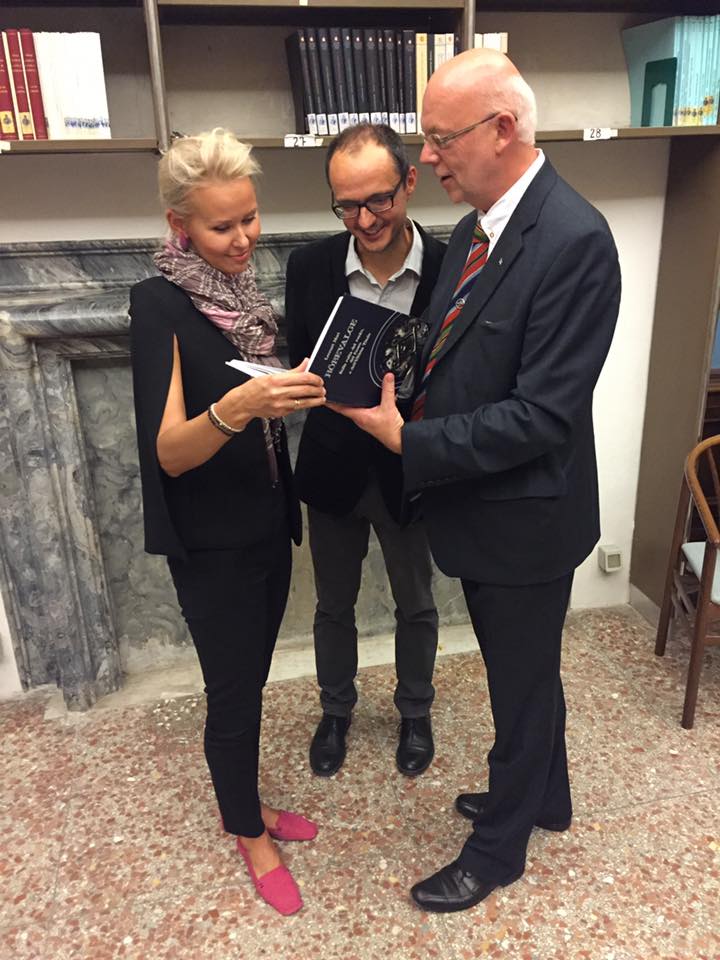
The book moves between documented history and imaginative reconstruction. In 2016 it appeared in Italian in a translation by Daniele Monticelli for Gangemi Editore. In 2025 Adam Cullen’s English translation was published by Hurst. In this conversation, we discuss the process of translating Silverwhite, its reception outside of Estonia and its relevance today.
On Translating Silverwhite
Kristjan Haljak:
Silverwhite weaves myth, memory and speculative history into a voice that feels both personal and national. What was the greatest challenge in translating that voice for readers in English and Italian?
Daniele Monticelli:
For me, the first challenge was the material itself. I realized quite quickly that it wasn’t possible to translate everything. The source text I worked from was the 2007 edition, where two of Meri’s books had been brought together more or less mechanically, without substantial editing.
On the one hand there were many repetitions; on the other, the narrative felt fragmentary. It often moved in circles rather than developing forward. So, together with Mart Meri, we decided that I would cut certain chapters in order to strengthen the narrative line. I chose to foreground the travel narrative, and within that structure the mythological and mythopoetic aspects emerged more clearly.
In that sense, the Italian version involved editorial decisions as well as translation.
[Editor’s note: The 2007 edition brought together Silverwhite (1976) and More Silverwhite: A Travelogue of the Big Bang, Wind and Mythopoetry (Hõbevalgem: reisikiri suurest paugust, tuulest ja muinasluulest, 1984) in a single volume. Although published eight years later, Hõbevalgem effectively functions as a prequel, revising and expanding material corresponding to the introduction and first chapter of the earlier book. In 2007 the two texts were printed together with minimal editorial harmonization.]
As for the author’s voice itself, that was not particularly difficult to translate. What has always interested me is that, although the book has often been read in relation to Estonian national identity, I see it more as a book about networks – about crossing borders and transnational contacts. Meri was writing in the 1970s, in a situation of political isolation, and what he was trying to show was that historically Estonia had never been isolated. As he used to say: we have always been in Europe.
Adam Cullen:
That was true for me as well. Early in the process I came up with a phrase – ‘the journey to the fallen sun’ – and used that as a kind of guide while translating.
Meri’s voice, especially in the narrative sections, was not hard to follow. He is very accessible when he is telling a story. The difficulty lay more in the research. Whenever possible, I tried to rely on existing English translations of the original sources rather than translating from Estonian as a bridge language. But with certain materials – Karelian folk songs, for example, or passages in specific dialects – I had to work directly from the Estonian.
Kristjan Haljak:
Did you also find yourself editing the structure?
Adam Cullen:
Yes. Like Daniele, I edited throughout the process, and with Mart Meri’s approval. At first I asked whether I could omit certain passages. The answer was usually yes. As the work progressed, I gained a clearer sense of the boundaries.
There were sections that delved deeply into Estonian linguistics, and I felt they did not serve the broader narrative. Later, Mart pointed out something important: one reason the book can be difficult even for Estonian readers is that Lennart Meri deliberately made it dense in places. Writing under Soviet censorship, he structured parts of the text in a way that could overwhelm a censor – so that certain things might pass unnoticed or simply be allowed through.
So some of the complexity belongs to its historical moment rather than being purely stylistic.
Daniele Monticelli:
That is true of much Soviet-era writing. But today publishers often reprint those texts without re-editing them. It is simpler and less costly. In the case of Silverwhite, we discussed a new editorial approach many years ago, but no one was prepared to undertake it. Perhaps out of respect for the author. Or perhaps because the book is difficult to categorize – should the editor be a historian, a folklorist, a literary scholar?
On Genre and Reception
Kristjan Haljak:
How do you imagine Silverwhite will resonate beyond Estonia, particularly in English and Italian? Does its blend of poetic archaeology and cultural speculation invite comparison – or does it resist categorization altogether?
Adam Cullen:
It is difficult to categorize. That can be problematic in practical terms – for bookshops, for shelving – but it is also what makes the book interesting.
Meri often writes about the limits of knowledge. There comes a point where documented evidence ends. Beyond that, imagination enters. That space – between what can be demonstrated and what must be conjectured – is where the book lives.
Daniele Monticelli:
Yes, it is not a historical novel, but neither is it purely academic. It is close to documentary writing or travelogue, yet the speculative element is essential. The narrator is always present. Meri does not pretend to be objective; he is engaged with his material.
In Italy there was some initial interest. The book was presented at travel literature festivals, and there were interesting discussions. Later, however, the momentum faded. One issue is distribution. Estonia provides substantial support for translation, but maintaining visibility once a book has been published depends on many other factors, including the publisher’s continued commitment.
On Europe and the Present
Kristjan Haljak:
Did your immersion in Silverwhite – with its deep historical reflections and Baltic mythopoetics – leave any lasting mark on your sense of self or place in the world?
Daniele Monticelli:
Working on the book was demanding. It is not a simple undertaking, although I often had to work on it in spare moments – in airports, on flights, on holidays.
What impressed me most was that Meri was able to write such a book in that political context. Under censorship and constraint, he imagined Estonia not as a peripheral province but as part of a network of historical contacts. At a time of isolation, he insisted on connection.
The book also suggested to me a particular image of Europe. Not so much a system of dominant centres and passive peripheries but rather a network. The waterways are important there – movement across water connects different nodes, like in a rhizome, and those nodes are not simply subordinate to one centre. These networks operate at different levels – some are more local, others more regional or global.
Adam Cullen:
I would not say it transformed me in a dramatic sense. It is not a book of sudden revelations; it works more like a slow burn.
But translating it made me more attentive to how history is narrated – how gaps are filled, how assumptions enter into storytelling. It encouraged a greater openness to interpretation.
Kristjan Haljak:
Could the book also be read as a response to political realism – to the idea that power and pragmatism determine everything?
Daniele Monticelli:
Yes. Meri was not writing as a cynic. Today we often hear that we must be ‘realistic’ – whether in the case of Ukraine, when people argue that occupied territories should simply be ceded in the name of peace. Or in discussions about Gaza, where it is said that of course we understand what is happening, but we must support Israel, because otherwise the Americans will not come to help us if Russia invades Estonia.
Realism is frequently used to justify very bad decisions. But for Meri, principles mattered. He once said that international law is our atomic bomb. For small nations, that is not a metaphor to be taken lightly. If you abandon principles in the name of cynical realism, you give up the only real protection you can rely on.
For Meri, abandoning principles was not an option. And he believed that imagination was necessary, especially in bleak times.
Adam Cullen:
And he does so without being naive. It is grounded in research, but it opens space.
With Russia being up to what it is, with America being up to what it is and with China acting as it does, the question of history becomes very concrete. Larger powers will always write and rewrite their own histories. That has always been the case.
For smaller nations, maintaining their own historical narrative becomes essential.
At the same time, we live in an age where technology – including AI – can generate alternative truths. That makes the space between imagination and history more complicated and potentially more dangerous. Silverwhite works in that space carefully. It recognizes speculation, but it remains attentive to sources.
Kristjan Haljak:
Thank you both. I feel that readers may recognize something in Silverwhite that resonates with the present moment. I appreciate the conversation.
This interview was conducted via video link on 10 July 2025.
Adam Cullen (b. 1986) is a poet and translator of Estonian literature into English. Originally from Minnesota, USA, he has lived in Estonia for close to twenty years.
Daniele Monticelli (b. 1970) is a professor at Tallinn University who translates Estonian literature into Italian. Originally from Milan, he has lived in Estonia most of his adult life.