

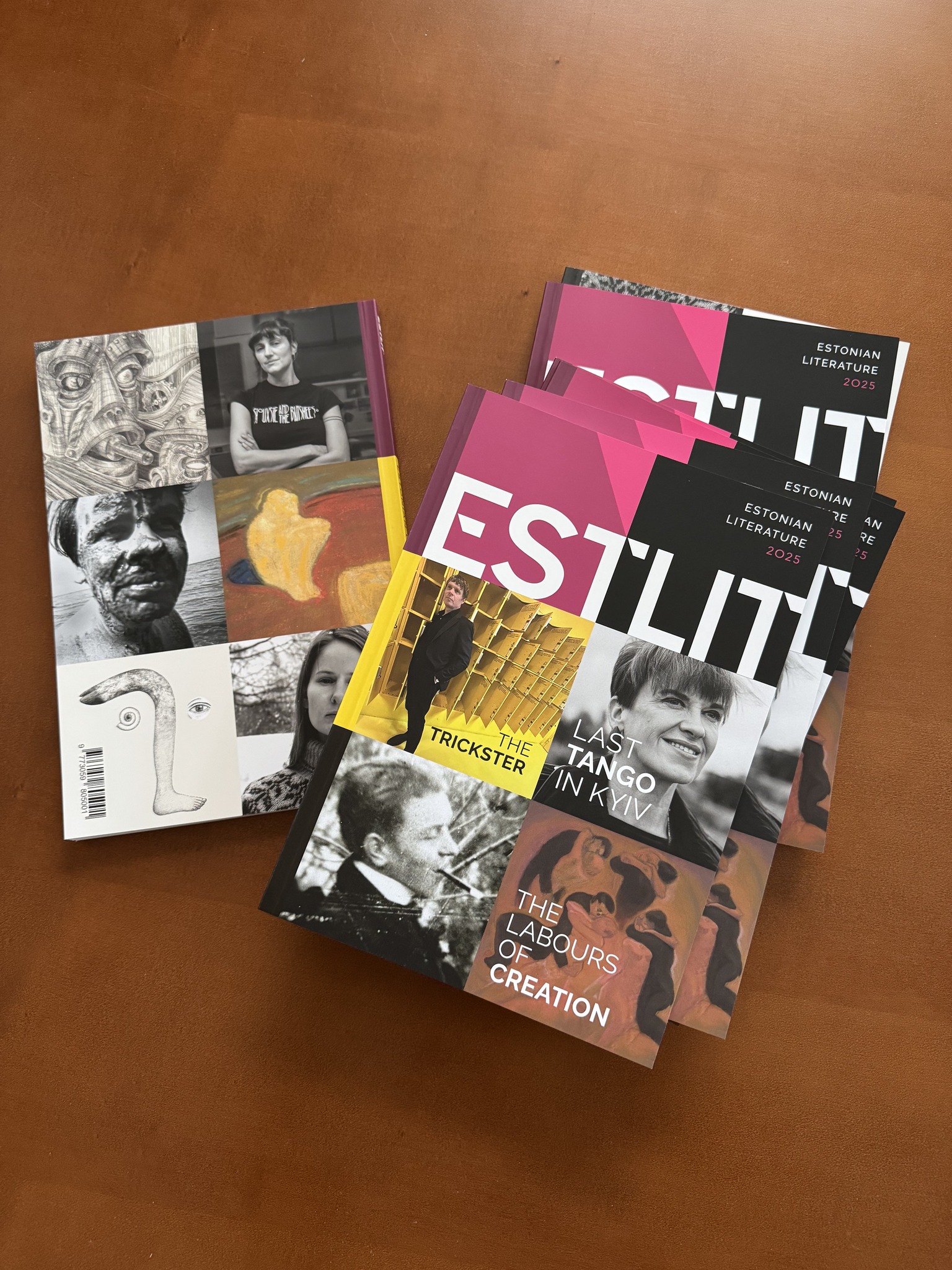
This issue marks the journal’s first appearance in print. EstLit. Estonian Literature, published by the Estonian Literature Centre, was first launched online this spring with a web issue themed around dark, psychedelic humour. In many ways it foreshadowed this, sowing the seeds for the fertile outburst we now witness this autumn.
In some respects one could say that this harvest is more explicitly political than the spring foray, while still sustaining the poetic and affective undercurrents whose existential value endures beyond war and the fears bound up in it. Yet, in reflecting the concerns of our literature today, we cannot avert our gaze from the dangers that arise from our eastern neighbour’s aggressive politics, which resound across the poetic landscape as well.
Perhaps most directly, such feelings and reflections are conveyed by two works at the heart of this issue: Maarja Kangro’s short story ‘Last Tango in Kyiv’ and Andrei Hvostov’s essay ‘On the Impotence of War’. But the broader struggle for freedom – both inner and outer – is carried forward, in one way or another, by the other texts printed here, too.
At the same time we also draw attention to authors whose focus, rather than the pressures of external reality, falls on the impassioned motions of the realities welling up from the deep layers of the human psyche – perhaps most intensely, in all their strangeness, in Ian Gwin’s translations from one of the early twentieth century’s most experimental poetic revolutionaries, Jaan Oks, and his prose poem ‘The Females’. But these ambiguous depths are also intensively explored in the poems of Triin Paja, Sveta Grigorjeva and Ernst Enno.
What are we to understand by Europe as a soft machine? With an implicit nod to the American Beat classic by William S. Burroughs, we might conceive of Europe as a living organism – one whose organic, mutable nature becomes metaphorically all the more vivid precisely when faced with the kind of danger to which the Russian Federation’s aggressive politics subjects it. Europe’s future is in question, in body as well as in soul.
We may nevertheless hope that it is in crisis that we feel European unity most intensely.
The unchecked sowing of fear of war is not always the wisest creative or existential strategy, psychologically speaking. Yet we cannot forget that Ukrainians’ struggle today is also a struggle for our freedom as Estonians – as Europeans.
We hope that the polyphonic content of this issue also conveys the variegated plurality of Estonian literature as a soft machine in its own right. In the broadest sense, ideologically, we strive for freedom – corporeal and poetic, psychic and political.
Kristjan Haljak
Editor-in-chief

In This Issue
Download the PDF of the Autumn 2025 print issue.
Poetry
‘All Falling into Silence’ and ‘Love Everything’ by Ernst Enno
‘Dialogue with a Stone’ and Other Poems by Triin Paja
‘The Universe is my Tinder’. Poems by Sveta Grigorjeva
Fiction
‘Last Tango in Kyiv’ by Maarja Kangro
‘Into the Silence’ by Brigitta Davidjants
‘Blind and Deaf Plates’ by Vaino Vahing
‘The Labours of Creation’ by Jaan Oks
Perspectives
The Cosmic Landscape of Estonian Literature. An interview with Hasso Krull
The Impotence of War by Andrei Hvostov
I Did Not Want It. Sebastian Guggolz on the German edition of Karl Ristikivi’s The Night of Souls
Urban Echoes: Rediscovering Mati Unt’s Autumn Ball as a Modern Classic by Maximilian Murmann
Reviews
A Manifesto of Gratitude and Wonder. Kairi Look’s Dance the Dust off the Floor. Merlin Kirikal
Something Oddly Expansive in Every Sentence. Mudlum’s Diary of a Rose Lunatic. Heli Allik
Armin Kõomägi’s Heaven. Vilja Kiisler
A Filthy, Slimy Age. Piret Raud’s The Age of Boiled Deer. Silvia Urgas
A Sober Glance at Estonian Life. Andrei Ivanov’s The Days. Peeter Kormašov
Meelis Friedenthal’s Around a Point. Märten Rattasepp