
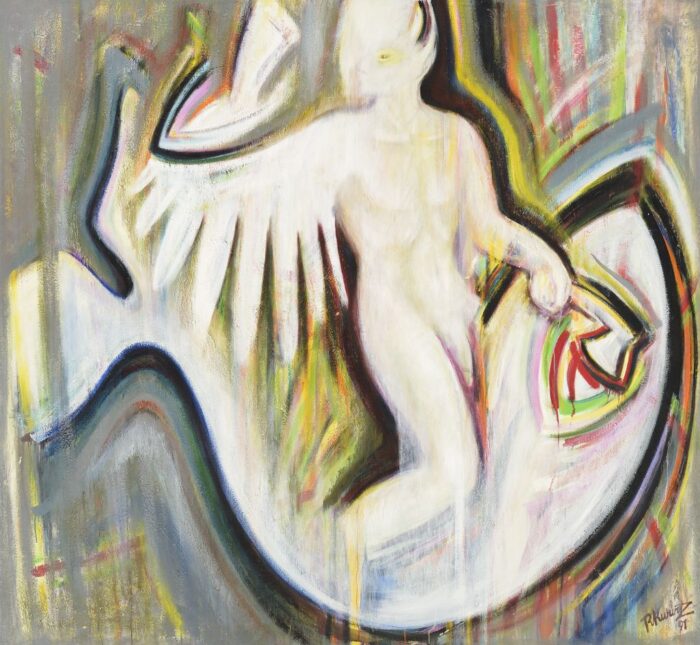
As we launch this third issue of EstLit, the situation in the arena of world politics has unfortunately not softened. Yet even when reflecting on developments in the field of art, the recent debate that surfaced at the Berlin Film Festival concerning the relation – or separation – between art and politics feels telling.
One recalls here the claim made by the father of psychoanalysis, Sigmund Freud, as a reproach to the psychoanalytic thinker Wilhelm Reich, who diverged from his line of thought, that psychoanalysis and politics ought to remain separate – a claim directly motivated by the desire to escape the inquisitorial persecution of the Nazis. Within their monstrous ideological system the Nazis labelled psychoanalysis a ‘Jewish science’, which, according to their idiotic-mystical doctrine, required immediate liquidation.
It is, of course, equally absurd to argue that the human psyche and its outward, inevitably socio-political manifestations should not be called political. Such a claim might be driven by nothing other than human fear – fear of confrontation and of possible repression. Yet rebellion and psychic freedom belong inherently to every soul – and to every genuinely artistic act. At its core psychoanalysis is conflict – the child’s conflict with their mother and father, the adult individual’s inevitable conflict with society. The striving for freedom is constant, and on that path towards lasting freedom, one of the greatest obstacles is often none other than a person’s own interiorized fascist.
The core of freedom is rebellion against the superego as the voice of symbolic or real ‘fathers’.
Thus, as a committed surrealist – however archaic that may sound in 2026 – I would firmly stand for the interconnectedness of art and politics. Political engagement in an extreme form was also prominent among the French surrealists of the 1920s – and with hindsight one can only shake one’s head sadly at their calf-like enthusiasm for the criminal Soviet Union’s political ‘avant-garde project’.
At the same time I would stress the absolute right of genuine works of art to ambivalence. In that sense I agree with Nick Cave, who has spoken in defence of Wim Wenders and of art’s antipolitical truth – the obligation to politicize art in some explicit manner may itself become a repressive act. Strangely enough, this could turn into a new version of the old Leninist-totalitarian approach, where whoever is not with us is against us. In other words, whoever does not explicitly oppose some particular enemy in their art, one that corresponds to the dominant discourse of the age, is presumed to be that enemy’s supporter – even though the absolute psychic truth of a work of art may always be inherently more ambiguous than the univocal practical language of newspaper articles and political slogans.
In this issue, two distinct voices in Estonian prose take centre stage. In her absurdist ‘Accused of Murder’, Maimu Berg develops a Kafkaesque-surreal mode that resonates with, yet remains distinct from, that of 1960s writers such as Mati Unt and Vaino Vahing, both featured in previous issues of our journal. In Lilli Luuk’s ‘Miss Kolkhoz’, the turning points in a young woman’s life unfold against the backdrop of the collapse of the Soviet empire and the restoration of the Republic of Estonia.
This spring the issue moves more decisively towards surrealism proper through Latvian poet and translator Guntars Godiņš’ essay on Estonian surrealist poetry, thus echoing the anthology of dark and psychedelic humour represented in our inaugural issue in spring 2025. Conceptually aligned with this trajectory is the selection of poems by Jaan Malin presented here. As further experimental extensions of the surrealist project, one might highlight the cycle of prose poems from In the Room Next to the Helicopter by the multidisciplinary artist and writer Kiwa.
Closely connected to the surrealist heritage, symbolist-decadent sensibility is represented in this issue by short prose pieces from the undisputed twentieth-century classics of Estonian literature, A.H. Tammsaare and Friedebert Tuglas.
Perhaps as a third axis, it might be important to note the conceptual layer that intersects with the previous two – the axis of exoticized-mystical Estonianness. Here belong Francis Young’s treatment of Lennart Meri’s Silverwhite, along with my own conversation with its translators Daniele Monticelli and Adam Cullen, as well as Philippe Villard’s review of the French edition of Nikolai Baturin’s Karu süda (Coeur d’ourse). When Lennart Meri said that international law is a metaphorical nuclear bomb protecting small states, we might add that the literature of those same small nations is, exaggerating somewhat, an imagined hydrogen warhead for their defence and for the deterrence of enemies.
In their own way, the poems by Mehis Heinsaar and Mathura situate themselves between these different axes.
The potential intersections of art and politics are likewise explored in Dina Bite’s review of a Latvian-language collection of Estonian plays and in Juan Rodríguez Pira’s overview of the anthology 10 Estonian Novels: Selected Excerpts. The theme is also central to Eret Talviste’s poetically and politically charged interview with the poet and dancer Sveta Grigorjeva.
Thus – literature is both bomb and door. Literature is an exit from the numbing political pressures of the world – not mere escapist fantasy but rather a politico-psychic penetration into the deeper core of reality, a door towards rebellious freedom.
Kristjan Haljak
In This Issue
Poetry
‘Your Strength Returns’ by Mehis Heinsaar
‘Grooving’ and ‘Middlesbrough Troll’ by Jaan Malin
‘The Western Glide’ and Other Poems by Mathura
‘In the Room Next to the Helicopter’ by Kiwa
Fiction
‘Accused of Murder’ by Maimu Berg
‘The Fourth Dimension’ by Friedebert Tuglas
‘The Nightingale and the King’ by Anton Hansen Tammsaare
Perspectives
Evoking Intimacy. A Conversation with Sveta Grigorjeva
Surrealism in Estonian Poetry by Guntars Godiņš
Reviews
Asking the Big Questions: On a Contemporary Estonian Anthology of Plays. Dina Bite
Notes on a Thin Black Book. 10 Estonian Novels: Selected Excerpts. Juan Rodríguez Pira
The Trapper’s Epic. Philippe Villard on Nikolai Baturin’s Coeur d’ourse
Francis Young on Lennart Meri’s Silverwhite