
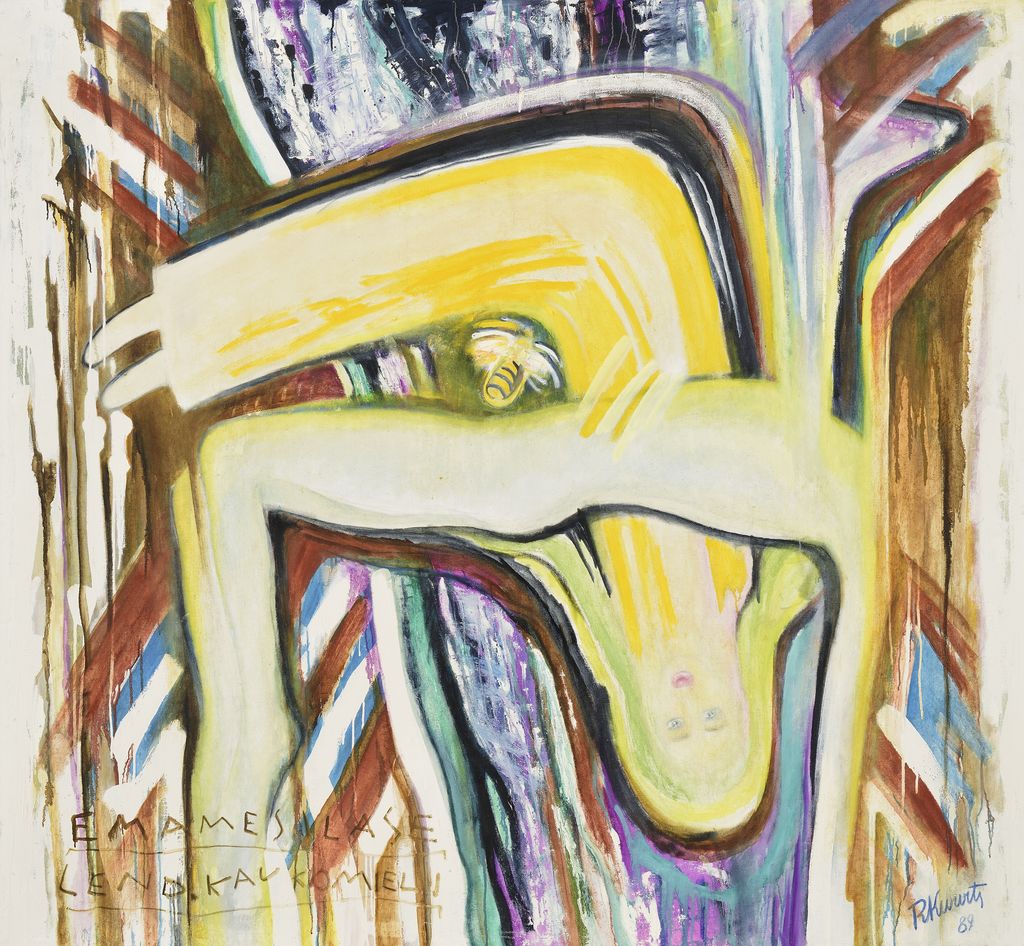
I’m already living tomorrow’s night that’s what nowadays is
I’m in life in dream in work quite the drunken flagshipJuhan Viiding
In the strange and speculative imaginative space of Stanislav Grof’s transpersonal psychology – fertile, perhaps, precisely because it borders on literature – the processes of birth and death are closely connected. In the so-called perinatal field of experience, the whole spectrum of human reality seems to be played out, including madness and death.
The medieval motif of the dance of death also comes to mind; it recurs, to a greater or lesser extent, in the texts of this issue of EstLit as well. Visually, perhaps the most eloquent example is a fragment from Bernt Notke’s famous Dance of Death, housed in St Nicholas’ Church in Tallinn, which, in the present issue, is placed between two longer, uncanny prose pieces, both of them flirting with one of the most inevitable aspects of human existence: Jüri Kolk’s ‘Ada’ and Andrei Ivanov’s ‘The Rubber Skin’. In Kolk’s story one can sense a strange, death-touched humour, blackened in the arms of destruction; in Ivanov’s text – an excerpt from an unpublished novel that flirts with the genre of necrorealism – destruction appears entirely of this world, cruel and hopeless.
At the other end of the spectrum is Kairi Look’s poetic prose, which truly begins in the perinatal sphere – in the womb – before moving, with subtle psychedelia, through the sensory landscape of childhood. Mehis Heinsaar, one of Estonia’s most distinctive magical prose writers, strikes a lighter, though no less uncanny, note in ‘Sixteen Years of Silence’. Playing with strange coordinates of identity and memory, Aliis Aalmann’s prose piece likewise hovers between the familiar and the foreign.
The timeless northern world of Nikolai Baturin’s The Heart of the Bear – represented here by the opening chapter of the novel and accompanied by a conversation with Guillaume Gibert and Aurélie Charron, its French translator and publisher – and Carolina Pihelgas’s ‘A Page of Madness’, which maps a subjective bodily and psychic extremity, likewise express a kind of estrangement from our habitual ways of coping with everyday reality.
The poetry section moves in related registers. In the selection of works by Juhan Viiding, one of the iconic Estonian poets of the second half of the twentieth century, dream reality and everyday reality, the here and the hereafter, merge in a charming poetic irony that somehow may not, after all, really be irony. Mirjam Parve’s uncanny corporeality and Maimu Berg’s delicate, comic metaphysics of beginnings and endings once again offer their own solutions to that same task, which may indeed be one of literature’s true labours: the art of not obeying reality. For perhaps, in some sense, every change begins with revolt, with disobedience.
Kristjan Haljak
Editor-in-chief
In This Issue

Poetry
Selected Poems by Juhan Viiding
Selected Poems by Mirjam Parve
Fiction
‘Bernardine Garden: A Kind Face’ by Aliis Aalmann
‘Sixteen Years of Silence’ by Mehis Heinsaar
‘A Page of Madness’ by Carolina Pihelgas
‘The Heart of the Bear’ by Nikolai Baturin
‘The Rubber Skin’ by Andrei Ivanov
Perspectives
A Realist Angel at the Fire Window. Afterword by Kristjan Haljak